
Hook / Thesis
Caterpillar is no longer just the world’s go-to maker of excavators and haul trucks — it has become a critical supplier to the emerging problem in AI infrastructure: reliable, large-scale power at the edge. Recent commercial activity tying Caterpillar to multi-gigawatt behind-the-meter projects, combined with solid cash generation and a backlog that leans into the energy transition, creates a favorable mid-term trade.
Technically, momentum is supportive: MACD shows bullish momentum and the 9/21/50-day moving averages trend underneath the current price, while short interest and short-volume flows indicate active positioning that can exacerbate moves. My trade thesis is a mid-term long: enter at $745.00, stop at $710.00, and target $820.00 over approximately 45 trading days.
What Caterpillar does and why the market should care
Caterpillar manufactures construction and mining equipment, off-highway diesel and natural gas engines, industrial gas turbines, and diesel-electric locomotives. It operates across Construction Industries, Resource Industries, Energy and Transportation, Financial Products and other support functions. The Energy and Transportation segment is increasingly relevant: it supplies reciprocating engines and power systems that can be deployed quickly to serve data centers, industrial plants and other large electricity users.
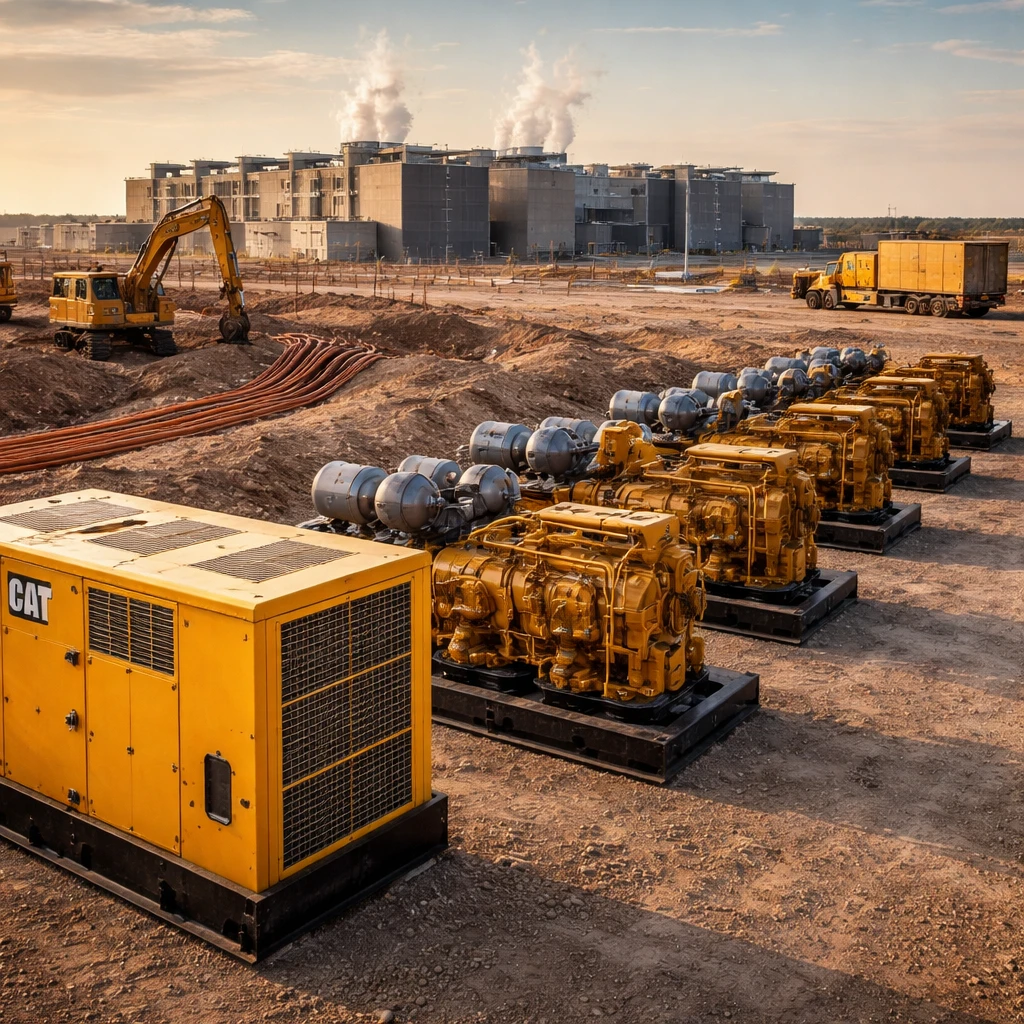
The market cares because AI data center growth has created an emergent, concentrated demand for gigawatts of baseload and standby power. Several industry moves point to a structural shift: hyperscalers and third-party builders are signing multi-hundred-million-dollar and multi-gigawatt deals to lock in generation capacity, and equipment suppliers with proven deployment track records stand to benefit. Caterpillar already appears in this flow: a recent $840 million agreement between a developer and Caterpillar for 2 GW of capacity highlights a material revenue stream that ties directly to the AI power bottleneck.
Data-driven support for the argument
Use the numbers: Caterpillar trades at a market cap of about $337.2 billion and reported free cash flow of $7.453 billion. Its P/E sits around 38.5 and price-to-book near 15.8, reflecting the market’s premium for its earnings and equity. Return on equity is robust at roughly 41.7%, signaling that the company converts shareholder capital into profit efficiently. Leverage is meaningful with debt-to-equity near 2.03, but the operating cash flow profile and $7.45B in free cash flow give Caterpillar capacity to invest in production, dealers and strategic partnerships.
From a technical and market-structure perspective, daily momentum indicators are constructive: MACD is positive and momentum reads bullish. Short interest is moderate in absolute terms (days-to-cover around 2.5), but short-volume spikes in some sessions tell us the stock has active intraday trading and can move quickly on news.
Valuation framing
At a $337B market cap and enterprise value near $370.4B, Caterpillar is priced like a high-quality industrial with strong earnings durability. EV/EBITDA sits around 26.2 and price-to-free-cash-flow is roughly 45.2. These multiples are elevated compared with industrial cyclicals historically, but they reflect a few realities: superior profitability (ROE ~41.7%), significant dealer and service moat, and now a growing structural revenue stream from power solutions tied to AI and data-center demand.
Put simply: investors are paying for durable margins and cash returns. If Caterpillar can convert backlog and multi-gigawatt deals into top-line growth without margin erosion, the current multiple can be justified. If not, valuation remains vulnerable to mean reversion. For a trader, the question is whether near-term execution and newsflow will push the stock toward a re-rating higher into the $820s (our target) or if macro/cyclical shocks will compress multiples.
Catalysts (2-5)
- Large-scale power contracts announced or expanded - additional multi-hundred-million to billion-dollar agreements tied to data-center and AI customers would be direct revenue and backlog drivers.
- Quarterly results that show above-consensus growth in the Energy and Transportation segment, particularly gas/diesel generation and power systems revenue.
- Dealer inventory rebuild and service revenue beat - higher parts and service margins would boost free cash flow and sentiment.
- Macro stability in oil and commodities and a cooling of geopolitical risk that supports construction and mining investment.
- Positive commentary from hyperscalers or large developers naming Caterpillar in gigawatt-scale projects (a credibility multiplier).
Trade plan
Trade direction: Long. Risk level: Medium.
Entry: $745.00. Stop-loss: $710.00. Target: $820.00.
Horizon: mid term (45 trading days). This horizon gives enough runway for earnings-related or large contract announcements to flow through price action while limiting exposure to a broader macro or cyclicality window that typically plays out over several months. The entry is set below current chatter-level prices to seek a modest pullback or consolidation as an opportunity; the stop sits under the 50/100-day dynamic support zone and recent intraday swings to limit capital at risk.
Position sizing: size this trade so that a move to the stop prints a loss you can tolerate — typically 1-2% of portfolio risk for an active retail trader. Re-evaluate at the target: if the business prints step-change growth beats, consider scaling out and raising the stop; if the target is reached on momentum without attendant fundamental confirmatory signs, take profit and reassess.
Risks and counterarguments
- Cyclical exposure: Much of Caterpillar’s revenue is tied to construction, mining and energy cycles. A dip in global capex or a sharp commodity slowdown could hit orders and margins.
- Interest rates and financing sensitivity: Higher rates can depress equipment demand since buyers often use financing (Financial Products segment), and elevated rates can compress margins and dealer activity.
- Execution risk on power projects: Moving from equipment supplier to large-scale power project partner introduces execution complexity — delays or cost overruns on multi-gigawatt projects would weigh on earnings and sentiment.
- Valuation vulnerability: With P/E ~38.5 and EV/EBITDA ~26.2, the stock is priced for continued outperformance. Any slowdown in growth could trigger a sharp multiple contraction.
- Geopolitical and commodity shocks: Rapid moves in oil or disruptions to shipping and supply chains could undermine both sales and margins across segments.
Counterargument: Critics will point to the elevated multiples and claim Caterpillar is overbought relative to cycle-sensitive peers. Indeed, if power contract wins don’t scale or margin pressure emerges from higher raw-material costs, the narrative could flip quickly. However, the company’s strong free cash flow ($7.45B) and outsized ROE (41.7%) give it room to invest in capacity and dealer support; that balance of cash strength and margin durability is what makes the mid-term long a reasonable asymmetric trade rather than a blind momentum bet.
What would change my mind?
I would reconsider or close the long if any of the following occurs: a) quarterly results show a persistent decline in the Energy and Transportation backlog or gross margins fall materially, b) the company announces meaningful project execution delays with cost overruns on key power deals, c) macro indicators (global capex, industrial production) show a steep and accelerating contraction that would drive durable weakness in equipment orders, or d) guidance is pulled and the company signals dealer destocking. Conversely, a string of contract announcements, margin expansion and an upgraded outlook for power systems would prompt me to add to the position and lift the stop.
Conclusion
Caterpillar sits at an interesting inflection: it still earns most of its revenue from traditional construction and resource customers, but it is increasingly a supplier to the AI-era power stack. The combination of tangible free cash flow ($7.45B), high ROE (41.7%), bullish technicals and visible contract activity tied to gigawatt projects supports a mid-term long trade at $745 with a $710 stop and $820 target over 45 trading days. Valuation is rich and the trade carries execution and macro risk—manage position sizing and move to protect capital if the data turns negative—but the upside is real if Caterpillar converts its backlog into clean revenue growth tied to the global push for reliable, on-demand power for AI and hyperscale computing.