
Cal-Maine Foods (CALM) is one of those stocks that can look “too boring” right up until it isn’t. Eggs are a staple, pricing can be wildly cyclical, and the headlines usually swing between avian flu fears and margin windfalls. But when a company in a volatile category shows up with zero debt-to-equity, a huge liquidity cushion, and a valuation that implies the good times are already over, I pay attention.
Here’s the trade stance: CALM is set up for a mid term rebound, helped by a strong balance sheet, a still-supportive demand backdrop for high-protein staples, and the company’s push into higher-value prepared foods. The market is clearly bracing for earnings weakness, but the stock is also sitting near recent lows with improving momentum signals. That’s the kind of mismatch you can trade, as long as you respect how fast egg economics can change.
The “GLP-1 tailwinds” angle matters more than people think. Whether consumers are eating less overall or rebalancing diets, the pattern that keeps showing up is protein prioritization. Eggs remain one of the most accessible protein options in the grocery cart. I’m not modeling a straight line to the moon here, but it’s a decent macro backdrop for demand resiliency, especially when paired with Cal-Maine’s specialty mix and prepared-food expansion.
What Cal-Maine actually is (and why the market should care)
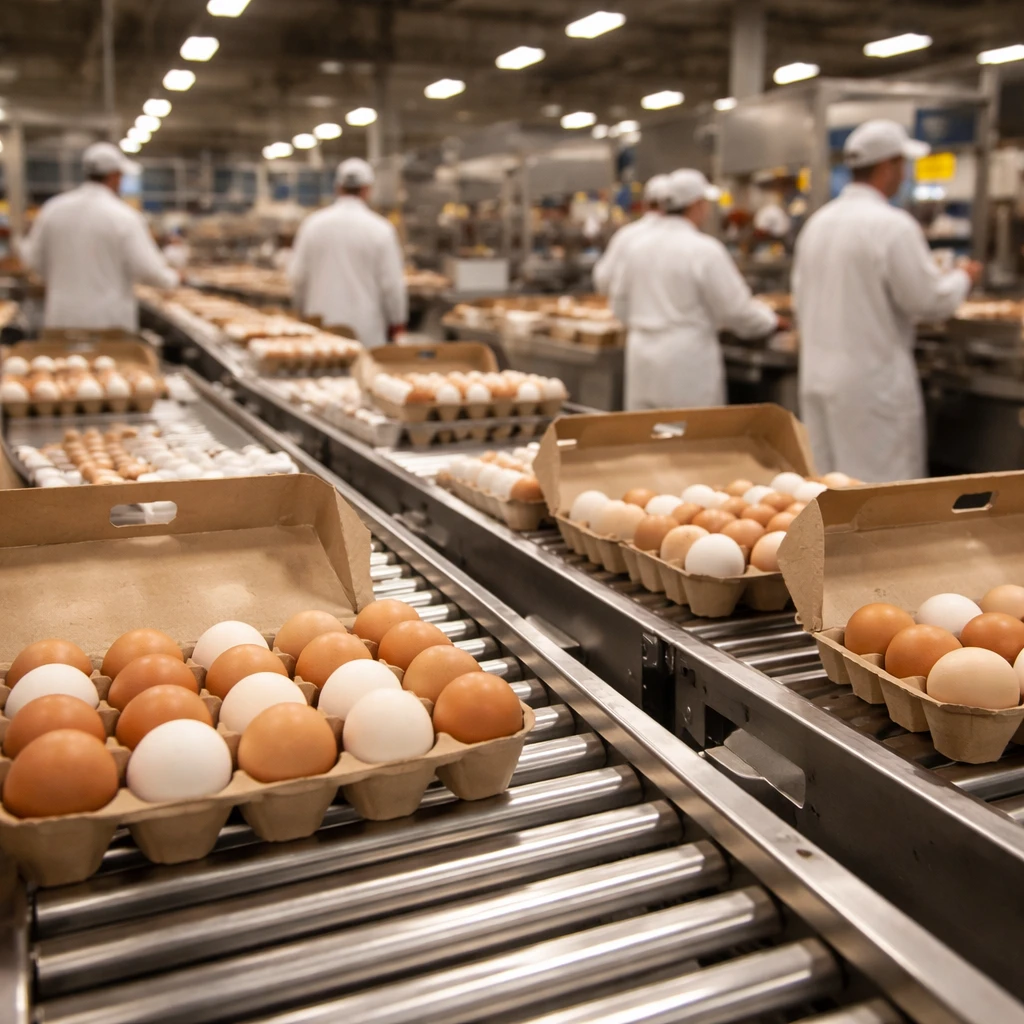
Cal-Maine Foods is a large U.S. shell egg producer that also sells into channels like national and regional grocers, club stores, foodservice distributors, and manufacturers. It operates an integrated footprint: farms, processing plants, hatcheries, feed mills, and warehouses. Translation: it’s not just a “label on a carton” business. The company has real operational control and scale, which matters when input costs and supply shocks hit.
Why the market should care right now comes down to two things:
- Financial flexibility: CALM has debt-to-equity of 0 and extremely high liquidity (current ratio 8.02, quick ratio 6.46).
- Operating leverage in a cyclical category: when egg prices or demand surprise to the upside, earnings can surge quickly. When they fall, the stock often overcorrects.
And the market is definitely treating this like the downcycle is here. CALM is down hard from its 52-week high of $126.40 (07/23/2025) and recently printed a 52-week low of $71.92 (01/14/2026). The current price around $80.55 sits closer to the lows than the highs, which is exactly where I want to look for asymmetric setups.
Numbers that matter (valuation, profitability, and balance sheet strength)
At roughly $80.55, CALM’s market cap is about $3.84B. The valuation metrics are what jump off the page:
- P/E: about 3.33 to 3.40 depending on the snapshot
- Price-to-sales: 0.91
- EV/EBITDA: 2.28 (enterprise value ~$3.47B)
- Free cash flow: about $1.17B, with P/FCF ~3.28
- Dividend yield: roughly 11.03% (also shown as ~10.83%)
Those are not “normal consumer staples” multiples. Those are “the market thinks earnings are about to roll over” multiples. And to be fair, that’s a reasonable worry in eggs, where pricing and feed costs can swing margins quickly. But here’s what keeps me constructive: CALM has the financial structure to ride through uglier periods without dilution, covenant issues, or forced asset sales. In cyclical food commodities, balance sheet safety is a real edge.
The company also showed it can put up monster quarters in the recent past. On 10/01/2025, Cal-Maine reported its strongest first quarter in company history, with net sales up 17.4% to $922.6 million. Again, I’m not assuming that pace continues every quarter. I’m saying the business has demonstrated earnings power recently enough that the market’s “permanent downshift” narrative may be too confident.
Profitability metrics reinforce that the last year wasn’t just “okay.” Return on assets is listed at 36.68% and return on equity at 42.84%. Those numbers are unusually high for most food names, and they help explain why CALM can throw off so much cash when conditions line up.
Prepared foods and mix: the underappreciated strategic lever
One reason I’m more willing to buy CALM on weakness is that management is not sitting still. The company is expanding prepared foods capacity and investing in optimization rather than treating eggs as a pure commodity treadmill.
Specifically, Cal-Maine is working on a $15 million network optimization project at Echo Lake Foods, targeting an additional 17 million pounds of annual scrambled egg production by mid-fiscal 2027. There’s also a $7 million investment into its Crepini Foods joint venture to increase capacity. That doesn’t magically de-commodity the business overnight, but it does help shift part of the portfolio toward value-added products and potentially steadier demand profiles.
Technicals: the stock is stabilizing near the lows
CALM is currently around $80.55 (01/23/2026 close context). The 10-day SMA is $76.77 and the 20-day SMA is $78.23, which suggests price has bounced off the recent washout and is reclaiming near-term levels. The 50-day SMA is still overhead at $82.95, so there’s a clear “first target” area where sellers might show up.
Momentum is not screaming euphoric, but it’s improving. RSI is about 52.1 (not overbought), and MACD is flagged as bullish_momentum with a positive histogram. In plain English: the downtrend has cooled, buyers are showing up, and you can define risk beneath a recent support zone.
Short interest is also notable. As of 12/31/2025, short interest was 5,062,933 shares, about 5.05 days to cover. That’s not “meme stock” fuel, but it is enough that a better-than-feared earnings print can force incremental covering.
Catalysts (what can move the stock)
- Earnings event: Cal-Maine is scheduled to report fiscal 2026 second quarter results on 01/07/2026 with a conference call at 9:00 a.m. ET. Earnings are the obvious volatility trigger.
- Dividend visibility: With a double-digit yield showing on the tape, any clarity on payout sustainability can impact investor appetite.
- Mix shift narrative: Continued progress in prepared foods capacity expansion (Echo Lake) is a concrete “less commodity” story investors can underwrite.
- Mean reversion: A move back toward the 50-day moving average (~$82.95) and then toward the 52-week midpoint becomes plausible if egg pricing fears are not as bad as positioned.
Trade plan (actionable)
I like this as a mid term (45 trading days) swing trade. The reason for that horizon is simple: CALM tends to move in waves around earnings and industry headlines, and the chart is close enough to recent lows that you can define risk tightly while giving the trade enough time to work through post-earnings digestion.
| Item | Level |
|---|---|
| Entry | $80.55 |
| Target | $88.00 |
| Stop | $74.90 |
How I’d manage it: If CALM reclaims and holds above the 50-day area (~$83) after earnings volatility, it can grind toward the high $80s where prior supply is likely. If it loses the mid-$70s region again, I don’t want to argue with it. Egg cycles can humble you fast.
Valuation framing (why this price can work)
CALM is priced like a business heading into a profit collapse: P/E ~3.3, EV/EBITDA ~2.3, and P/FCF ~3.3. Sometimes that’s exactly right for cyclical ag names. But when you pair that with no leverage and very high liquidity, the downside case becomes more about “earnings normalize” than “balance sheet breaks.” That distinction matters for a trade, because it tends to put a floor under panic selling.
Also, the stock is still well below the 52-week high of $126.40. I’m not calling for a full retrace. I’m arguing that a move from ~$80 to the high $80s is not an outrageous ask if the next earnings update is merely “not as bad as feared” and if investors rotate back toward cash-generative defensives.
Counterargument (the bear case that can be right)
The cleanest bear argument is that CALM’s recent profitability was the product of unusually favorable conditions, and we’re now on the other side of that. If egg pricing softens while feed costs rise, earnings can compress quickly. In that world, a low P/E is not “cheap” - it’s a snapshot of peak-ish earnings, and the multiple expands the wrong way as profits drop.
That’s why I’m keeping the stop tight enough to respect a real regime shift.
Risks (what can break the trade)
- Earnings downside and guidance shock: The market is already primed for disappointment, and if the print confirms a sharper margin drop, the stock can revisit or break the recent $71.92 low quickly.
- Input cost pressure: Feed costs and supply chain friction can squeeze profitability even if demand holds up.
- Avian flu and operational disruption: Production interruptions can cut supply and raise costs, and the market often reacts emotionally to these headlines.
- Dividend variability: The yield looks attractive, but if the payout changes materially, the “income support” bid can weaken.
- Commodity-style multiple risk: Even with a strong balance sheet, the market can keep discounting the next downcycle, limiting upside to a modest mean reversion.
Conclusion: a balance-sheet-first long with defined risk
CALM is not a sleepy staple right now. It’s a volatile ag name trading at a compressed valuation, backed by a fortress-like financial profile (zero debt-to-equity, very high current and quick ratios), and supported by a business strategy that’s pushing further into prepared foods. The setup is good enough for a mid term (45 trading days) long trade with clear levels.
I’m constructive above the mid-$70s and looking for a move toward $88.00. What would change my mind is straightforward: a decisive break below $74.90 (especially on heavy volume) or an earnings update that indicates the cash generation profile is deteriorating faster than the market already expects.