
Hook & thesis
EVgo has moved from a growth-at-all-costs story to a company that can point to tangible signs of profitability: record charging revenue, domestic modular construction that cuts installation costs and a sharp ramp in Autocharge+ enrollment. Those operational improvements make a near-term rating upgrade from sell-side analysts a credible catalyst. The market currently prices EVgo at about $3.14 a share; I see asymmetric upside to $4.50 over the next 180 trading days if management continues to convert throughput gains into positive adjusted EBITDA.
This is a trade idea built around an operational inflection rather than a binary M&A event. The entry and risk parameters below reflect the stock's liquidity profile (average volume ~3.4M) and persistent short interest (about 31.2M shares on 01/15/2026). The plan: take a tactical long with a clear stop and a horizon that gives time for margin improvement and multiple expansion.
Why the market should care - the business and the fundamental driver
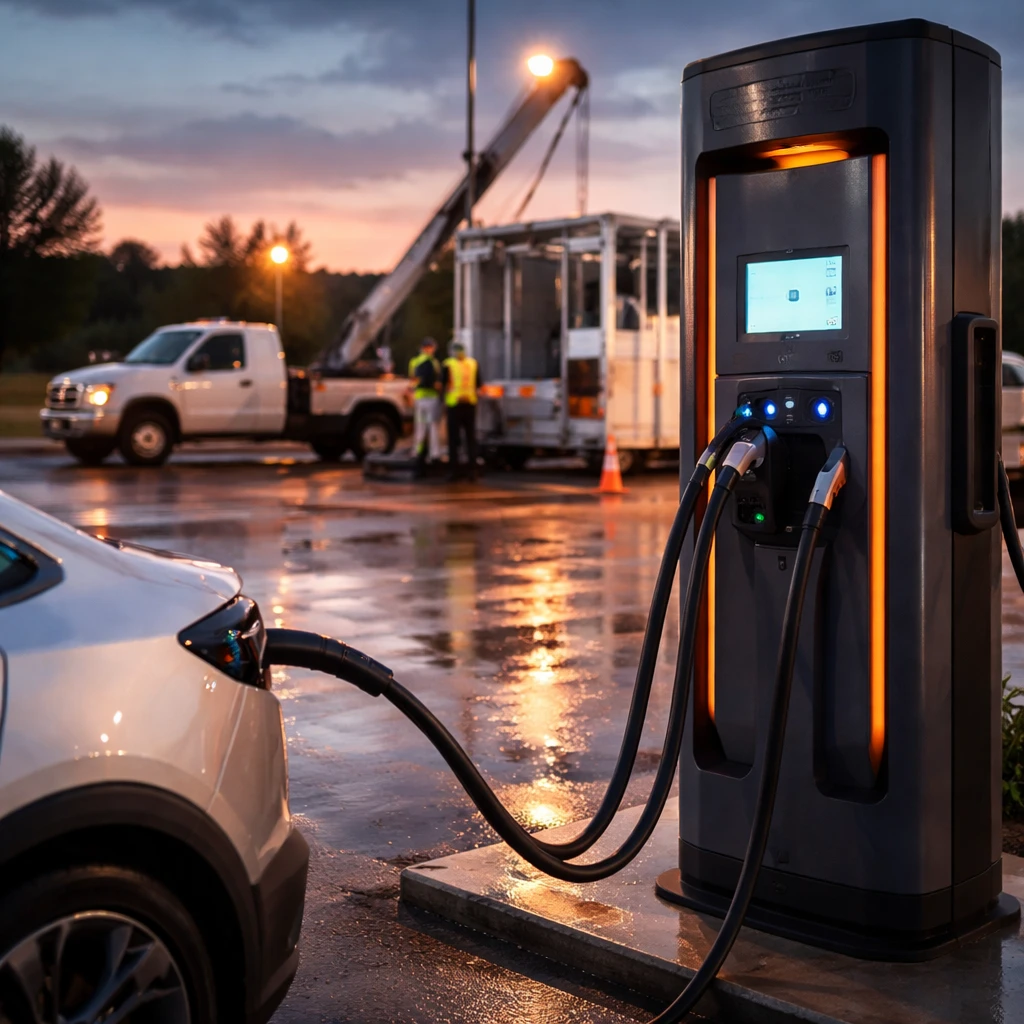
EVgo operates one of the largest public fast-charging networks in the U.S., offering network charging, home/work charging solutions and subscription plans. The company benefits from network effects: more stations and better software features attract more drivers, which then drive higher throughput and revenue-per-station. Two recent developments move the needle:
- Prefabricated modular charging skids rolled out aggressively (announced 12/16/2025) - these reduce site labor, installation time and supply-chain complexity, lowering capital intensity for new stations.
- Autocharge+ scale (announced 12/03/2025) - surpassing 5 million sessions and sixfold enrollment since 2023; nearly 80 EV models supported and ~300k customers. Higher automatic sessions reduce friction, increase utilization and support recurring revenue.
What the numbers say
Use the recent financial and market metrics to ground the thesis:
- Current price: $3.135 a share (market snapshot); 52-week range: $2.20 - $5.18.
- Market capitalization: roughly $965.5M and enterprise value approximately $452.9M - the latter reflects a net-cash posture that supports continued buildout without desperate fundraises.
- Liquidity: average daily volume in the 30-day window ~3.4M shares, with two-week average ~3.86M, so execution-size is manageable for a retail/institutional trade of moderate size.
- Profitability/efficiency metrics: trailing EPS -$0.36, free cash flow last reported -$122.8M, but current and quick ratios are 2.04, signaling short-term balance-sheet resilience.
- Valuation anchors: price-to-sales ~1.27 and EV-to-sales ~1.36. Those multiples are consistent with a growth-tech infrastructure asset that is moving toward positive adjusted EBITDA; if management can sustain margin gains, multiple expansion is plausible.
- Balance-sheet positives: stated cash per share of ~$1.36 and negative net-debt metrics (debt-to-equity -0.49) imply the company is not overlevered while it scales.
Valuation framing
EVgo trades at EV/sales of ~1.36 and P/S of ~1.27 today. Those multiples are not trivial given the company's negative free cash flow, but they become more tolerable if the company can demonstrate consistent adjusted-EBITDA generation. The enterprise value of ~$453M versus a market cap near $965M reflects net cash and capital structure; in plain terms, the market is assigning value both to the current network and the near-term profit opportunity.
Qualitatively, EVgo should trade closer to utility/infrastructure multiples if throughput and margins trend upward: recurring revenue, higher utilization and lower build costs (via modular skids) make the revenue stream less lumpy and more predictable. If management's guidance evolution continues - especially after the raised outlook from Q3 2025 - an analyst rating upgrade is logical and could re-rate the stock toward $4.50-$5.00 on sentiment and multiple expansion.
Catalysts (what to watch)
- Rolling adoption and monetization of Autocharge+ (scale and ARR conversion) - more enrolled drivers flow to higher session frequency and stickier revenue.
- Further roll-out of prefabricated charging skids (announced 12/16/2025) that materially lower installation capex and time-to-live for sites.
- Quarterly results that show sequential improvement in adjusted EBITDA or a narrowed free-cash-flow loss runway. Q3 2025 already showed record charging revenue and a raised sales outlook (reported 11/10/2025).
- Partnership expansions like Pilot and GM network milestones (noted 03/25/2025) that demonstrate access to high-throughput, amenity-rich locations.
- Analyst coverage upgrades: once the company posts consistent margin beats, a formal rating upgrade could create a quick repricing event.
Trade plan (actionable)
| Trade Item | Detail |
|---|---|
| Direction | Long |
| Entry price | $3.10 |
| Target price | $4.50 |
| Stop loss | $2.70 |
| Horizon | Long term (180 trading days) - allow time for sequential margin improvement, quarterly results and potential rating upgrade. |
| Position sizing guidance | Risk no more than 2-4% of portfolio on initial entry. Adjust size if volatility increases or new information materially changes outlook. |
Rationale for parameters: entry at $3.10 places the trade slightly below intraday price to avoid immediate slippage; the $2.70 stop limits downside (~13% below entry) while giving the stock room to trade given its 30-day volatility. The $4.50 target is constructive but reachable if the company sustains revenue growth and posts improving margins that prompt multiple expansion toward the $4.50-$5.00 range within six to nine months.
Risks and counterarguments
No trade is without meaningful risk. Below are the downside scenarios and a counterargument to my bullish thesis.
- Execution risk - Faster deployment via modular skids is promising, but execution across hundreds of sites remains complex. Delays or cost overruns would keep capex high and push out margin inflection.
- Cash burn and negative FCF - Free cash flow was negative $122.8M in the recent reporting; continued large FCF deficits could force dilutive capital raises or slow expansion cadence, compressing the equity multiple.
- Competition and pricing pressure - Larger networks or vertically integrated OEM programs could pressure prices or divert high-throughput locations, limiting EVgo's ability to grow revenue per site.
- Traffic/utilization sensitivity - EV charging revenue is a function of throughput; macro slowdowns in EV sales or seasonal utilization dips can cause volatile top-line results and push out profitability.
- Short interest volatility - Short interest (~31.15M shares on 01/15/2026) and elevated short-volume days can amplify downside moves and make the stock more volatile during negative headlines.
Counterargument: The market may be right to demand a higher valuation discount until EVgo demonstrates sustained positive adjusted EBITDA and consistent free cash flow improvement. EV/Sales north of 1.2 while FCF remains negative is a stretch for some institutional buyers — if the company posts another miss or guidance is cut, the stock can revisit the low $2s fast. That scenario is why the trade uses a defined stop and modest position sizing.
What would change my mind
I will reassess the bullish stance if any of the following occur:
- Management fails to convert Autocharge+ engagement into higher ARPU or shows materially worsening churn in enrolled customers.
- Free cash flow does not show sequential improvement within two reporting cycles, or a large dilutive capital raise is announced.
- Material delays or cost blowouts in the skids rollout that negate the assumed capex savings and delay profitability timelines.
- Guidance is cut materially and remains below street expectations for consecutive quarters.
Conclusion
EVgo looks like a classic operations-led rerating candidate: the network scale is meaningful, the balance sheet is not overstretched, and there are tangible cost and revenue levers - modular skids and Autocharge+ - that can push the company toward adjusted-EBITDA profitability. At an entry of $3.10 and a target of $4.50 over 180 trading days, the trade balances upside from a likely multiple expansion and margin improvement against defined downside via a $2.70 stop.
If the company executes on skids deployment, converts Autocharge+ users into higher recurring revenue, and posts sequential margin expansion over the next two to three quarters, a rating upgrade is a realistic catalyst that could drive the stock toward the target. Conversely, persistent cash burn, missed guidance or failed execution would force a re-evaluation of this idea.
Key monitoring plan - Watch the next two quarterly reports for adjusted-EBITDA trends and cash-flow commentary, monitor Autocharge+ metrics disclosed on the next call, and track short-interest updates that could amplify volatility.
Trade idea summary: Long EVGO at $3.10, target $4.50, stop $2.70, horizon long term (180 trading days). Risk-managed exposure with a clear catalyst path tied to profitability and a likely rating upgrade.