
Hook & thesis
Alphabet's TurboQuant and similar model-optimization advances are being misread as a demand killer for memory. In reality, lowering the cost of running large models makes AI workloads economical at higher scale — more users, more applications, more data — and that pushes cloud operators and hyperscalers to deploy more memory bandwidth and capacity, not less. Micron sits squarely in the path of this incremental consumption: it recently started mass production of HBM4 and reported an explosive fiscal Q2 2026 where revenue hit $23.9 billion and EPS came in at $12.20 with a 41.49% net profit margin.
This is a trade idea: buy Micron on a measured pullback. The near-term weakness in the shares looks like profit-taking after a big run and headline risk around normalization; the longer-term setup is a structurally tighter memory market with powerful pricing and multi-year AI-driven demand. My plan: entry $360.00, stop $320.00, target $480.00 over a long-term horizon (180 trading days).
Business snapshot - why the market should care
Micron designs and manufactures memory and storage across four business units: Compute & Networking (CNBU), Mobile (MBU), Embedded (EBU) and Storage (SBU). Its product stack includes commodity and high-margin items: DRAM, NAND, SSDs and HBM used in GPUs for AI. Two things matter to buyers and investors:
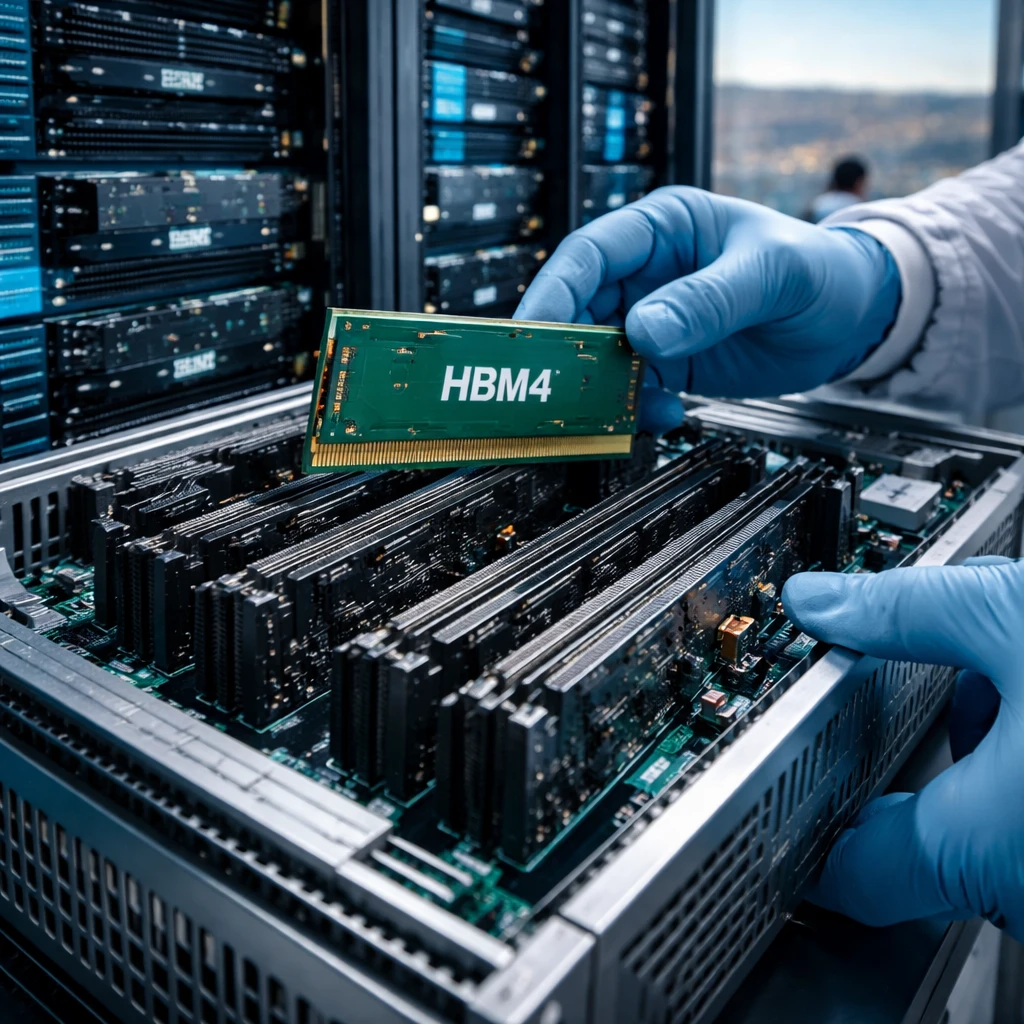
- Capacity leadership on next-gen memory: Micron has begun mass production of HBM4 for high-end GPUs. HBM4 targets the ultra-high-bandwidth needs of modern AI accelerators.
- Tight supply and pricing power: Recent readouts show strong price moves (DRAM up ~65-67%, NAND up ~75-79% reported in earnings commentary), and Micron's Q2 FY2026 results reflected that pricing environment.
What the numbers say
Micron posted fiscal Q2 2026 revenue of $23.9 billion, a 196% year-over-year surge, and EPS of $12.20, comfortably ahead of prior guidance. The firm reported a 41.49% net profit margin for the quarter — unusually high for the industry — and free cash flow of roughly $10.28 billion on a trailing basis. The balance sheet is solid: debt-to-equity sits near 0.14 and liquidity metrics (current ratio ~2.9, quick ratio ~2.32) indicate ample short-term flexibility.
Valuation is pragmatic today. The shares trade around a market cap of $402.9 billion and a P/E in the high-teens (~16-17x). Given the rapid earnings expansion management is projecting into fiscal 2027 (street commentary has scenarios far higher than current numbers), this multiple prices in growth but leaves room for upside if secular AI demand and tight supply persist.
Why Alphabet's TurboQuant helps Micron
TurboQuant reduces quantization friction, which lowers operational cost per inference. Lower costs do two things for cloud customers: they increase utilization of existing model deployments and expand the addressable use cases for models that were previously too expensive to serve at scale. More models and more inference throughput mean more memory transactions, more HBM per GPU node, and higher SSD throughput for the storage layer.
In plain terms: better efficiency -> cheaper per-op -> more ops -> more hardware. That multiplier effect benefits suppliers of HBM, DRAM and enterprise SSDs. Micron's mass production of HBM4 and meaningful share of premium memory products means it is the direct beneficiary of that increased consumption.
Catalysts to watch (2-5)
- Product ramps: Continued HBM4 shipment announcements and capacity ramp timelines (follow Micron statements and hyperscaler disclosures).
- Earnings cadence: Fiscal Q3 FY2026 guidance and margin commentary (upcoming quarter) that sustains high pricing levels or extends favorable ASP (average selling price) trends.
- Customer wins: Public confirmations from hyperscalers or major cloud providers that they are deploying HBM4-based nodes or committing multi-year purchases.
- Industry supply signals: Capital expenditure timelines from major memory peers — slower capex by competitors would sustain tight supply and pricing.
- Macro demand proxies: Continued adoption of large models in production (announcements from major software/cloud vendors) and broader AI usage growth metrics.
Valuation framing
Micron's market cap of about $403 billion and a forward P/E in the high-teens is neither a give-away nor frothy; it reflects a mix of stellar recent top-line acceleration and skepticism about the durability of memory cycles. Historically, memory suppliers trade through volatile cycles driven by supply-demand swings and capex timing. Today two structural differences reduce downside risk compared with prior cycles:
- AI-specific demand is more persistent and higher-margin than traditional PC/mobile DRAM.
- Hyperscaler procurement patterns and multi-year contracts provide revenue visibility that didn't exist in prior cycles.
If Micron sustains even a portion of the Q2 margin profile, the high-teens P/E could re-rate higher. Conversely, if memory pricing collapses rapidly, the current valuation would be vulnerable — that is the trade's core risk.
Trade plan (actionable)
| Element | Plan |
|---|---|
| Direction | Long |
| Entry | $360.00 |
| Stop loss | $320.00 |
| Target | $480.00 |
| Horizon | Long term (180 trading days) - allow the HBM4 ramp and hyperscaler procurement cycles to play out. |
| Risk profile | Medium - asymmetric upside if AI-driven memory demand persists; downside if pricing normalizes sharply. |
Rationale for the specific levels: $360 entry captures a disciplined pullback level near recent trading and gives room for short-term volatility. The $320 stop sits under material support and protects capital while still leaving room for noise; the $480 target is within reach if the HBM4 ramp and favorable margins continue and if the market revises forward earnings higher.
Risks and counterarguments
- Memory price normalization: A classic cycle risk — if DRAM and NAND pricing suddenly correct toward pre-2024 levels, Micron's revenue and margins would compress rapidly. This is the single biggest execution risk.
- Capex-determined supply response: Competitors could accelerate capacity expansions, easing tightness. Memory investments are lumpy; an aggressive response by others would push prices down.
- Geopolitical and trade constraints: Export controls, wafer fabrication restrictions or supply-chain disruptions could limit Micron's ability to ship products or access critical equipment, creating execution risk.
- Product substitution and efficiency gains: The counterargument to this trade is real: efficiency improvements like TurboQuant could reduce per-inference memory needs materially if customers re-architect deployments (for example, offloading more work to sparsity-aware chips or using model distillation aggressively). If the net effect is a sustained reduction in memory bandwidth demand per workload, Micron's growth could disappoint.
- Investor sentiment and valuation compression: Even if fundamentals remain strong, a market rotation out of cyclicals or tech could compress multiples and temporarily undercut the share price.
Counterargument - If cloud providers move aggressively to bespoke accelerators with very different memory topologies (e.g., far more on-chip SRAM, or a shift to architectures that rely less on HBM), demand for Micron's particular product mix could be weaker than expected. This is a lower-probability path today but one to monitor through design-win disclosures.
What would change my mind
I will reconsider this long thesis if any of the following materialize:
- Quarterly guidance that shows a sharp downtick in ASPs or a clear, sustained reversal in DRAM/NAND pricing.
- Public reports of a rapid build-out of competing HBM capacity that materially exceeds demand, evidenced by large capacity announcements and a visible pricing response.
- Design-win losses: clear evidence that major hyperscalers are choosing alternative memory suppliers or architectural approaches that significantly reduce Micron's exposure to the AI accelerator market.
Conclusion
Alphabet's TurboQuant should be viewed as a demand multiplier, not a demand killer. By lowering per-inference costs, it increases the workloads that are economical in production and that expands memory consumption. Micron has both the product roadmap (HBM4 mass production) and the recent earnings proof points (Q2 FY2026: $23.9B revenue, $12.20 EPS, 41.49% net margin) to capture that incremental demand. The stock trades at a valuation that still requires execution — hence the stop at $320 — but offers a favorable asymmetric return if AI-driven memory tightness persists.
Trade plan recap: long MU at $360.00, stop $320.00, target $480.00, horizon long term (180 trading days). Monitor pricing trends, hyperscaler announcements and quarterly guidance closely; those will determine whether this thesis composes into outsized returns or needs to be abandoned.