
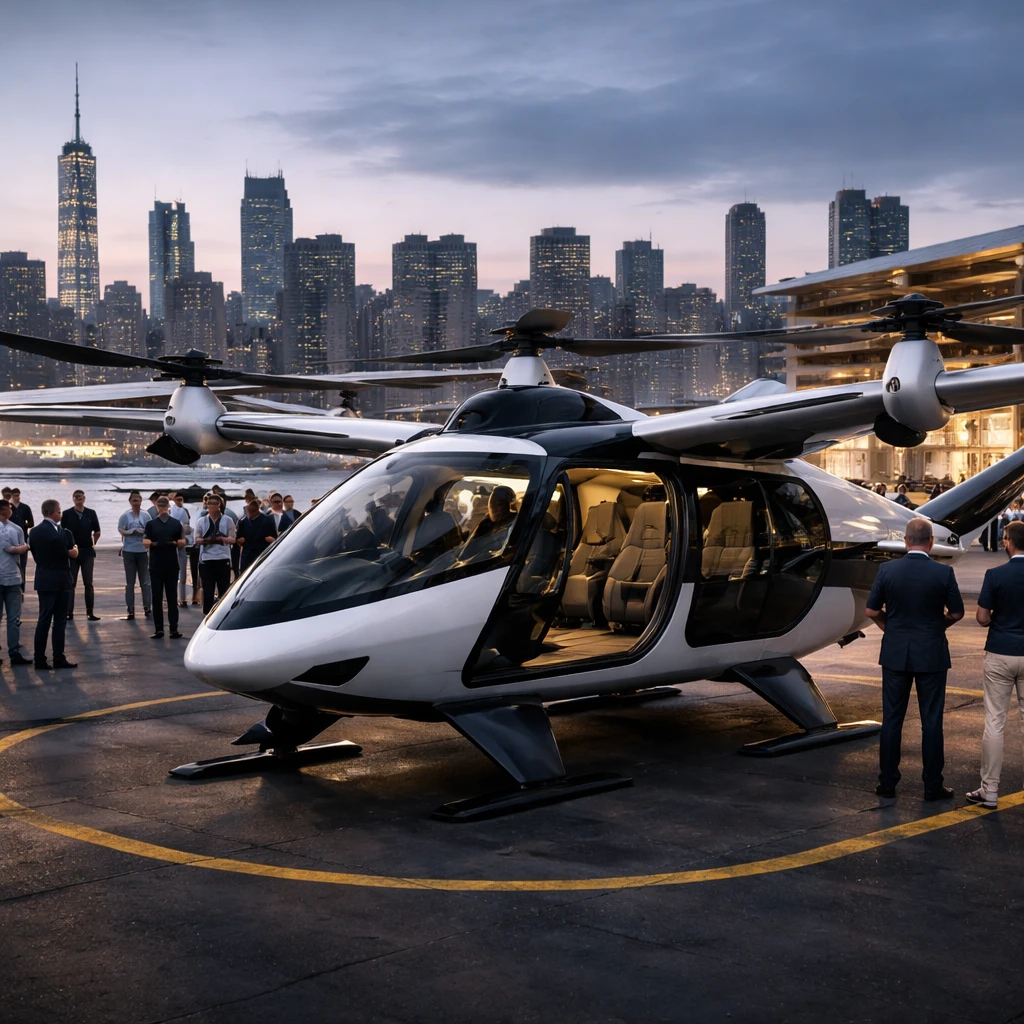
Vertical Aerospace Ltd (NYSE:EVTL) opened the U.S. leg of its Valo tour in New York earlier this month, presenting the company’s commercial eVTOL to investors, potential customers and partners. The New York appearance follows Valo’s public introduction in London in December 2025 and precedes the Miami stop planned for February.
The showcase in New York was framed by company leadership as an important turning point in Vertical’s evolution from prototype developer to aerospace manufacturer. According to the company, the event offered U.S. stakeholders a first-hand look at Valo’s design features and claimed operational capabilities ahead of an expected entry into service contingent on regulatory approval in 2028.
At the New York venue, attendees examined the aircraft and its cabin, which company executives highlighted for passenger comfort and operational practicality. Vertical emphasised a segregated pilot cockpit, described as supporting safety, privacy and pilot training; a passenger cabin the company described as the largest in its segment; and a dedicated luggage hold claimed to accommodate roughly 70lbs per passenger. The company said hundreds of visitors attended and reacted positively to those design elements.
The New York tour stop also served as a public demonstration of Vertical’s intentions to expand its presence in the U.S. market, which the company characterises as strategically important because of its size and the presence of key customers and suppliers. Vertical cited relationships with aviation firms and operators including American Airlines and Bristow, and noted the participation of Tier-1 suppliers such as Honeywell among its partners and potential suppliers.
Vertical said it is exploring route development in the New York region with partners Bristow and Skyports, using existing heliport infrastructure such as Downtown Skyport. Those route concepts are intended to replace protracted ground transfers with short air journeys, with the company pointing to potential time savings for trips such as JFK to Manhattan if eVTOL services are implemented.
Technical and certification milestones
Chief executive Stuart Simpson characterised 2025 as a year of execution and set out the technical and regulatory milestones the company plans to pursue in 2026 as it progresses toward its certification and entry-into-service timetable.
Among the milestones Vertical identified as priorities are completing piloted transition flight - described by the company as the final flight-phase and a core technical de-risk for eVTOL aircraft. Vertical noted that successful piloted transition validates flight dynamics and the fundamental capability of an eVTOL platform. The company also said it expects to be only the second eVTOL original equipment manufacturer to conduct a piloted transition flight and the first to do so under the regulatory scrutiny applied in the U.K. and the E.U.
Vertical plans to complete build of a final prototype that will facilitate extensive public flight demonstrations, particularly in the U.K., and enable hybrid-electric flight testing. The company intends to retrofit a gas turbine to this prototype after conducting flights in a pure battery-electric configuration, with hybrid flights to follow later in the year. Vertical described the forthcoming piloted hybrid-electric flight as a first for the sector and a meaningful technical milestone for the industry.
The company also signalled expectations of announcing additional partnerships, customers and suppliers, and indicated plans for further stops on its U.S. Valo Tour beyond Miami.
Regulatory approach and testing regime
On the regulatory front, Vertical positioned its path to certification as clearer relative to some U.S. peers, attributing that clarity to the EASA/CAA framework and the SC-VTOL process. The company emphasised the role of the U.K./E.U. Permit to Fly flight-test regime, noting that while the regime makes European flight testing more challenging it effectively front-loads certification efforts by subjecting aircraft and programmes to early, rigorous scrutiny.
Vertical said the Permit to Fly system has resulted in close familiarity between the company and its home regulators in the U.K. and E.U., encompassing aircraft design, company processes and personnel, which the company expects will streamline later certification activity. The company pointed to EASA’s certification history within electric aviation, referencing prior type certification for a small electric aircraft and certification of an electric engine, as evidence of regulatory capability in the region.
Funding plans and path to profitability
The company provided specific financial targets tied to its commercialisation timeline. Vertical is targeting cash breakeven by the fourth quarter of 2029 and aims to achieve positive net operating cash flow that exceeds $100 million in 2030. The company said these targets are underpinned by what it described as industry-leading capital efficiency.
Vertical quantified its remaining capital needs for certification, stating it is targeting approximately $700 million in additional funding to reach certification toward the end of 2028. The company also asserted it expects to achieve the piloted transition flight for more than $1 billion less than peers, a claim framed as reflective of the company’s capital discipline and development approach.
Management said it is in discussions with strategic investors to support the ramp toward commercialisation and that it intends to preserve capital efficiency throughout certification and production ramp phases. The company presented its funding strategy as integral to delivering certification on its intended timeline while protecting shareholder returns.
Market demand, production and business model
Discussing market readiness and demand, the company cited third-party market estimates for total addressable market sizes that it says indicate substantial long-term demand for eVTOL and hybrid-electric aircraft. Vertical outlined production and delivery targets, saying it plans to deliver 175 aircraft (including eVTOL and hybrid variants) by 2030 and to scale production to roughly 900 aircraft per year at scale by 2035, with the hybrid-electric variant supporting the ramp.
Vertical also described potential non-passenger markets for the hybrid-electric model, including logistics, emergency services and defense, where payload, range and uncrewed capabilities could be valuable. The company emphasised the breadth of opportunity as part of its long-term commercial rationale.
On the customer pipeline, Vertical stated it holds the second-largest order book in the sector, reporting approximately 1,500 pre-orders from a globally diversified base of airlines, lessors and operators. The company highlighted its relationship with a top-tier aircraft lessor, noting that having Avolon as a backer will broaden the buyer base and support faster global adoption following certification.
Vertical described its commercial strategy as built on three business lines: sales of the Valo eVTOL, sales of the hybrid-electric variant, and a battery-as-a-service offering to support both new and existing customers. The company argued that certifying to the highest global safety standard - the same standard applied to commercial airliners - will enable broader global operations once certification is secured and differentiate Valo from peers certifying to lower standards.
Management suggested that adherence to the highest safety standard will initially limit competitor access to higher-requirement jurisdictions such as the U.K. and the E.U., creating what the company called a geographic advantage in those markets for the opening years of operation.
Operational focus and route development
The New York showcase underscored operational plans focused on dense, congested urban corridors where premium travel demand and existing heliport networks provide a platform for initial services. The company argued New York is a logical proving ground given its urban density, congestion and the presence of heliport infrastructure that could be adapted for electric air services.
Vertical reiterated ongoing work with Bristow and Skyports to explore electric air routes into and out of Manhattan, including utilization of Downtown Skyport and other existing heliports. The stated objective for these routes is to reduce long ground and ground-plus-air transfers to minutes-long flights, using Valo’s claimed speed and operational profile.
What to watch next
- Piloted transition flight and the completion of the final prototype, which the company says will enable expanded public flight demonstrations and hybrid-electric tests.
- Announcements of additional strategic partnerships, customers and supplier agreements that the company expects to make during 2026.
- Progress on the U.S. Valo Tour, beginning with Miami in February and continuing to other U.S. cities, providing further opportunity for stakeholders to inspect the aircraft and for the company to engage potential customers and partners.
Vertical presented these milestones and commercial objectives as central to translating recent technical progress and public demonstrations into a scalable business capable of delivering positive operating cash flow by 2030.
The company’s statements reflect a sequence of technical, regulatory and commercial steps that management says will culminate in certification and entry into service in 2028, followed by a production and delivery ramp through the early 2030s. The pace of those outcomes, according to the company, depends on continued execution across flight testing, regulatory engagement and funding.