
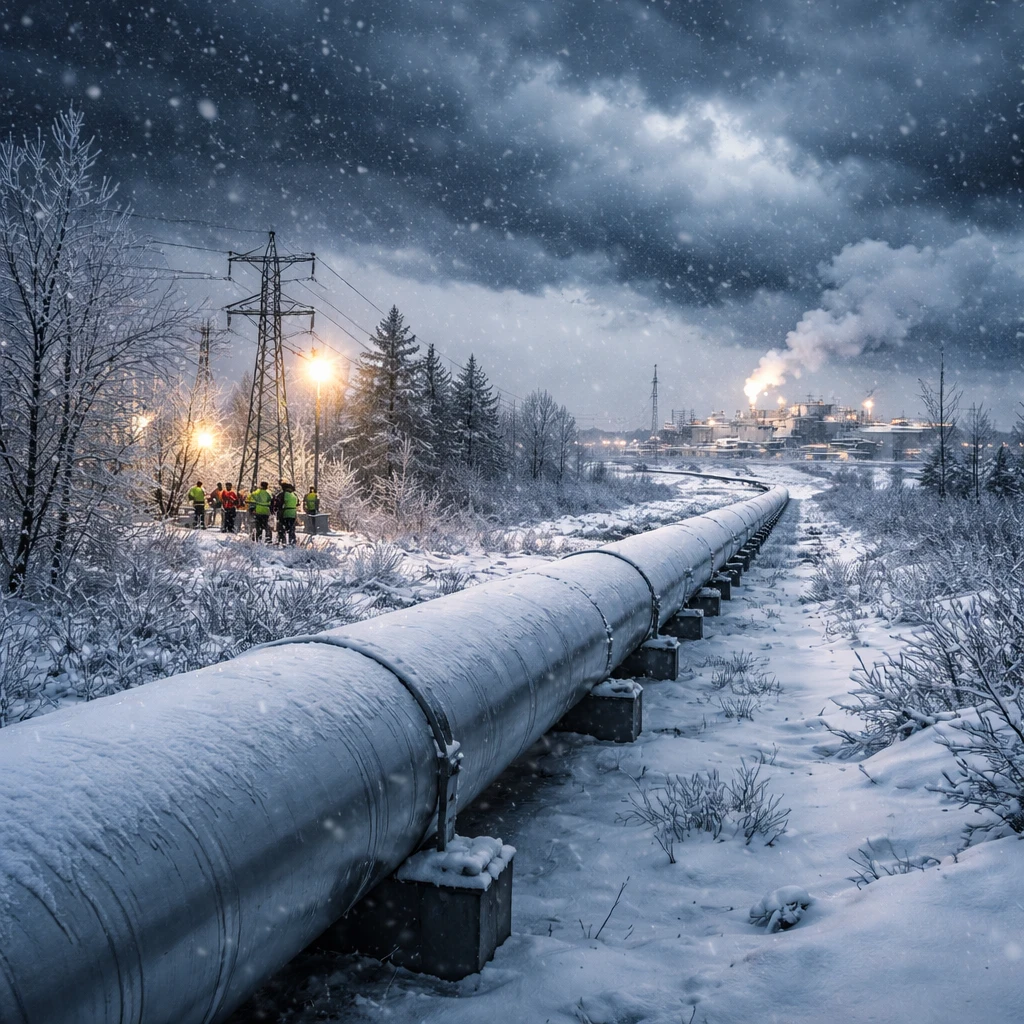
Natural gas markets in the U.S. experienced a pronounced uptick this week as a strengthening Arctic cold front advanced across much of the country, according to analysts at BofA Securities. Forecasters warned a powerful winter storm could arrive over the coming days, bringing snow and ice to roughly two dozen states from the Midwest to the East Coast during the next two weeks.
Meteorological services cautioned that impacts could extend into parts of the South, where "catastrophic" ice accumulations could lead to tree damage and power outages, the Weather Channel reported while citing the federal National Weather Service’s Weather Prediction Center.
The market reaction was acute. U.S. spot natural gas futures on Thursday rose by more than 56% on a week-on-week basis, touching an intraday high of $5.65 before settling at $4.86, market commentators including Morgan Stanley analysts Kalei Akamine and Noah Hungness flagged. For context, spot gas had closed at $3.12 on January 16.
Stocks with elevated exposure to natural gas prices, including EQT Corp, Expand Energy, and Range Resources, advanced in step with the commodity, though brokers noted those equity gains were measured rather than outsized.
Analysts pointed out that the equity market has largely remained disciplined in translating gas price moves into valuations. Over the past 12 months, equities in this space have traded within a band that implies gas in the $3.50 to $4.00 range, the analysts said.
BofA’s commodities research group provided a quantified view of the storm’s potential effect on fuel demand, estimating the event could add nearly 30 billion cubic feet (bcf) of incremental heating demand over the next two weeks. The analysts described that shift as "meaningful." Prior to the storm, many market participants had been projecting end-of-winter storage levels of about 1.9 to 2.0 trillion cubic feet (tcf); those expectations have since been revised down to roughly 1.7 tcf.
Historical precedent offers a range of outcomes from winter storms, with reductions in supply typically spanning from 20-30 bcf on the low end up to 100-140 bcf on the high end, according to the analysts' framing. Independent weather vendors, the analysts added, have produced projections that vary substantially - from 20 bcf to 200 bcf of natural gas supply being affected by elevated winter storm-related demand.
Regional dynamics matter for the ultimate impact. Temperatures in Texas’s energy-rich Permian basis are expected to warm by Monday, and infrastructure in colder regions has reportedly been better prepared for freezing conditions, the analysts noted. Those operational differences can alter whether the market faces true supply shortfalls or predominantly logistical delivery challenges.
The memory of 2021 remains relevant in reliability discussions. Following a period of freezing weather in Texas that year which resulted in a large-scale blackout in the state, utilities and grid operators have faced tighter rules around winter readiness. The analysts noted, citing reporting, that an artificial intelligence-driven rise in data center usage has reduced windows for power plants to go offline and perform maintenance checks.
Market observers suggested this week’s brief spike past $5.00 may reflect heightened concern over the physical deliverability of energy resources to end users, rather than an absolute shortage of gas supplies. In the analysts’ view, a balanced-market price for natural gas sits around $3.50, while $4.00 is classified as "tight."
Heading into the season, the analysts had assessed that liquefied natural gas demand would be largely offset by new supply. That placed weather as the dominant driver of price swings: an early December cold period, a sequence of warm weeks in January and now another swing toward cold, which is unfolding as the market reacts.
Implications for markets and participants
The confluence of severe weather and market positioning has produced a volatility-rich environment for energy markets, regional utilities and gas-dependent industries. Producers and midstream operators will be watching both physical flows and storage trajectories closely, while power generators and grid managers remain focused on operational readiness.