
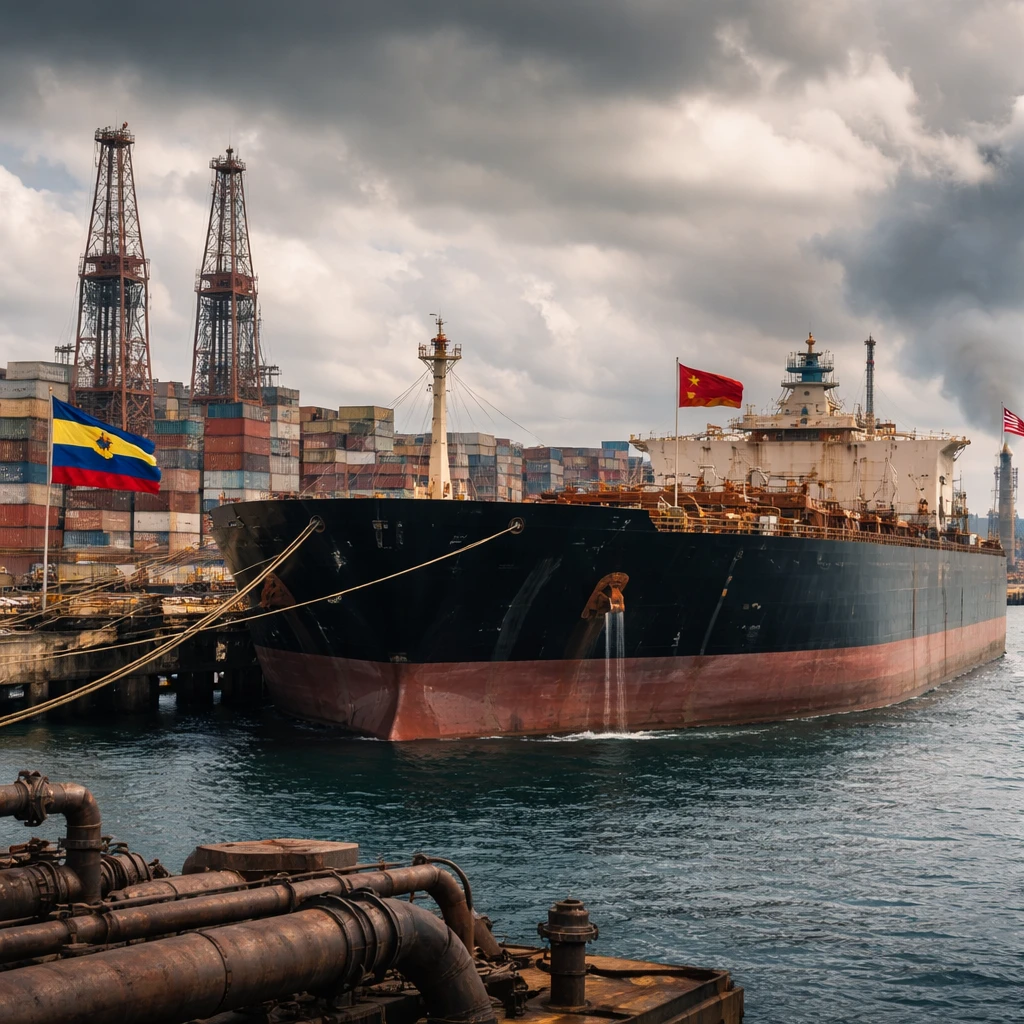
The United States' recent assumption of control over Venezuela's oil exports has significantly disrupted the mechanisms by which the South American nation serviced part of its substantial foreign debt, particularly the loans owed to China. This shift positions Washington and Beijing on a potential collision course, exacerbating challenges for Venezuela as it continues navigating its default status and seeks to restructure its estimated $150 billion in foreign liabilities.
Approximately 10% of Venezuela's external debt portfolio comprises Chinese loans, historically repaid through shipments of crude oil. Documentation from Venezuela’s state oil company, PDVSA, reveals a pattern of supertankers ferrying oil cargoes to China under a temporary arrangement initiated in 2019. These cargoes represented interest payments on Beijing’s loans but constituted only a segment of Venezuela's overall exports to China.
Significantly, a portion of the proceeds from these oil shipments was deposited into accounts under Chinese control, facilitating debt servicing despite Venezuela’s default since 2017 and the imposition of various sanctions restricting payments to other creditors. However, the U.S. government's recent maneuver to redirect oil sale revenues into a Qatar-based account administered by Washington introduces fresh leverage over the distribution and prioritization of creditor repayments.
Experts caution that this unprecedented financial control complicates existing creditor arrangements. Christopher Hodge, chief economist at Natixis and former U.S. Treasury official, highlighted the opacity and entangled nature of Venezuela's financial situation under these conditions, emphasizing the difficulties this presents in untangling the rights and claims of various creditors within the evolving hierarchy.
The Trump administration asserts that the new oil sale framework aims to benefit both American and Venezuelan interests. According to a U.S. official, while China remains permitted to purchase Venezuelan crude, the U.S. intends to prevent sales at historically discounted prices that characterized previous transactions. Traders have offered Venezuelan oil to Chinese refiners through private market channels; however, these sales are not structured to settle debt obligations.
China’s Ministry of Foreign Affairs has condemned the seizure and rerouting of Venezuelan oil exports, reaffirming the necessity to protect legitimate rights and interests of Chinese stakeholders in Venezuela. The diplomatic tension underscores the precariousness of the situation as it unfolds.
From a restructuring standpoint, advisors warn that U.S. financial oversight over Venezuela's primary revenue stream could subordinate the claims of existing legacy bondholders and bilateral lenders alike. Legal questions persist regarding the extent of the U.S. administration’s authority to dictate payment priorities, thereby potentially reshaping creditor negotiations.
Given that Venezuela defaulted on roughly $60 billion worth of bonds several years ago, reaching a restructuring agreement is critical for the nation’s ability to regain market access and attract new investments. Debt restructuring conventionally involves cooperation among bilateral lenders, often coordinated through platforms such as the Paris Club, setting a benchmark for private creditor losses during restructuring. Deviations introduced by U.S. financial control threaten to complicate adherence to such standards.
Should the U.S. pressure China to accept substantial write-downs on its loans, and China resist, protracted restructuring stalemates could ensue. This would likely exacerbate Venezuela’s ongoing economic hardships, limiting its capacity to satisfy bondholders and other creditors. Jean-Charles Sambor, head of emerging market debt at TT International, which holds Venezuelan bonds, suggests this scenario could prolong the nation’s dire economic conditions.
China's immediate recourse remains constrained, as sovereign lending disputes generally evade litigation and require government-level negotiations to resolve. Nonetheless, potential long-term effects include Beijing withholding cooperation on future debt restructuring frameworks—such as the Common Framework—applied in recent cases involving Ghana, Zambia, and Ethiopia. Such moves by China could have wider implications for debt workouts involving developing nations globally.
In summary, the U.S. decision to control Venezuela’s oil revenues—historically a key instrument of debt service—has introduced significant complexities into an already fraught process for resolving the country’s default. The interplay between Washington and Beijing’s interests, creditor hierarchies, and restructuring negotiations render Venezuela’s fiscal outlook uncertain and potentially protracted.