
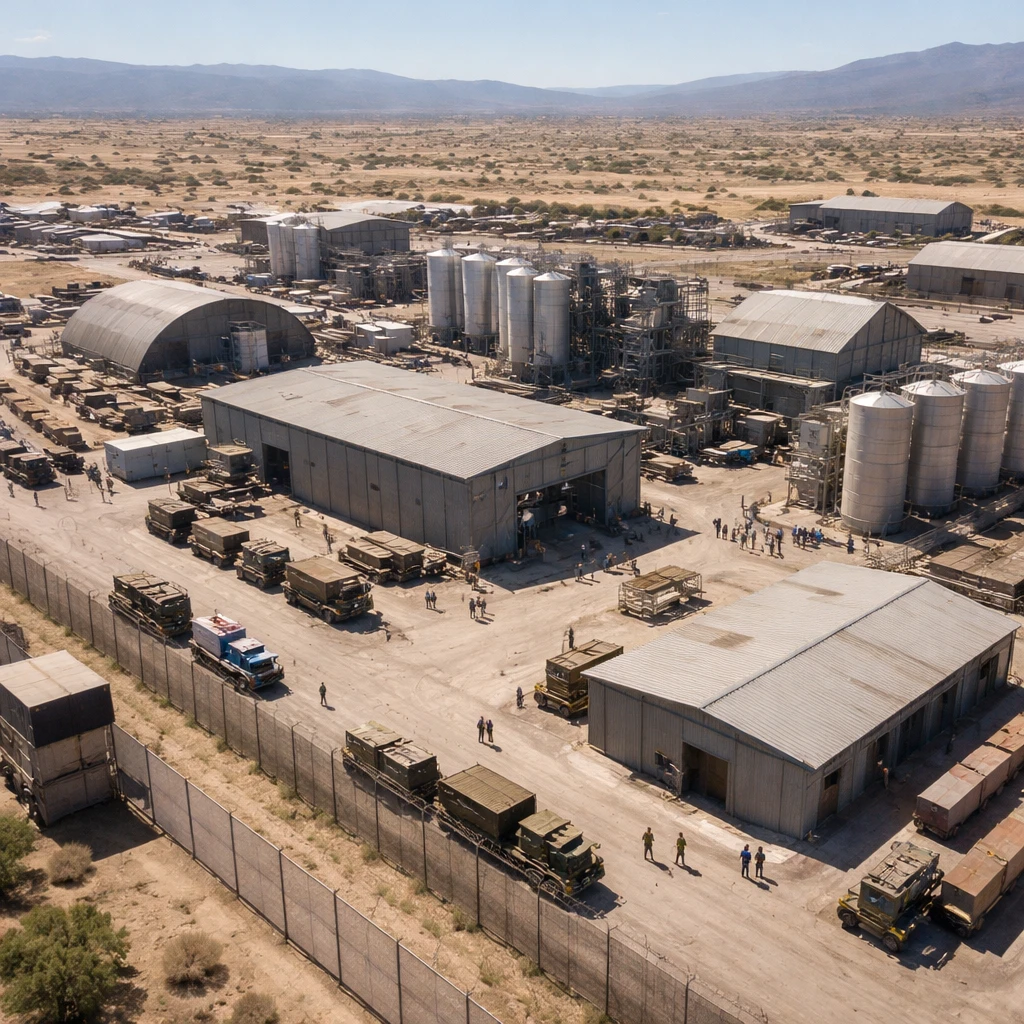
The US Army has signed off on plans allowing several firms to build mineral-processing operations on Army property across the country, according to people familiar with the matter who requested anonymity prior to any formal announcement. The approvals cover plants that will handle rare earth elements, graphite, lithium and boron.
REalloys Inc., Titan Mining Corp., ioneer Ltd. and Energy Exploration Technologies Inc. have reached agreements with the Pentagon to site the facilities at military installations, the people said. The companies will construct and operate the plants on Army depots and arsenals, with production tied to both industrial and defense uses.
Under the arrangements, REalloys will establish a rare-earth separation operation at the Toole Army Depot in Utah. Officials familiar with the plan said material produced at that separation facility will be stockpiled at the site for military requirements.
Titan Mining is slated to build graphite purification plants at two locations - Pine Bluff Arsenal in Arkansas and Anniston Army Depot in Alabama. Energy Exploration Technologies will develop a lithium-processing facility, while Sydney-based ioneer, the only non-US company among the four, is set to construct a boron plant.
The initiative is being advanced as part of the administration's broader priority to expand domestic output of critical minerals and to reduce dependence on imports, particularly from China. The government has already used tools such as loans and equity stakes to support producers; placing processing capacity on military property represents a novel delivery mechanism for that policy objective.
Rare earths, lithium and graphite are key inputs in a range of products including consumer electronics, automobiles and defense systems. Officials involved in the approvals have framed the siting of processing plants on Army facilities as a way to secure supply chains for materials used in both commercial and national security applications.
Summary
The Army has approved company plans to build processing plants for rare earths, graphite, lithium and boron on military bases. Four companies - REalloys, Titan Mining, ioneer and Energy Exploration Technologies - will develop the facilities, with some production designated for military stockpiles. The step aligns with the administration's push to boost domestic critical-mineral capacity and lower import dependence.
Key points
- The approved projects cover rare-earth separation, graphite purification, lithium processing and boron production.
- Sites include Toole Army Depot (UT), Pine Bluff Arsenal (AR) and Anniston Army Depot (AL).
- Sectors affected include defense supply chains, mining and materials processing, and industries relying on batteries and electronics.
Risks and uncertainties
- The timing and full terms of the agreements have not been publicly disclosed - this generates uncertainty for market participants and suppliers in mining and processing sectors.
- Reliance on military property as a platform for processing is a novel approach - implementation risks and operational challenges on federal installations could affect project schedules and costs.
- The scope of production destined for military stockpiles versus commercial markets is not specified, leaving demand allocation and revenue implications unclear for the companies involved.