
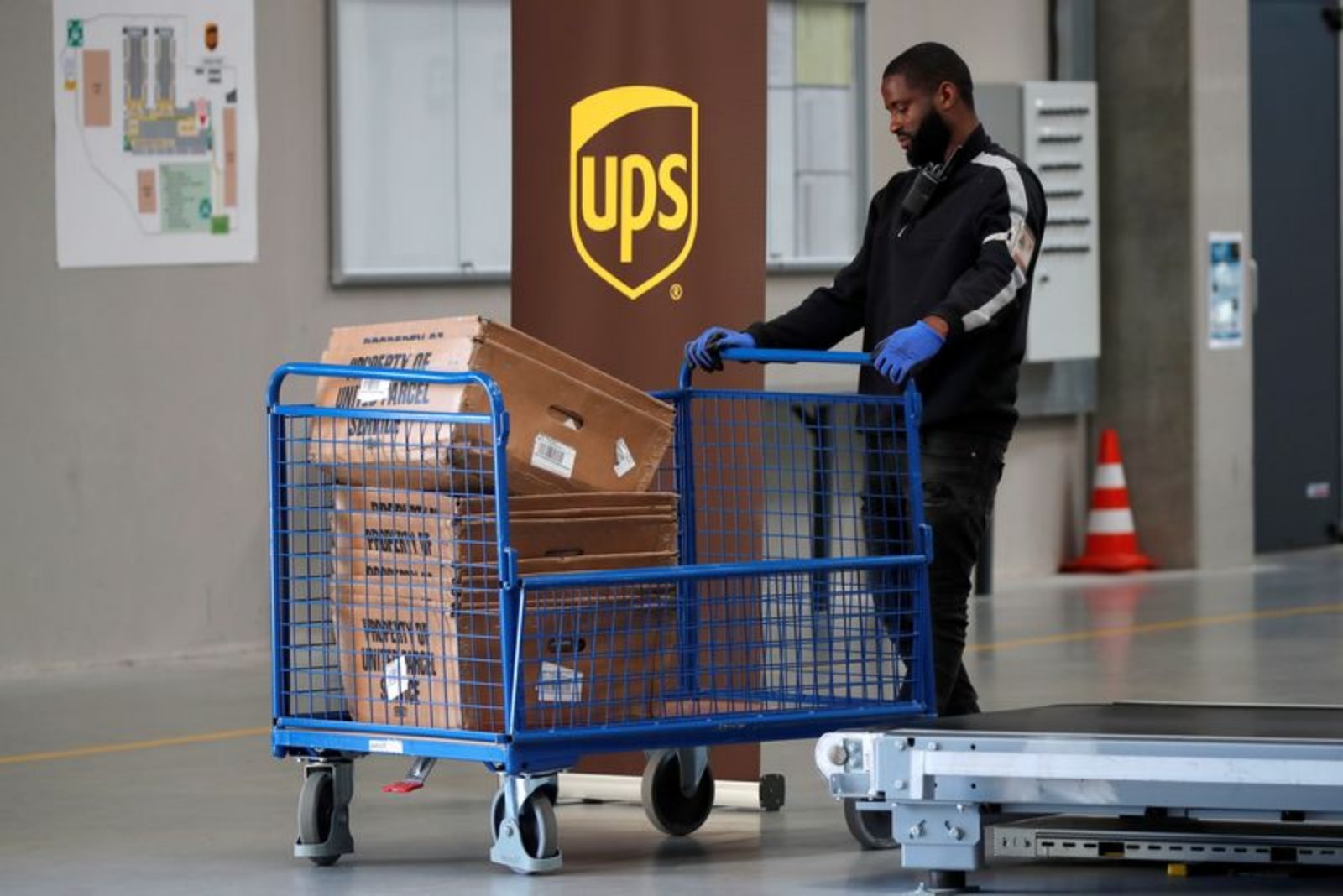
United Parcel Service will cut as many as 30,000 jobs and close 24 additional facilities in 2026, the company said on Tuesday, continuing a network reconfiguration tied to a sustained reduction in deliveries for Amazon.com. The moves come as UPS shifts toward higher-margin business and away from lower-profit volumes tied to its largest customer.
Shares of UPS rose about 4% in midday trading following the announcements and the release of fourth-quarter financial results that topped analysts' expectations. Rival FedEx also moved higher, gaining 2.6%.
Company statement and plan
Chief Executive Officer Carol Tome told analysts on a conference call that UPS is in the "final six months" of an "Amazon accelerated glide down plan." For the full year 2026, the company expects to reduce Amazon-related deliveries by another one million pieces per day while continuing to reconfigure its network to prioritize more profitable shipments.
UPS began accelerating a plan last January to cut millions of low-profit deliveries for Amazon, which the company has described as "extraordinarily dilutive" to margins. Management has said the strategy is intended to improve overall profitability by targeting higher-margin parcel flows.
Workforce changes and approach
In 2025, UPS implemented significant cost and capacity changes, eliminating 48,000 jobs, offering driver buyouts and closing operations at 93 buildings as Amazon volumes decreased. The company said this year's workforce reductions will be achieved through attrition and a new buyout offer for full-time drivers, and that layoffs are not planned, according to Chief Financial Officer Brian Dykes.
According to UPS's 2024 annual report, the company had about 490,000 employees, with nearly 78,000 in management roles. The company noted that 2025 employment figures were not immediately available. UPS also emphasized that it employs a unionized workforce in parts of its operations.
Dykes said many of the reductions will come from not backfilling positions when part-time workers depart the company.
Volumes and market adjustments
UPS said it is also working to stabilize volumes after the end of certain U.S. duty-free, "de minimis" low-value e-commerce shipments originating from major China-linked discount retailers, such as Shein and Temu. Management expects this shift in flow dynamics to influence near-term parcel volumes.
The company forecast 2026 revenue of $89.7 billion, up from $88.7 billion in 2025. The consensus analyst expectation had been almost $88 billion on average, according to data compiled by LSEG. UPS expects revenue to decline in the first half of 2026 as the company executes the Amazon "glide-down," then to increase sequentially in the second half of the year once those reductions are complete.
Fourth-quarter performance
UPS reported consolidated fourth-quarter revenue of $24.5 billion for the period ended December 31, beating estimates of $24 billion. On an adjusted basis, the company earned $2.38 per share for the quarter, surpassing analyst expectations of $2.20 per share.
Jonathan Chappell, an analyst at Evercore ISI, said the quarterly beat was driven mainly by revenue-per-piece gains in both domestic and international segments, continuing a trend of stronger-than-expected pricing across recent quarters.
Dykes told Reuters that peak season volumes excluding Amazon were mixed: small and medium-sized businesses were somewhat stronger than expected while large retailers were a bit weaker. "We were down a little bit from last year," he said.
Despite lower overall volume, UPS reported an 8.3% increase in revenue per piece in its U.S. domestic segment. International revenue per piece rose 7.1%, reflecting the company's push toward higher-margin shipments.
Aircraft fleet changes
UPS said it retired its remaining MD-11 fleet of more than two dozen cargo jets by the end of 2025, accelerating a previously announced plan. The retirements followed a fatal MD-11 crash in November. Replacement Boeing 767 aircraft are already scheduled for delivery.
The company recorded a non-cash, after-tax charge of $137 million related to writing off the MD-11 fleet.
Management signaled a near-term volume contraction tied to the strategic reduction of Amazon shipments and changes in low-value cross-border flows, while reporting improved pricing and a stronger-than-expected holiday quarter. The company is balancing restructuring and operational adjustments with the aim of improving revenue quality and margin performance over 2026.