
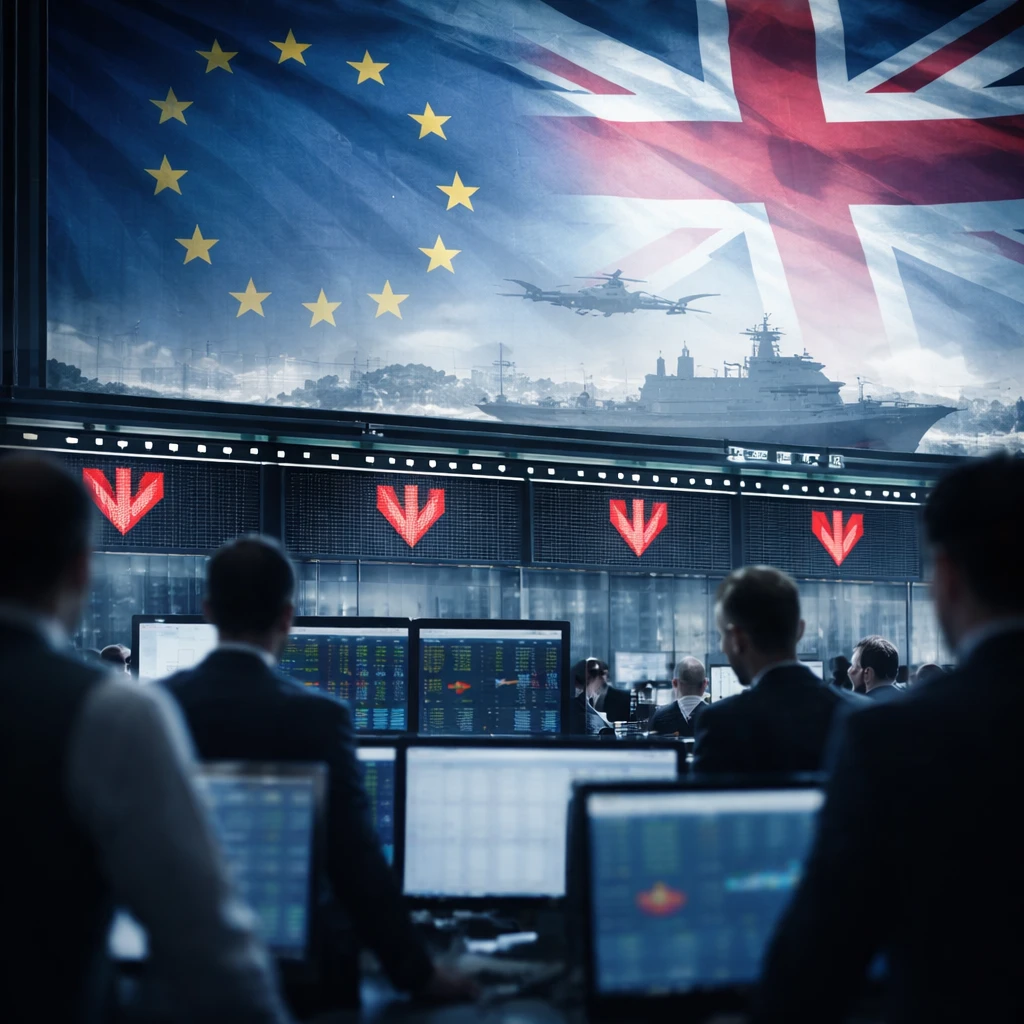
Shares of British defence contractors declined on Monday following comments from Prime Minister Keir Starmer that suggested the U.K. could revisit participation in a prospective second edition of the European Union's SAFE loans initiative.
By 08:37 GMT in London, Bae Systems had dropped 2.7%. Other defence-related names, including Babcock, Rolls-Royce, and QinetiQ, were each down by roughly 1%.
The remarks come as European institutions assess whether to launch another iteration of the SAFE fund, intended to support defence projects across the continent. Officials are preparing to travel to London this week for wider discussions, underscoring that the possible new facility is on the agenda for both EU and U.K. representatives.
Starmer said his government would examine the prospect of joining a potential follow-up to the multi-billion-euro SAFE loan scheme. He framed the review as part of a broader push for Europe to accelerate its defence capabilities, noting political drivers for stronger cooperation.
"Europe, including the UK, needs to do more on security and defence ... that’s an argument I’ve been making for many months now," Starmer said. "That should require us to look at schemes like SAFE and others to see whether there is a way in which we can work more closely together."
"Whether it’s SAFE or other initiatives, it makes good sense for Europe in the widest sense of the word - which is the EU plus other European countries - to work more closely together," he added.
The European Commission is weighing a new round of the fund amid heightened concerns about regional security and questions raised about long-term U.S. security commitments under President Donald Trump. The original SAFE programme raised funds on capital markets to lend to participating countries on long maturities for defence projects, covering equipment such as ammunition, drones and missile systems.
London previously explored joining the initial €150 billion SAFE facility, but negotiations ended in November when the U.K. declined to make a financial contribution. That decision halted efforts at the time to use the programme as a lever in resetting post-Brexit relations with the EU.
Under the SAFE model, the EU borrows and then lends to recipient countries. While the U.K. cannot apply directly for SAFE loans as a non-member, joining the initiative as a third country would permit British firms to compete for procurement contracts funded through the scheme.
EU Trade Commissioner Maros Sefcovic and other EU officials are due to visit London this week for broader discussions, signalling ongoing diplomatic engagement on the matter. Starmer has also been pursuing separate bilateral defence agreements with European partners, and his remarks suggest a willingness to expand those efforts.
Recent bilateral deals cited alongside the broader SAFE discussion include a £10 billion agreement with Norway to build anti-submarine warships in the U.K., and a separate £8 billion deal to sell 20 Typhoon fighter jets to Turkey. Starmer indicated that further bilateral arrangements remain under consideration as part of his approach to strengthening Britain’s defence partnerships.
Market participants reacted to the prospect of renewed EU-U.K. defence engagement with caution on the equities of major defence contractors, reflecting sensitivity to potential shifts in procurement dynamics and future access to European-funded contracts.