
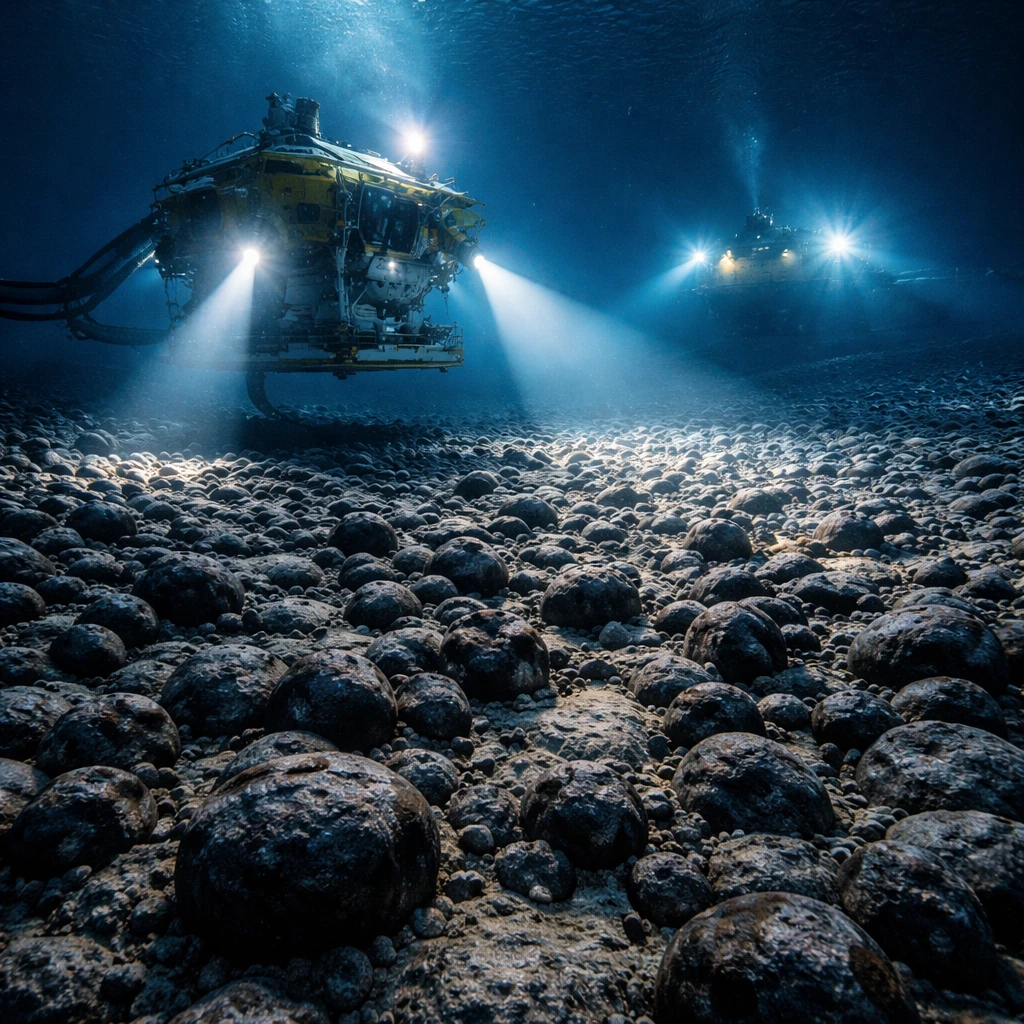
The Metals Co has become the inaugural deep-sea mining company to apply for an international seabed mining permit using the U.S. Department of Commerce’s newly simplified review process. Located in the Clarion-Clipperton Zone between Hawaii and Mexico, the proposed mining regions contain significant deposits of polymetallic nodules rich in critical minerals pivotal for electric vehicle and clean energy technologies. While the new rules promise expedited processing, environmental groups caution about the potential irreversible damage to ocean biodiversity. The company aims to secure its permit by year-end and has arrangements with major commodity trader Glencore for extracted metals.
Key Points
- The Metals Co is the first company to apply for a deep-sea mining permit under the newly revised, streamlined U.S. permitting regulations.
- The targeted area, the Clarion-Clipperton Zone, contains vast quantities of polymetallic nodules with critical minerals essential for electric vehicle and renewable energy production.
- The new U.S. regulatory framework aims to reduce permitting times, potentially accelerating commercial deep-sea mining operations and impacting the mining and clean energy sectors.
The Metals Co, a Vancouver-based deep-sea mining entity, has taken the lead in applying for a U.S. government permit to mine international seabeds following the introduction of revised regulations intended to expedite the licensing process. These regulatory amendments, implemented by the National Oceanic and Atmospheric Administration (NOAA) under the U.S. Department of Commerce, consolidate licensing and permitting procedures into a single review with the goal of reducing approval timeframes.
Gerard Barron, CEO of The Metals Co, conveyed optimism regarding the changes, stating that the new guidelines facilitate "faster permitting" and could enable the company to advance to commercial production more swiftly than previously possible. The company has resubmitted an application initially filed in April, targeting operations within the Clarion-Clipperton Zone in the Pacific Ocean, an area spanning between Hawaii and Mexico.
This region has been identified as containing approximately 800 million metric tons of polymetallic nodules. These rock formations are enriched with critical minerals such as nickel, copper, cobalt, and manganese, which are integral to manufacturing electric vehicles and supporting renewable energy infrastructure.
The Metals Co has articulated that deep-sea mining could potentially reduce reliance on terrestrial mining operations, which frequently face opposition from local communities. Concurrently, environmental organizations have voiced strong concerns over the possible permanent biodiversity loss that industrial extraction from the ocean floor could precipitate.
International oversight of seabed mining is governed by the United Nations-backed International Seabed Authority, which continues endeavors to establish comprehensive global mining standards. It is notable that countries maintain the sovereign right to permit deep-sea mining within roughly 200 nautical miles from their coastlines.
Moreover, The Metals Co has secured a commercial deal with London-listed commodities trader Glencore, which has agreed to purchase the metals harvested from its seabed mining activity. Barron reported that the company is targeting the acquisition of a mining permit by the end of the current year.
This development marks an important step in the advancing commercial viability of deep-sea mining, set against ongoing environmental debates and the evolving regulatory landscape within the energy and mineral extraction sectors.
Risks
- Environmental concerns remain significant, with warnings from advocacy groups about possible irreversible biodiversity loss caused by seabed mining, posing risks to marine ecosystems and biodiversity sectors.
- The International Seabed Authority is still in the process of finalizing international mining standards, creating regulatory uncertainties for deep-sea mining firms.
- Community resistance to terrestrial mining, which deep-sea mining hopes to alleviate, underscores potential social challenges and risks in mining operations.