
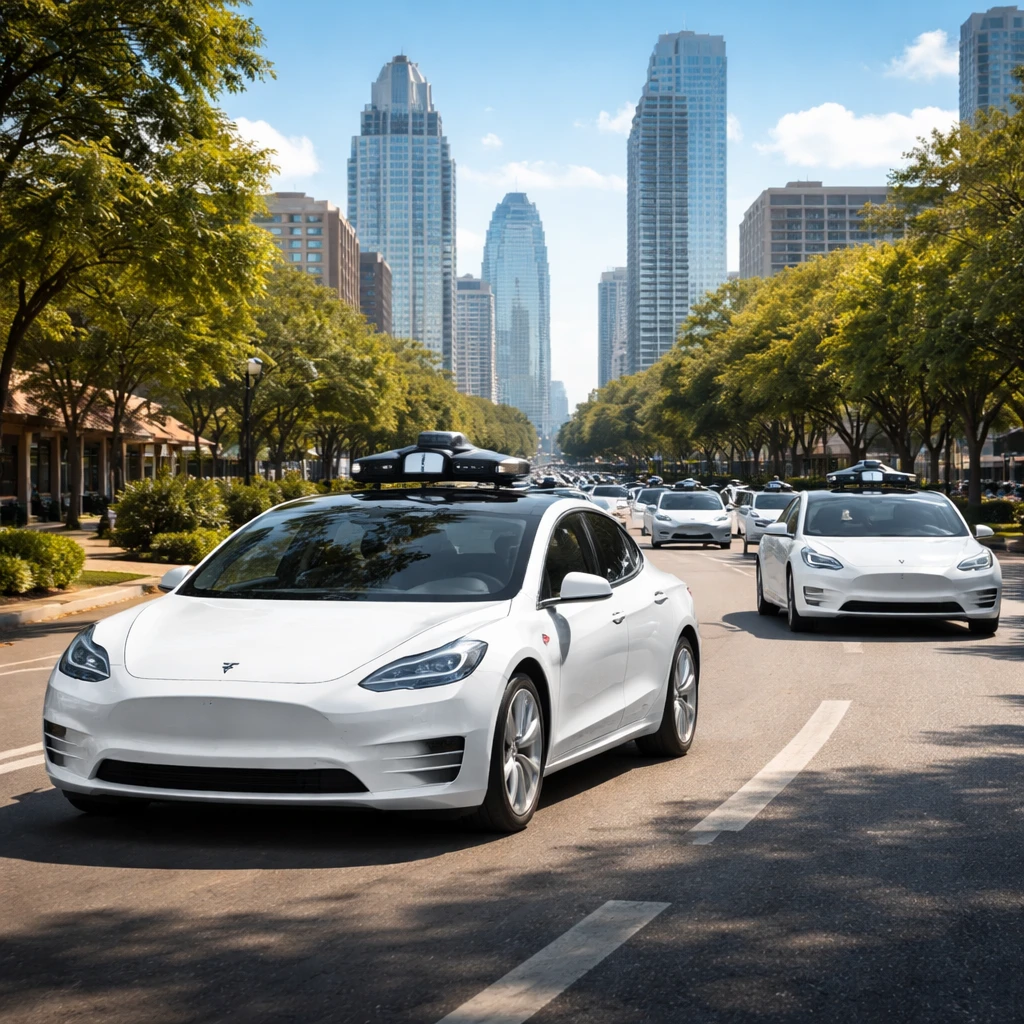
Tesla has begun operating fully autonomous vehicles without safety drivers in its Austin robotaxi pilot, marking a significant step in its autonomous driving capabilities. Morgan Stanley views this advancement as a pivotal validation of Tesla’s camera-based autonomy system and anticipates rapid expansion of robotaxi services across multiple U.S. metro areas by the end of 2024. The firm projects Tesla could operate 1,000 robotaxis by the close of 2026 and potentially expand to tens of thousands over the next decade, challenging conventional industry assumptions about autonomous vehicle technology deployment.
Key Points
- Tesla began operating fully autonomous robotaxis without safety drivers in Austin, demonstrating practical application of its vision-only autonomy approach.
- CEO Elon Musk anticipates Robotaxi operations expanding to 8-10 metropolitan areas by the end of 2024, accelerating the network rollout.
- Morgan Stanley projects Tesla could have 1,000 robotaxis active by the end of 2026, with growth to 30,000 by 2030 and up to 5 million by 2040, highlighting substantial scaling potential.
Tesla has reached a noteworthy milestone in its autonomous driving journey by launching driverless operations within a portion of its robotaxi fleet based in Austin, Texas. This significant development underlines Tesla's commitment to its vision-only autonomy approach and sets the stage for accelerated deployment of autonomous ride services nationwide. According to Morgan Stanley analyst Andrew Percoco, this event represents a crucial juncture in validating Tesla’s autonomous driving technology model.
Tesla has publicly acknowledged the initiation of unsupervised vehicle operations within the Austin robotaxi fleet, with plans to steadily increase the number of fully driverless vehicles. During the company’s third-quarter earnings call, CEO Elon Musk indicated that the removal of safety drivers in Austin is anticipated within a few months. Furthermore, Musk projected that by the end of the year, Tesla intends to have its Robotaxi service operational in approximately eight to ten metropolitan areas.
Morgan Stanley had initially anticipated the elimination of safety drivers to occur around early 2026. The company now considers the accelerated timeline to be one of the most significant milestones underpinning Tesla’s $125 per share valuation framework and its broader robotaxi aspirations. The financial institution expects substantial growth in the coming years, forecasting that Tesla could deploy around 1,000 robotaxis by the end of 2026. Looking further ahead, the analyst suggests this figure could increase to 30,000 vehicles by 2030 and could potentially reach an ambitious 5 million units by 2040.
If Tesla successfully broadens the Robotaxi program to additional metropolitan regions and maintains improving safety metrics, Morgan Stanley believes it could meaningfully disrupt prevailing assumptions within the autonomous vehicle industry. This is particularly notable given Tesla’s reliance on an optical-only sensor system, which contrasts with competitors using more complex sensor suites.
Overall, Tesla’s recent progress highlights a significant stride toward commercial-scale deployment of driverless transportation services, with implications for the automotive, technology, and mobility sectors moving forward.
Risks
- The timeline for completely removing safety drivers and scaling robotaxi services could experience delays due to regulatory or operational challenges.
- Safety performance data must continue to improve to support expansion and regulatory approval, presenting an ongoing risk to program growth.
- Tesla’s reliance on an optical-only sensor system may face technological scrutiny compared to competitors using multiple sensor modalities, impacting industry acceptance.