
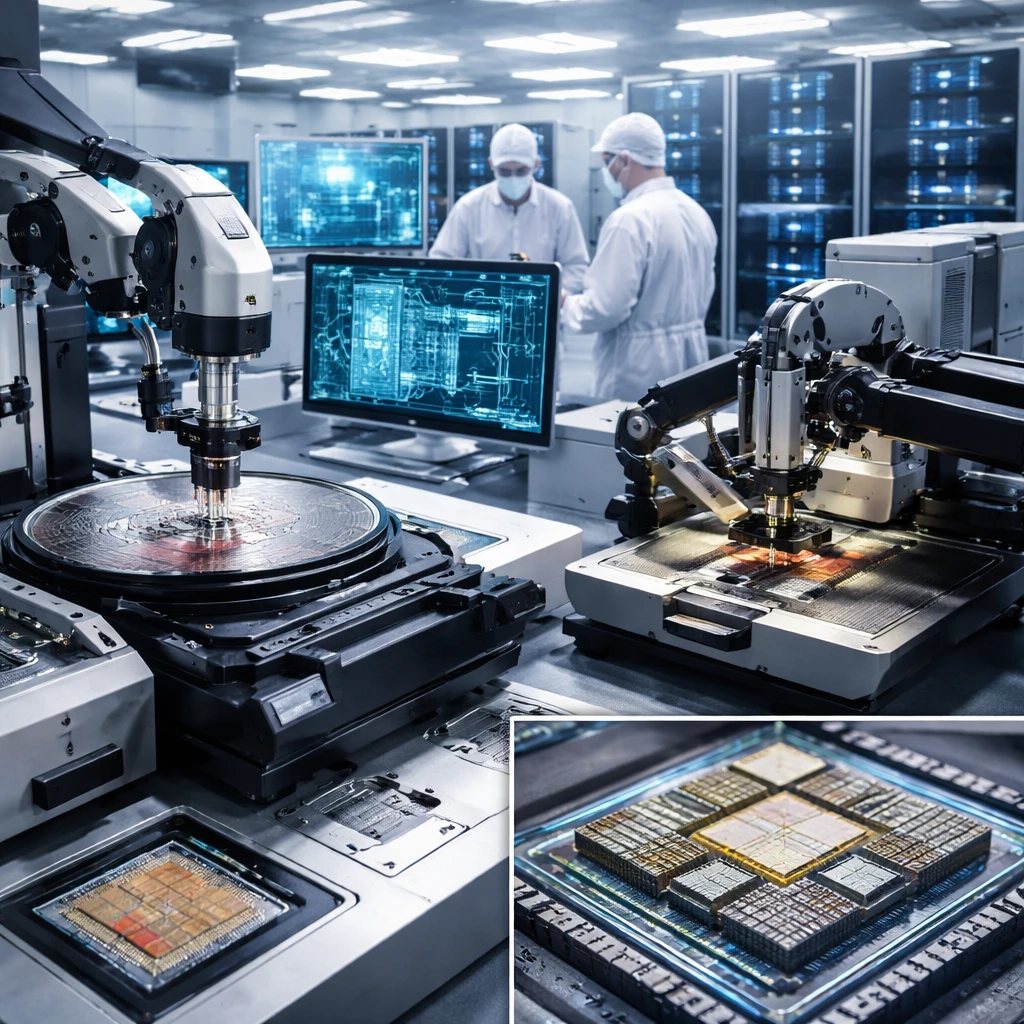
Teradyne stock climbed 5.2% in morning trading after the company announced a jointly developed integrated test cell solution with Tokyo Electron designed to screen AI accelerators and data center chips that use advanced 2.5D and 3D packaging architectures.
The production-ready system brings together Teradyne’s UltraFLEXplus automated test platform and Tokyo Electron’s Prexa SDP prober. Company statements emphasize the pairing as a direct response to a pressing manufacturing challenge: in package designs that rely on multiple chiplets, a single defective die can render a high-value package unusable, which makes comprehensive device screening an essential step in production.
The product news arrived amid a constructive analyst backdrop. Morgan Stanley’s Shane Brett recently raised his price target on TER to $387 from $376, and JPMorgan’s Samik Chatterjee maintains an Overweight rating with a $400 target. Adding to investor confidence, Teradyne declared a quarterly cash dividend of $0.13 per share payable June 12, 2026, a sign of management’s comfort with the company’s financial footing.
Those corporate developments build on Teradyne’s record first-quarter 2026 performance, when the company reported revenue of $1.282 billion, an 87% year-over-year increase. CEO Greg Smith said that "approximately 70% of our revenue tied to AI-related demand," framing the results as evidence of the firm’s wafer-to-AI-data-center strategy.
The broader market provided a favorable backdrop during the session. The NASDAQ was trading up 1.4%, the S&P 500 gained 0.9%, and the Dow Jones added 0.3%, with the technology and semiconductor equipment sector among the day’s outperformers as investor interest in AI infrastructure remained elevated. Collectively, Teradyne’s automated test equipment competitors, including Advantest and Cohu, operate within a semiconductor test equipment market that industry estimates put at $16 billion in 2026 and growing toward $21.6 billion by 2031, with expansion attributed to chiplet proliferation and AI infrastructure growth.
Taken together, the Tokyo Electron partnership highlights Teradyne’s strategic positioning at the intersection of increasing chip complexity and advanced packaging test - a segment where no single platform yet dominates. That positioning, coupled with recent analyst support and a risk-on market session, helped drive the stock to a session high of $379.
Summary
Teradyne and Tokyo Electron introduced a production-ready integrated test cell that combines Teradyne’s UltraFLEXplus with Tokyo Electron’s Prexa SDP to screen AI accelerators and data center chips using 2.5D and 3D packaging. The announcement coincided with analyst target upgrades, a declared cash dividend, and Teradyne’s record Q1 2026 revenue, contributing to a notable rise in the company’s share price.
Key points
- Product collaboration: The integrated test cell pairs UltraFLEXplus automated testing with the Prexa SDP prober to address screening needs for chiplet-based packages.
- Financial and analyst support: Recent analyst target increases, an Overweight rating at JPMorgan, and a declared dividend of $0.13 per share support investor sentiment.
- Strong quarterly performance: Teradyne reported record Q1 2026 revenue of $1.282 billion, up 87% year-over-year, with CEO Greg Smith stating roughly 70% of revenue is tied to AI-related demand.
Risks and uncertainties
- Manufacturing vulnerability in chiplet designs - A single defective die in a chiplet-based package can make a high-value unit unusable, placing heavy reliance on effective screening solutions and affecting semiconductor equipment makers and chip manufacturers.
- Competitive landscape - The advanced packaging test segment currently lacks a dominant platform, creating uncertainty for market share outcomes among automated test equipment companies like Teradyne, Advantest and Cohu.
- Market growth dependency - Projections that the semiconductor test equipment market will expand from $16 billion in 2026 toward $21.6 billion by 2031 are driven by chiplet proliferation and AI infrastructure expansion, making future market size contingent on those trends.
Sectors impacted
- Technology and semiconductor equipment
- Data center and AI infrastructure
- Electronic manufacturing