
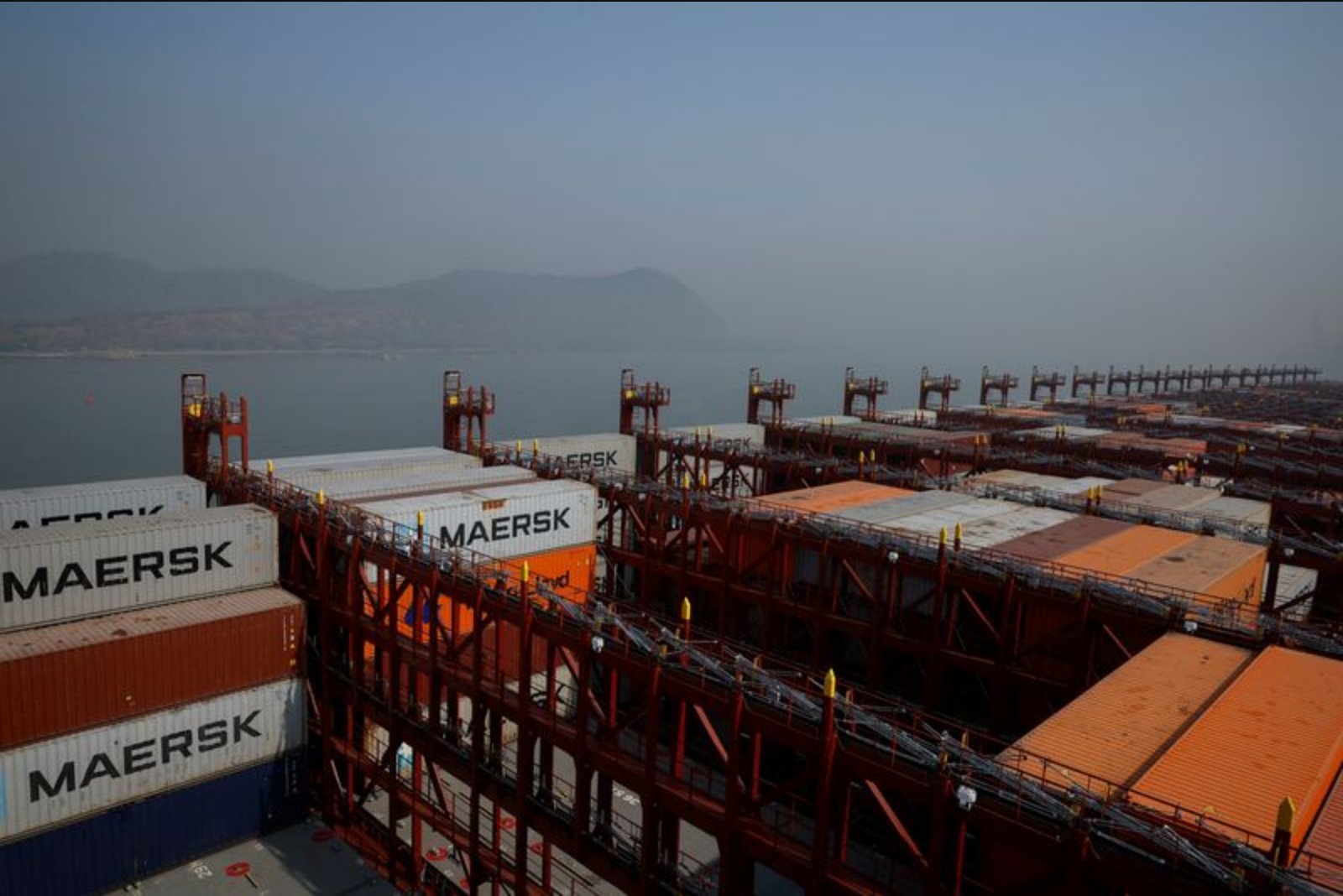
Maersk said its underlying operating result for the fourth quarter came in roughly where analysts expected, and the company warned that a combination of lower freight rates and persistent industry pressures would restrain earnings in 2026.
"We delivered a strong performance and high value for our customers in a year where supply chains and global trade continued to be reshaped by evolving geopolitics," CEO Vincent Clerc said in a statement. "As we enter 2026, we face another year of shifting market dynamics."
The Danish shipping group provided a headline range for underlying earnings before interest, tax, depreciation, and amortisation - EBITDA - for the year: between $4.5 billion and $7 billion. That compares with $9.53 billion of underlying EBITDA recorded in 2025.
Analysts polled by the company had a consensus expectation of $6.49 billion for underlying EBITDA this year.
For the fourth quarter specifically, Maersk reported underlying EBITDA of $1.84 billion, which was broadly in line with the $1.88 billion forecast provided by analysts.
The company framed the outlook as one in which freight rate declines and continuing industry challenges will weigh on results in the coming fiscal year. Management tied the guidance and commentary to the evolving configuration of supply chains and global trade flows, noting ongoing shifts in geopolitics as a backdrop for market dynamics.
Maersk's published figures and its guidance present a picture of a company moving from the levels of 2025 toward a materially lower expected EBITDA range for 2026, while the narrow miss or near-match in the fourth quarter underscores that recent results aligned with market forecasts.
Market participants and stakeholders will be able to compare the company's guidance range to the analyst poll figure to gauge where consensus sits relative to Maersk's internal outlook.
As Maersk prepares for the year ahead, the firm highlighted that shifting demand and structural changes across global trade corridors are factors it is monitoring closely. The company did not provide additional numerical detail beyond its stated guidance range and the quarter result.
Further clarity on how those market dynamics will evolve, and how they will translate to results within the provided EBITDA range, will depend on developments in freight rates and the broader set of industry challenges the company referenced.