
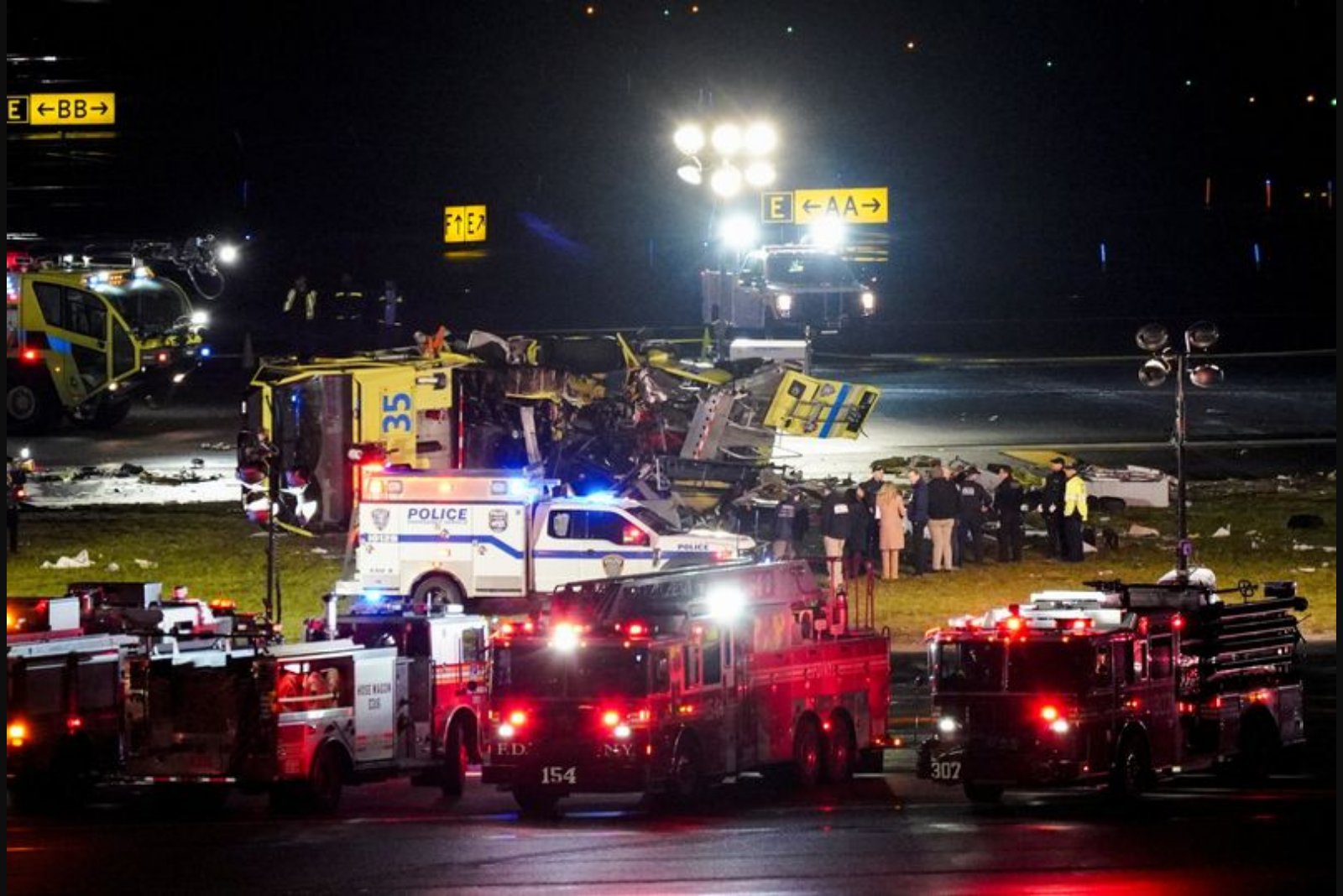
Investigations are underway into a deadly collision at LaGuardia Airport in which an Air Canada Express aircraft struck a fire truck while landing. The accident resulted in the deaths of the two pilots and left 39 of the 76 passengers and crew hospitalized. Authorities and safety investigators are examining communications, procedures and the equipment used by airport response vehicles to determine potential causes and who may be held liable.
Audio published by LiveATC.net captured air traffic controller communications related to the incident. The recording indicates that the controller who cleared Air Canada flight 8646 to land had simultaneously been trying to find a gate assignment for a United Airlines flight after that crew reported a bad odor that had made flight attendants ill. The same controller, according to the recording, appears to have cleared a fire truck to cross the runway as the Air Canada jet, operated by Jazz Aviation, was on approach.
Shortly after approving the fire truck's passage, the controller is heard saying, "Stop, truck one, stop." In another recording, an unidentified controller who appears to be involved in the collision is heard acknowledging personal responsibility, saying, "I messed up," and indicating that he had been handling an emergency earlier. The National Transportation Safety Board has opened a formal investigation. An NTSB official has stated that the fire truck did not have a transponder, unlike similar vehicles at other U.S. airports, and that omission made it harder for LaGuardia's warning systems to detect and track the vehicle's movements.
The accident has also reignited attention on air traffic control staffing and the intersection of operational choices and legal exposure for federal and local entities. Determining whether the government can be held liable for the crash depends on statutory regimes that govern suits against federal employees and agencies as well as the rules that apply to local airport operators.
At the federal level, two statutes shape potential claims. The Federal Employees Liability Reform and Tort Compensation Act of 1988, widely known as the Westfall Act, provides federal employees immunity from common law tort suits for actions taken within the scope of their employment. Negligence is among the common law torts covered by that framework. Meanwhile, the Federal Tort Claims Act provides a limited waiver of the federal government's sovereign immunity, allowing claims for "personal injury or death caused by the negligent or wrongful act or omission" of federal employees acting within the scope of their employment.
Through the FAA, victims or their families can pursue compensation for alleged negligence by air traffic controllers under the FTCA. But because the Westfall Act and the FTCA interact, courts and counsel must sort through issues of federal employee immunity, scope of employment determinations and the procedural prerequisites that govern FTCA claims.
LaGuardia is operated by the Port Authority of New York and New Jersey, and two of the Port Authority's officers were inside the fire truck involved in the incident. The Port Authority can be sued under state law in the relevant jurisdictions. That means potential claimants may pursue remedies against both federal and local entities, subject to different procedural rules and deadlines.
Pursuing a claim against the FAA requires an initial administrative step. Claimants have two years from the date of an incident to submit an administrative claim to the FAA that details the nature of injuries, the legal grounds for recovery and the monetary damages sought. Once a claim is filed, the FAA has six months to either accept or deny it. If the FAA denies the administrative claim, the claimant then has six months from the date of that denial to commence a lawsuit in federal court. If the FAA simply fails to respond within six months, a claimant may treat that inaction as a denial and proceed to file suit.
Claims against the Port Authority follow a more compressed timetable. Potential plaintiffs have 90 days after an incident to file administrative claims with the Port Authority. They must then wait at least another 60 days before initiating litigation, and any lawsuit must be filed within one year of the incident. These contrasting schedules mean claimants and their counsel must navigate parallel but distinct procedural paths to preserve legal rights against federal and local defendants.
Substantively, claimants can assert wrongful death actions seeking compensation for economic losses such as medical expenses, lost wages and diminished future earning power, as well as non-economic losses including emotional distress and loss of companionship. At this initial stage, lawyers who have worked on similar aviation litigation describe the factual circumstances of the LaGuardia incident as giving rise to what one practitioner called "exceptionally strong" claims. Another attorney observed that a plane receiving clearance to land creates a reasonable expectation for the flight crew and passengers that the runway will be clear and safe for landing.
Defenses that the FAA and other defendants might raise include arguments that controllers complied with applicable operations manuals or that staffing and employment decisions are discretionary acts shielded from liability. Under such a defense, an agency could argue that determining how many controllers to staff at a tower involves judgment and policy choices. As an illustrative explanation of that defense framework, one hypothetical offered in public commentary suggested the FAA might say it had discretion to operate a tower with fewer controllers if it believed it was reasonably safe to do so, even if others later conclude a higher staffing level would have reduced risk.
Controller staffing levels have been a recurring point of debate. U.S. Transportation Secretary Sean Duffy told reporters that LaGuardia had 33 air traffic controllers on duty compared with a target of 37. The FAA has faced a broader long-running shortage of air traffic controllers, and those workforce constraints are likely to figure in both public discussion and legal arguments about workload, supervisory oversight and potential causation.
Past cases offer some legal context, though they do not determine the outcome here. In one example, the FAA faced a $6.55 million suit filed in 2019 by the family of John Brown, a pilot who died in a 2016 crash near Reno-Tahoe International Airport after his small plane encountered wake turbulence from a Boeing 757. A trial judge initially placed fault on the pilot, but the 9th U.S. Circuit Court of Appeals later found in 2024 that an air traffic controller had not acted reasonably when he failed to instruct Brown to maintain "visual separation" from the jet and to obtain confirmation that Brown was maintaining such separation. The appellate court said it was not requiring strict recitation of language from the Air Traffic Controller Manual nor demanding "magic words," but concluded the burden on that controller to confirm separation was "minimal." The Brown family and the FAA reached a settlement last year; the government did not admit liability in agreeing to that resolution.
Separate litigation arising from a different accident also highlights how multiple entities can be drawn into lawsuits after air incidents. In lawsuits following a January 2025 collision over the Potomac River involving American Airlines flight 5342, operated by PSA Airlines as American Eagle, and an Army helicopter that resulted in the deaths of 67 people, at least 34 lawsuits have been filed. Plaintiffs in that matter allege the government should be responsible for controller negligence and for failures by the Army flight crew. In a court filing, the government characterized the Army pilots' "failure to maintain vigilance" to see and avoid the American Eagle plane as a "proximate cause" of that accident, while denying that controller negligence was also a proximate cause. The NTSB subsequently reported that "degraded controller performance and situation awareness" related to a high workload contributed to the collision.
Those prior disputes illustrate legal issues that are likely to surface after the LaGuardia crash: how courts evaluate controller conduct against operational manuals and training, the role of equipment such as transponders in incident prevention and detection, and how discretionary staffing decisions factor into claims of negligence. They also underscore that settlements are possible without admission of liability, depending on the trajectory of investigations and litigation.
At this stage, investigators continue to assemble the factual record. The NTSB's work into the absence of a transponder on the fire truck and the analysis of controller communications will be central to understanding the sequence of events on the runway. Any civil litigation will follow statutory timelines and will involve legal arguments rooted in the Westfall Act, the FTCA and applicable state and local law for claims against the Port Authority. For victims and their families, these procedural and substantive rules will determine the legal avenues available to seek compensation and accountability.