
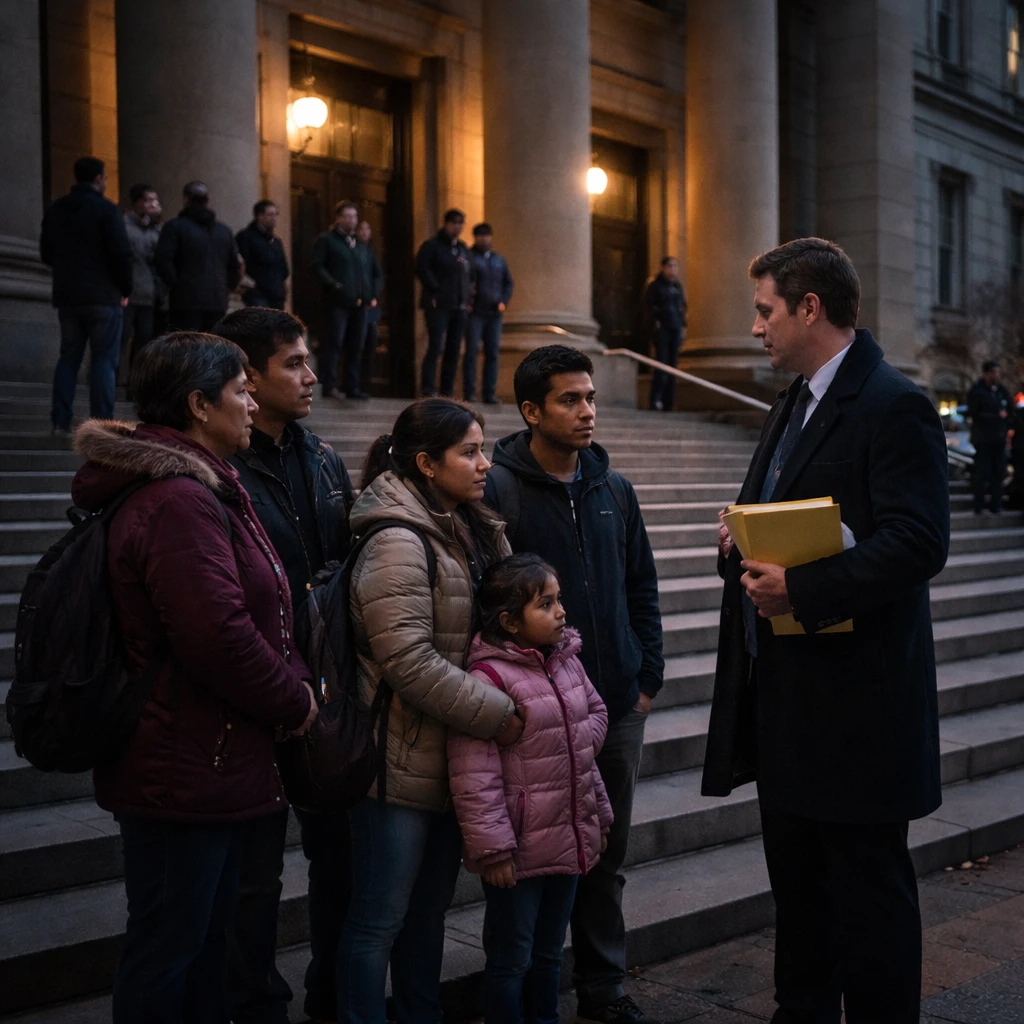
A federal judge in Boston has temporarily halted the Trump administration's effort to end the legal status of more than 8,400 relatives of U.S. citizens and green card holders who entered the United States from seven Latin American nations.
U.S. District Judge Indira Talwani issued a preliminary injunction late on Saturday that prevents the Department of Homeland Security from terminating humanitarian parole granted to thousands of people from Cuba, Haiti, Colombia, Ecuador, El Salvador, Guatemala and Honduras. Those individuals were admitted under family reunification parole programs that the Biden administration either created or updated.
The family reunification programs allowed U.S. citizens and lawful permanent residents to apply to sponsor family members in those seven countries, enabling those relatives to reside in the United States while they waited for immigrant visas to become available.
The Homeland Security Department announced on December 12 that it would end the programs, saying they conflicted with the administration's immigration enforcement priorities and were subject to abuse that let, in the department's words, "poorly vetted aliens to circumvent the traditional parole process." That termination had been scheduled to take effect on January 14, but Judge Talwani first issued a temporary restraining order blocking the end of the programs for 14 days while she reviewed the matter.
In her decision to extend relief, Talwani said the department, led by Homeland Security Secretary Kristi Noem, had not provided evidence to back its fraud concerns nor had it considered whether those affected could practically return to their home countries, where many had reportedly sold homes or left jobs. "The Secretary could not provide a reasoned explanation of the agency’s change in policy without acknowledging these interests," Talwani wrote. "Accordingly, failure to do so was arbitrary and capricious." Talwani was appointed by President Barack Obama.
The department did not respond to a request for comment.
The preliminary injunction was issued in the context of a class action lawsuit brought by immigrant rights groups challenging a wider rollback of temporary parole that had been granted to hundreds of thousands of migrants. In related litigation earlier in the case, Talwani had blocked the administration from ending parole grants for about 430,000 Cubans, Haitians, Nicaraguans and Venezuelans. That earlier order was later lifted by the Supreme Court, and an appeals court overturned the injunction.
The current ruling leaves in place the humanitarian parole status for the roughly 8,400 people from the seven specified countries while the court continues to examine whether the department's decision to terminate the programs complied with legal standards for administrative decision-making.
Context and legal posture
At issue is whether the department provided a reasoned explanation for changing course on programs that had permitted family members to come to the United States in advance of visa availability. The judge’s ruling emphasizes procedural shortcomings identified in the department’s decision-making, specifically the absence of substantiated fraud allegations and a lack of consideration of the practical consequences for individuals who had uprooted their lives.
The injunction preserves the status quo for those covered by the family reunification parole programs while litigation proceeds.