
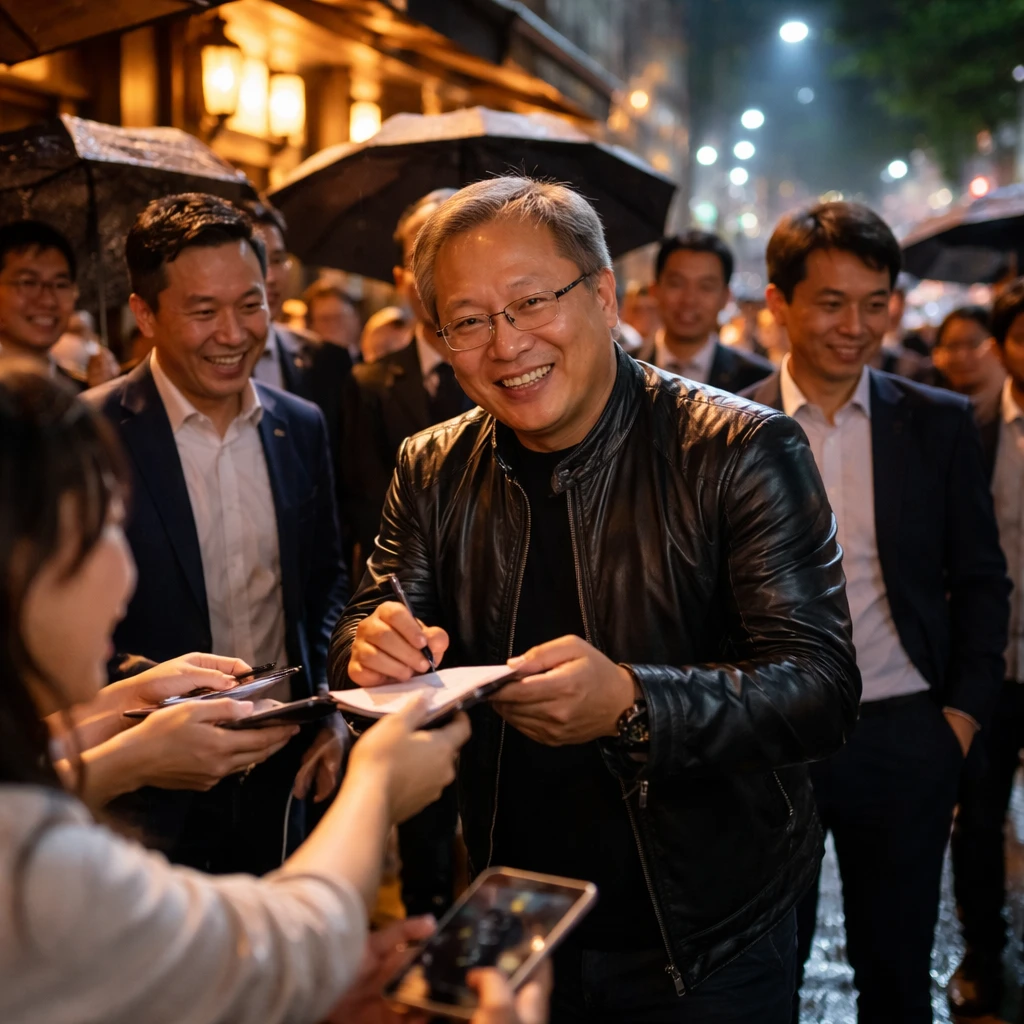
During a rain-soaked stop outside a Taipei restaurant late on Saturday, Nvidia Chief Executive Jensen Huang both applauded and gently pressed his key Taiwanese suppliers to step up production to satisfy rising demand tied to artificial intelligence applications.
Standing before reporters after hosting what he called a "trillion-dollar dinner" for supplier executives - a reference to the combined market value of the firms at the event - Huang described expectations for another strong year of business and singled out the importance of increased wafer and memory supplies.
"TSMC needs to work very hard this year because I need a lot of wafers," Huang said with a laugh, referring to Taiwan Semiconductor Manufacturing Co, the world’s largest maker of advanced chips used in AI workloads. He added praise for TSMC’s efforts: "TSMC is doing an incredible job and they’re working very, very hard. We have a lot of demand this year." After making remarks, he posed for photographs with a smiling TSMC Chief Executive C.C. Wei. Wei did not take questions from reporters.
Huang also forecasted a substantial capacity expansion at TSMC, saying: "Over the next 10 years, TSMC will likely increase their capacity by much more than 100%, and so this is a very substantial scale-up in the next decade." Those remarks sit alongside TSMC’s recent guidance that capital spending could rise by as much as 37% this year to $56 billion, and that investments would increase "significantly" in 2028 and 2029 in response to AI demand.
Memory supply was another area of concern raised by Huang. He warned of a production crunch for memory chips that underpin AI workloads, saying plainly: "We need a lot of memory this year," and noting that the entire supply chain faces challenges because demand has surged.
The dinner included around two dozen executives and featured prominent technology leaders, including Young Liu, chairman of contract electronics manufacturer Foxconn, which serves as Nvidia’s largest server maker. Huang periodically stepped away from the gathering to greet and sign autographs for many fans who gathered outside.
Huang, who emigrated to the United States as a child and co-founded Nvidia in California in 1993, has become a focal point for media attention when he returns to Taiwan. Local coverage has dubbed him "the people’s dad," and he has been met by crowds at multiple points during this trip.
Reflecting on his ties to Taiwan and the role the island’s companies play in Nvidia’s success, Huang said: "We have so many partners here in Taiwan. Nvidia won’t be possible without Taiwan. There’s magic in this island. The companies here have extraordinary technology, they’ve incredible culture. I’m really proud of Taiwan." He arrived from China on Thursday and is expected to depart on Monday.
Summary
During a high-profile visit to Taiwan, Nvidia CEO Jensen Huang praised Taiwanese technology partners, pressed for increased wafer and memory production to support strong AI demand, and highlighted anticipated capacity expansion at TSMC. The visit included a suppliers' dinner attended by senior executives and widespread public attention.
Key points
- Huang urged Taiwan’s major suppliers, notably TSMC, to increase wafer output to meet robust AI-related demand.
- Huang signaled concern about memory chip availability amid heightened demand across the AI supply chain.
- The visit underscored the centrality of Taiwan’s chipmakers and electronics manufacturers to Nvidia’s business and the broader AI hardware ecosystem.
Risks and uncertainties
- Supply constraints for memory chips may limit the ability of AI hardware makers to meet demand - this affects semiconductor and server hardware sectors.
- Failure to scale wafer production quickly enough could create bottlenecks for AI deployments, impacting semiconductor foundries and OEM server makers.
- Broad supply chain challenges implied by Huang could exert pressure across manufacturing and distribution in technology hardware markets.