
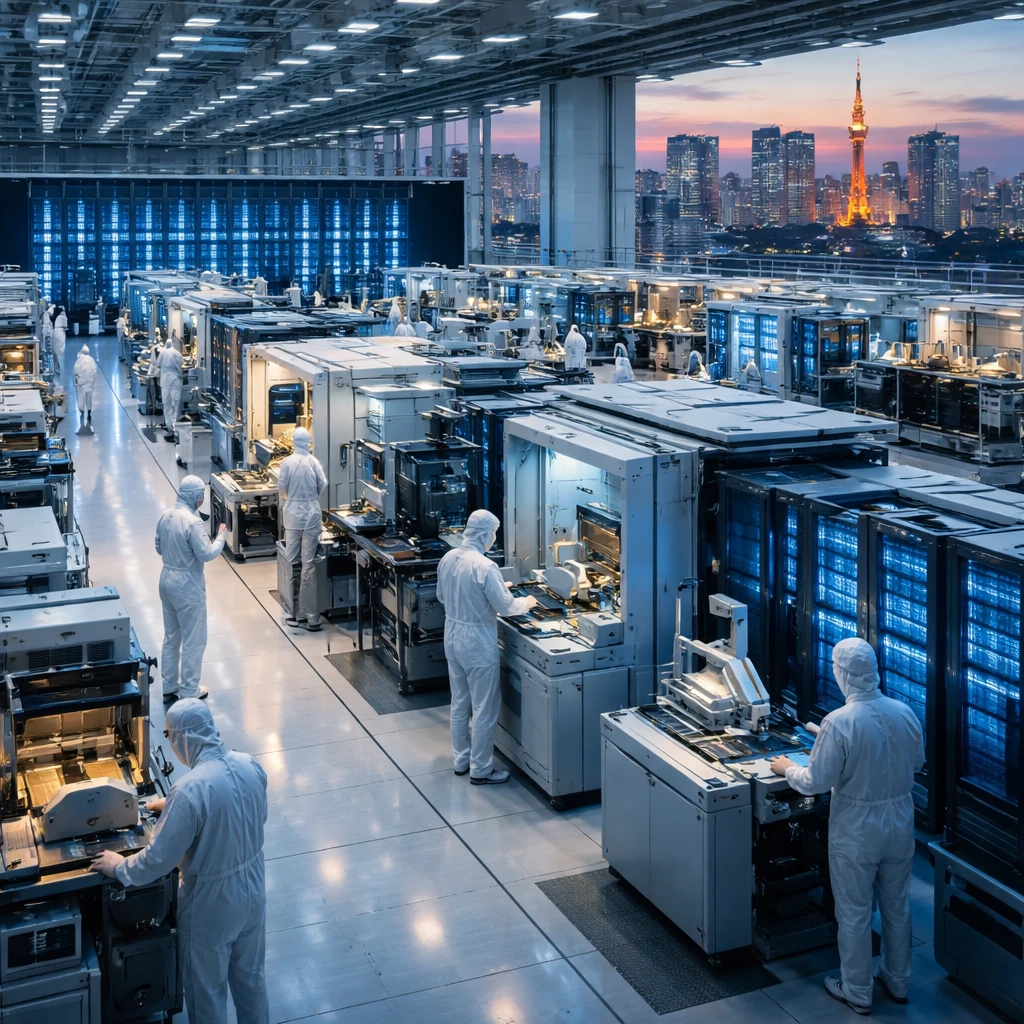
Japanese technology shares climbed on Monday after a report in the Nikkei said the government is weighing a plan to marshal about 10.5 trillion yen ($65.1 billion) of public and private investment into "physical AI" technologies through 2040. Traders and portfolio managers pushed up equities tied to semiconductors, fabrication and testing equipment, and AI-related investments amid expectations the initiative could underpin long-term hardware demand.
Market moves were concentrated among major chip and technology names. Chipmaker Renesas Electronics (TYO:6723) led the group with a roughly 6% gain, while semiconductor components maker Rohm (TYO:6963) climbed nearly 4%. Equipment providers also outperformed: chip-testing gear maker Advantest (TYO:6857) advanced about 2% and wafer fabrication equipment supplier Tokyo Electron (TYO:8035) rose approximately 3%.
Investor interest extended beyond pure-play chip suppliers. AI startup backer SoftBank Group (TYO:9984) added about 2%, and electronics giant Sony (TYO:6758) increased roughly 1.7% during the session.
The reported "physical AI" plan is said to be a component of Prime Minister Sanae Takaichi's broader growth strategy, which is expected to emphasize areas such as artificial intelligence, semiconductors and robotics. According to the report, the physical AI initiative would sit within a wider public-private investment roadmap aimed at shoring up key strategic industries.
That broader strategy carries an ambitious headline figure: an aim to mobilize as much as 370 trillion yen ($2.3 trillion) in investment across 17 sectors by 2040, with priorities cited including AI, chips and space development. The report frames the physical AI proposal as one targeted element within that wider, multi-sector investment objective.
Market participants interpreted the coverage as a signal that Tokyo may pursue direct support for hardware and manufacturing capacity tied to next-generation AI systems. Equity gains on Monday reflected investors betting the plan could translate into stronger demand for advanced manufacturing equipment and infrastructure over the long run.
Context and market reaction
While details remain limited to what the Nikkei reported, the immediate effect was a clear rotation into companies most directly exposed to chip production and AI hardware. The move underscores investor sensitivity to policy signals that could affect capital spending cycles and industrial demand in Japan's technology and manufacturing sectors.
What remains uncertain
The proposal is described as under consideration, and the scale and timing of any official commitments were not detailed in the report. As such, market participants are responding to the potential for policy-driven investment rather than confirmed allocations.
For now, the rally highlights how expectations of coordinated public-private spending on technology infrastructure can influence share prices across semiconductor and industrial supply chains.