
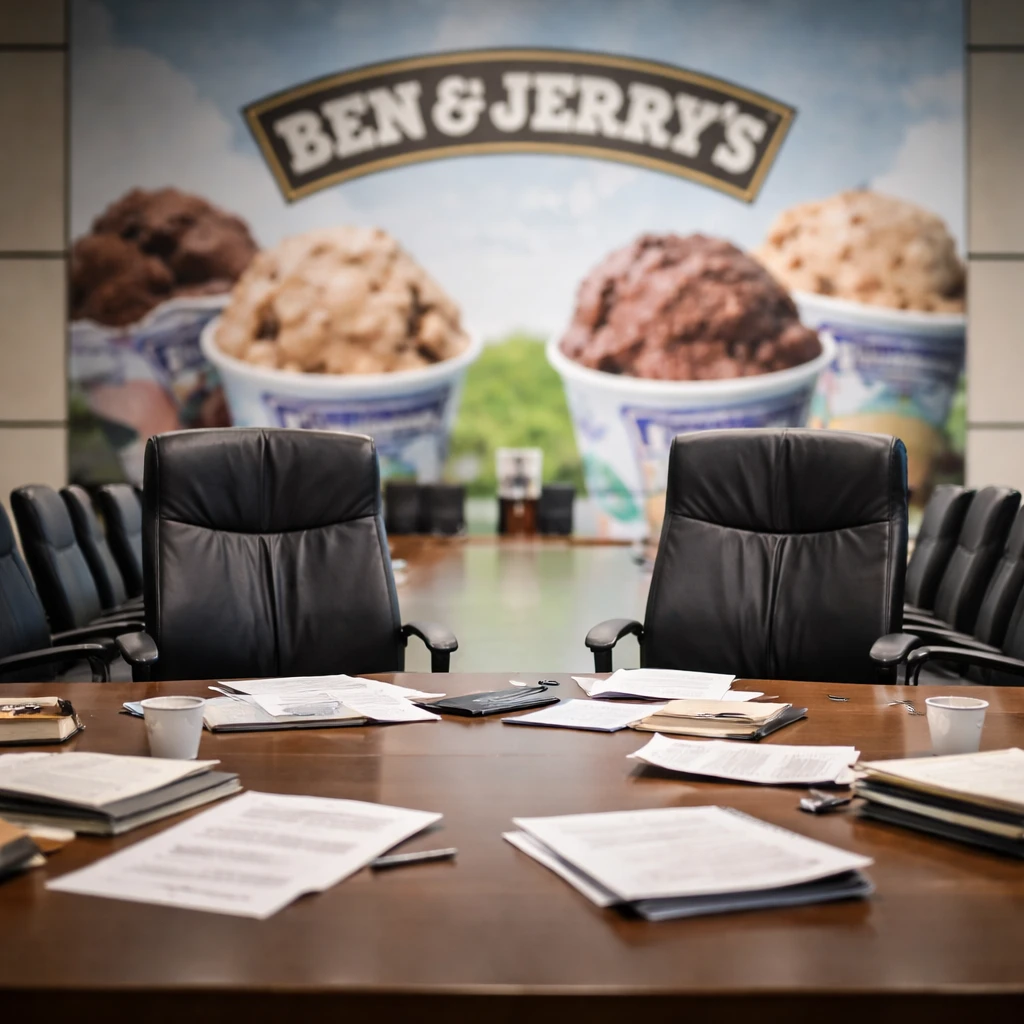
Ben & Jerry’s, the socially conscious ice cream brand, is experiencing heightened internal strife as its battle to uphold its progressive mission in the face of pressures from its parent companies reaches a new peak. The Magnum Ice Cream Company, which now oversees Ben & Jerry’s following a recent spinoff from Unilever, has publicly accused Anuradha Mittal, former chair of Ben & Jerry’s independent board, of serious misconduct that has contributed to a significant reduction in the board’s membership.
After Unilever, which acquired Ben & Jerry’s in 2000, separated its ice cream division into Magnum in December, it retained a 19.9% stake in the new entity. Since 2024, Ben & Jerry’s and its autonomous board, based in Vermont, have been engaged in litigation with Unilever and subsequently Magnum in the U.S. District Court for the Southern District of New York. The core issue in the case is what Ben & Jerry’s describes as efforts by the parent company to undermine the brand’s social mission and restrict the autonomy of its independent board.
In a court filing dated January 20, Magnum detailed that the board of Ben & Jerry’s, which once had eight members, now comprises only two directors: the company’s CEO and a Unilever-appointed member. The filing also disclosed that the board chair, Anuradha Mittal, was removed in mid-December after Magnum declared her unfit to serve. Subsequently, two long-serving independent directors also departed following the instatement of nine-year term limits on board membership by Magnum.
Magnum’s filing further revealed that an investigation into the Ben & Jerry’s Foundation—a separate nonprofit funded by the brand—conducted by Ernst & Young uncovered concerns over conflicts of interest. Allegedly, the foundation had granted funds to organizations where trustees, including Mittal, held senior roles and received compensation or benefits. According to Magnum, this situation contributed to the decision that Mittal’s conduct made her ineligible to continue as a board member.
In addition, Magnum stated that the remaining three independent directors declined to undergo compliance training as required, resulting in their departure from the board effective January 1.
Mittal has denied these allegations, accusing Magnum and Unilever of attempting to discredit her and erode the board’s authority. She condemned the actions as a "midnight purge" and criticized Magnum for withholding the full audit report and details of the investigation into the foundation, which she characterized as "collateral damage" caught in the conflict.
Magnum, describing the prolonged legal dispute as unfortunate, expressed ongoing commitment to supporting the Ben & Jerry’s team. The company conveyed anticipation for reestablishing a refreshed board dominated by independent directors and led by an independent member, signaling an aspiration to restore some governance stability.
The deterioration of relations between Ben & Jerry’s and Unilever, which ultimately led to the creation of Magnum, began in 2021 when Ben & Jerry’s announced its decision to cease sales in the Israeli-occupied West Bank—a political position that sparked controversy within the relationship between the brand and its parent company.