
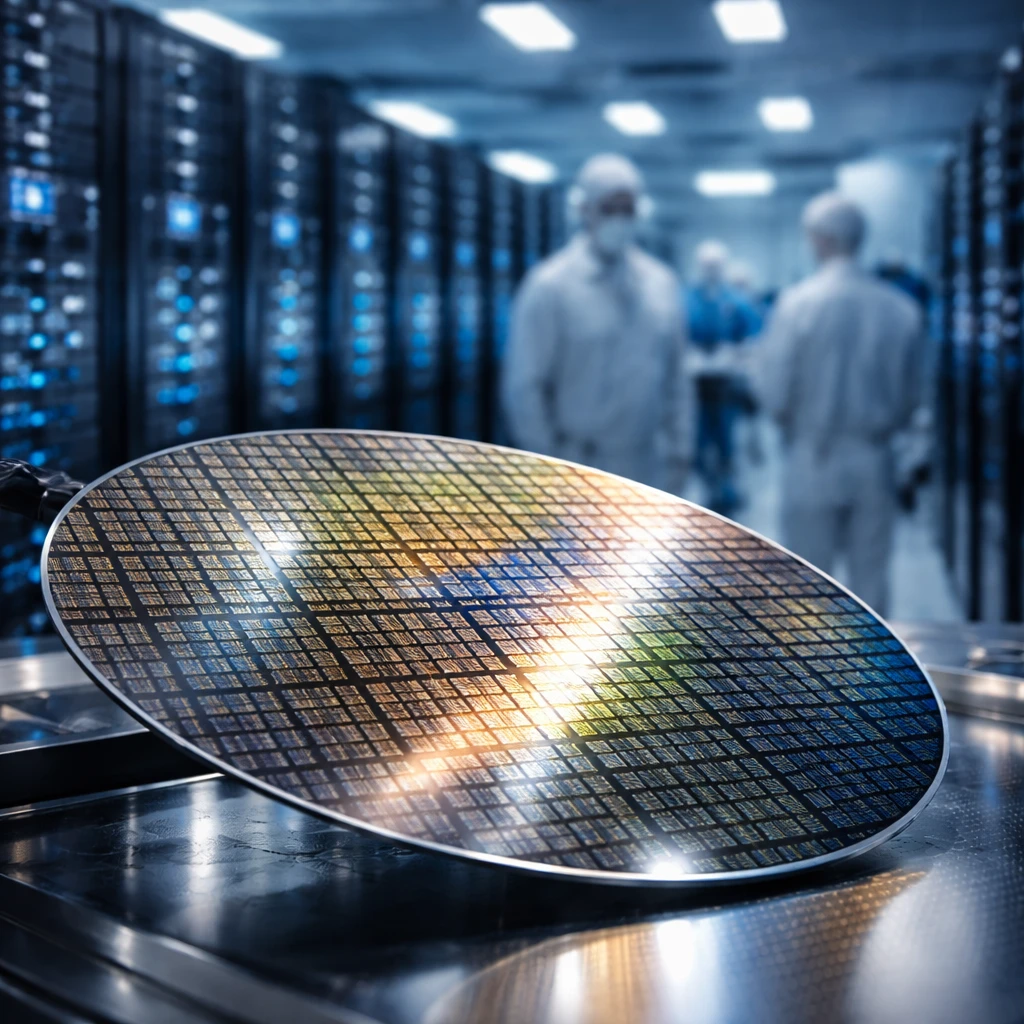
Intel delivered a decisive Q2 2026 financial report that materially exceeded consensus expectations and prompted a positive market reaction after hours. Revenue totaled $16.13 billion, outpacing the $14.33 billion consensus by roughly 12.5%, while non-GAAP earnings per share were $0.42 versus an estimated $0.21 - a 100% surprise to the upside. Shares rose after the print, capping a rebound from a pre-release decline of about 28%.
What the quarter answered
Investors had several open questions heading into the release; management’s commentary and the reported metrics addressed many of them.
- AI transition confirmed: Management said AI-linked businesses now account for approximately 70% of total revenue and reported more than 70% year-over-year growth for that mix. The Data Center & AI (DCAI) segment produced $6.3 billion, up 59% year-over-year and 24% sequentially. The company described Xeon 6 as "one of the fastest ramping products in Intel’s history," which supports the view that AI workloads are driving meaningful demand.
- Advanced node scaling: Intel confirmed 18A is in volume production and cited more than 400 designs for Series 3 products across consumer and commercial customers. Management said yields are tracking ahead of expectations, an important credibility marker after prior process delays.
- Balance sheet and investment capacity: Liquidity was highlighted as a strength: $30 billion in cash plus a $10 billion revolver provides $40 billion of total liquidity. The company generated $7.0 billion in operating cash flow during Q2 and raised its 2026 capital expenditure outlook to greater than $20 billion, an increase of $3 billion from prior guidance. Management framed this as customer-driven investment rather than a desperation move.
- Gross margin trajectory: Non-GAAP gross margin came in at 41.8%, beating guidance by 280 basis points. Management attributed the improvement to higher average selling prices, better yields, and a favorable product mix, and said moving above 42% in Q3 is now a credible target.
The unresolved challenge
Despite several bright spots, the foundry business continues to weigh on overall profitability. Intel Foundry generated $5.8 billion in revenue, a 6% sequential increase, but still reported a -$2.1 billion operating loss. That loss did narrow by $348 million quarter-over-quarter, indicating progress, but substantial deficits remain. Reports that SK Hynix is a potential buyer for the Ohio campus suggest management may be rethinking the scale of its foundry commitments, a strategic signpost worth watching.
Catalysts and timing to watch
- Intel 14A risk production - H2 2027: a next-generation process node that will influence competitive positioning versus other major foundries.
- 14A high-volume ramp - 2028: timing for any revenue inflection tied to external foundry customers adopting the next node at scale.
- Q3 2026 earnings - ~Oct 22, 2026: consensus estimates ahead of the report called for EPS of $0.27 and revenue of $15.07 billion; management guided Q3 to $15.8 billion-$16.8 billion, which implies a high bar and represents a sequential decline versus Q2’s $16.13 billion midpoint for some scenarios.
- Near-term supply constraint resolution: easing constraints on logic wafers, memory and substrates could lift volumes should those bottlenecks abate.
- Ohio campus asset discussion - TBD: potential monetization through a sale could free capital and lessen capex requirements.
- Ten long-term supply agreements and ongoing collaborations such as the one with Fortinet on SP6: these could convert into recognized revenue as product ramps continue.
Analyst and market recalibration
Some sell-side analysts are adjusting their models to reflect the stronger results. DA Davidson raised its price target to $100 from $77 while maintaining a Neutral rating, signifying recognition of fundamental improvement but lingering valuation questions. At the same time, consensus EPS estimates have risen by 19.6% over the past year, and the FY2027 EPS forecast of $1.64 indicates the market still anticipates a protracted recovery rather than an immediate re-acceleration.
Bull and bear perspectives
- Bulls: Point to seven consecutive quarters of beating guidance, an AI revenue base that is now meaningful and scaling, 18A de-risked through early production and improving yields, and a $20 billion-plus capex plan supported by customer demand.
- Bears: Emphasize that foundry operating losses of -$2.1 billion remain structurally significant, that the potential sale of the Ohio campus could be viewed as a pullback from earlier capacity ambitions, and that Q3 guidance - while above consensus - could represent a sequential revenue decline relative to the Q2 peak.
Overall, the narrative of recovery has tangible momentum, but the central unresolved question is whether operational leverage in 2027-2028 will be sufficient to justify a sustained period of heavy annual investment at the $20 billion scale.