
Stock Markets March 25, 2026

India Orders Faster Gas Rights-of-Way as LPG Dependence Persists

Regulatory steps aim to speed pipeline rollouts even as piped gas use remains concentrated in cities

By Derek Hwang
India Orders Faster Gas Rights-of-Way as LPG Dependence Persists

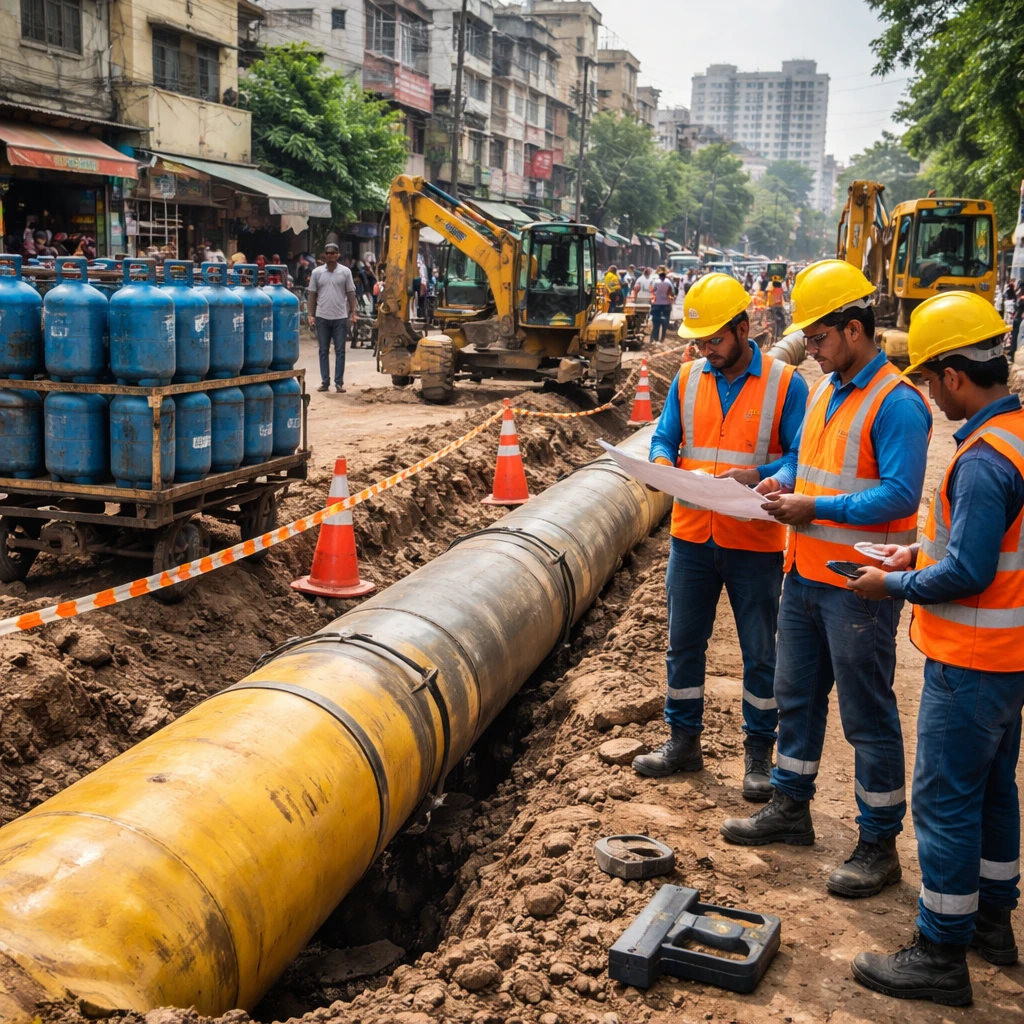
Indian regulators have issued directives to streamline right-of-way approvals and push city gas distributors to expand connections, acknowledging that liquefied petroleum gas (LPG) continues to be the dominant household fuel while piped natural gas (PNG) penetration remains low. Targets for dramatic expansion of domestic PNG connections have been set, but supply disruptions and slow volume recovery are expected to weigh on mid-stream and downstream gas company earnings in the near term.

Key Points

  • Government order establishes fixed timelines, deemed approvals, and caps on right-of-way charges to speed natural gas infrastructure expansion.
  • PNG penetration is around approximately 5% and concentrated in large cities despite LPG connectivity exceeding more than 330 million households; fewer than two-thirds of PNG-connected households consume it.
  • PNGRB target of approximately 126 million domestic PNG connections by 2034 represents a roughly 7.5-fold increase; industrial and commercial connections total about 22,000 and 49,000 and contribute over one-third of city gas distribution sales.

The Indian government on Wednesday implemented a regulatory framework intended to address long-standing right-of-way obstacles for natural gas infrastructure development, according to Macquarie.

The measures impose fixed timelines for approvals, introduce deemed approval provisions where timelines are not met, and cap charges associated with right-of-way to accelerate pipeline expansion.

Separately, the Petroleum and Natural Gas Regulatory Board (PNGRB) issued guidance urging city gas distribution companies to prioritize maximizing new consumer hookups in areas where existing pipeline infrastructure is already in place.

Despite widespread availability of LPG - connectivity now exceeds more than 330 million households - penetration of piped natural gas remains limited. PNG is used by around approximately 5% of households overall and is mostly confined to larger urban centers. Moreover, fewer than two-thirds of households that are connected to PNG actually consume it.

PNGRB has set an explicit target of reaching approximately 126 million domestic PNG connections by 2034, which would equate to about a 7.5-fold increase from current levels. At the same time, industrial and commercial PNG connectivity stands at roughly 22,000 and 49,000 connections respectively; these segments nevertheless account for more than one-third of total gas sales for city gas distribution firms.

Historically, city gas distribution firms have directed capital expenditure toward compressed natural gas (CNG) station rollouts because those investments typically deliver faster payback periods than extending pipeline networks. The regulatory push and Minimum Work Program obligations from PNGRB are expected to prompt a reorientation toward pipeline development. Failure to meet prescribed work program schedules could expose companies to penalties and, in extreme cases, cancellation of authorization.

Macquarie highlighted that ongoing supply disruptions have underscored India’s reliance on LPG. The firm also noted that the recent regulatory changes create a framework that could speed up PNG connectivity nationwide. However, Macquarie expects that near-term earnings for mid-stream and downstream gas companies will be affected by current supply disruptions, and that recovery in volumes may take longer than was previously anticipated.

Risks

  • Ongoing supply disruptions are pressuring reliance on LPG and are expected to suppress near-term earnings for mid-stream and downstream gas companies - impacts concentrated in the gas distribution and midstream sectors.
  • Failure by city gas distribution companies to meet Minimum Work Program schedules could trigger penalties or authorization cancellations - a regulatory risk affecting capital allocation and project pipelines.
  • Low actual consumption among PNG-connected households and historically greater CAPEX allocation to CNG stations may slow the pace of pipeline volume growth, affecting revenue recovery timelines for downstream operators.

More from Stock Markets

Broadcom to Build Google’s Next-Gen AI Chips Under Long-Term Pact; Anthropic Gains Access to Multi-Gigawatt Capacity Apr 6, 2026 OpenAI Asks California and Delaware Attorneys General to Probe Alleged Anti-Competitive Conduct by Elon Musk and Associates Apr 6, 2026 Broadcom Secures Multi-Year TPU and Networking Supply Deals with Google; Shares Rise After-Hours Apr 6, 2026 Mexican Equities Slip as Major Sectors Drag Index Down 1.03% Apr 6, 2026 Colombian equities finish higher as COLCAP reaches one-month peak Apr 6, 2026