
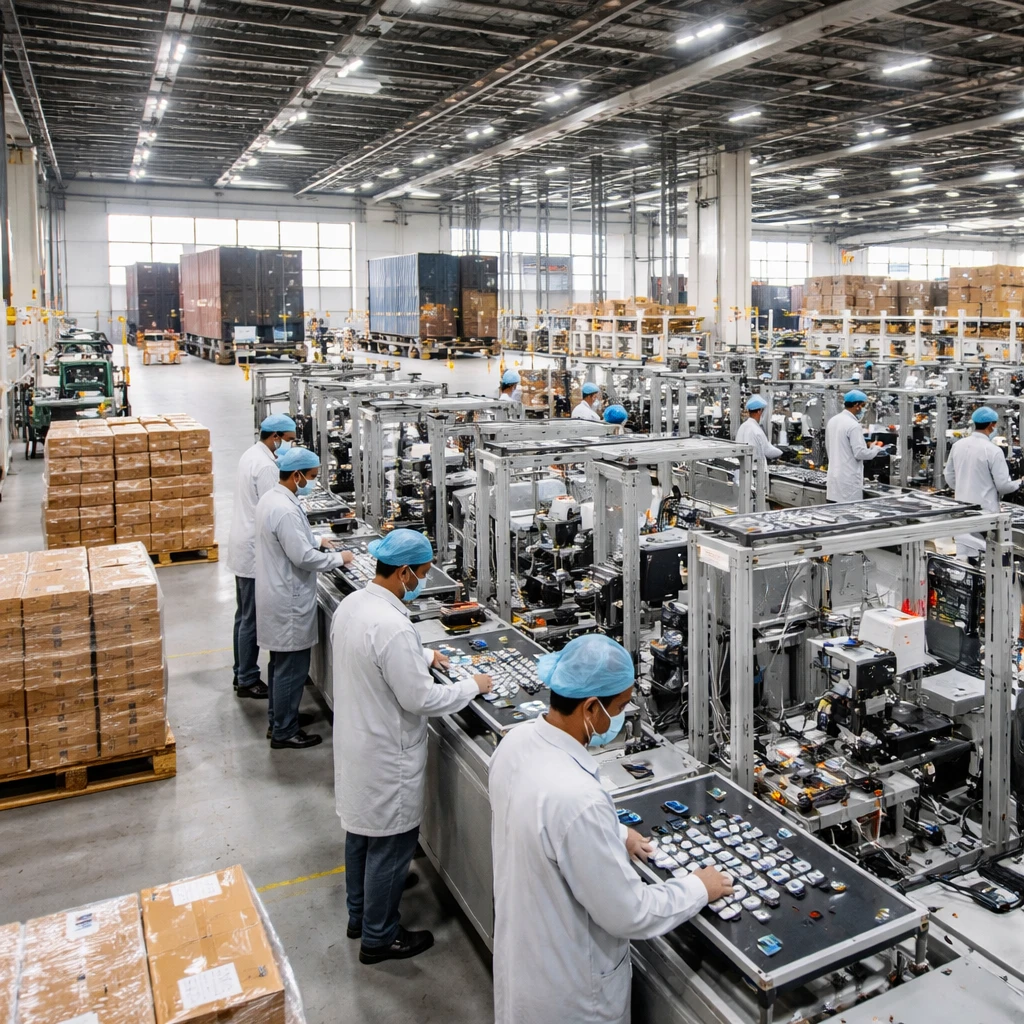
India has taken a significant step to reduce a tax-related obstacle for multinational electronics makers by clarifying that foreign ownership of production machinery provided to contract manufacturers will not automatically create taxable income in India - provided the equipment is located in customs-bonded areas and the rule applies through the 2030-31 tax year.
The change was announced as part of the Finance Minister's 2026-27 annual budget presentation. The government said it is amending laws "to promote manufacturing of electronic goods for a contract manufacturer" so that "mere ownership of machines by a foreign company does not lead to income or taxes on it." An accompanying budget document states: "Any income arising on account of providing capital goods, equipment or tooling to a contract manufacturer, being a company resident in India, is eligible for exemption."
Smartphone production is a central objective of Prime Minister Narendra Modi's industrial strategy. Multinational firms - most prominently Apple - had been pressing New Delhi for legal certainty that owning high-end assembly equipment in India would not create a so-called "business connection" that could expose foreign companies to income taxes on sales. Under the previous interpretation of Indian law, Apple feared that paying for machines used by its Indian contract manufacturers could be treated as creating such a taxable link, a concern that had steered its contract assemblers into buying expensive machinery themselves.
As a consequence of that uncertainty, contract manufacturers including Foxconn and Tata had invested billions of dollars to acquire the machines needed to produce iPhones in India. The new budget provision is intended to remove that obstacle by ensuring foreign ownership of capital goods in qualifying bonded facilities will not trigger income tax consequences in India for a limited period.
The exemption is limited in scope. It applies only to factories established in customs-bonded areas - zones that are technically treated as outside India's customs border. The government noted that if devices produced in those facilities are sold within India, import duties would still apply, meaning these bonded-area operations are structured to be export-oriented rather than primarily serving the domestic market.
Industry and legal advisers welcomed the clarification. Shankey Agrawal, a partner at Mumbai-based BMR Legal, said the measure "removes a key deal-breaking risk for electronics manufacturing in India" and added that it would support "faster scale-up and greater confidence for global electronics players to manufacture in India." Apple did not immediately respond to a request for comment.
The move arrives as Apple ramps up assembly in India as part of a broader diversification away from China. Data cited in the budget materials indicate that iPhone market share in India has doubled to 8% since 2022. Globally, China still accounts for 75% of iPhone shipments, but India's portion has also grown markedly - quadrupling to 25% of global iPhone shipments since 2022.
Those figures and the budget language together underline the government's aim to make India a more attractive manufacturing base for high-value electronics, while balancing trade and tax rules through the use of customs-bonded zones and a time-bound exemption. The policy is explicitly limited by location and duration, and it preserves import taxes on devices moved into the domestic market from bonded facilities.
Implications for supply chains
By clarifying tax treatment for foreign-owned capital equipment in bonded zones, the budget change could lower one structural hurdle to faster factory scale-up and encourage global electronics companies to consider expanding or shifting production capacity into India - at least for export-oriented operations. The provision leaves in place customs and import tax mechanics that channel bonded-area production toward exports rather than domestic sales.