
Stock Markets June 26, 2026 04:42 PM

Fitch Moves Boeing Outlook to Positive Citing Durable Production Ramp

Rating agency points to stabilized 737 MAX output, improving cash flow and debt reduction as drivers for potential upgrade

By Priya Menon
Share
Twitter Reddit Facebook LinkedIn
BA

Fitch Ratings upgraded Boeing's outlook to Positive from Stable while maintaining the company's long-term issuer default rating at 'BBB-'. The revision reflects confidence in the durability of the 737 MAX production recovery, steadying 787 output, a return to full-year profitability, and an expected shift to positive free cash flow in 2026. Fitch highlights faster deleveraging driven by debt reduction and improving EBITDA as key factors supporting the outlook change.

Fitch Moves Boeing Outlook to Positive Citing Durable Production Ramp
BA
Summarize with
ChatGPT Perplexity Claude Grok Gemini

Key Points

  • Fitch raised Boeing's outlook to Positive from Stable and affirmed the long-term issuer default rating at 'BBB-'; short-term IDR and commercial paper remain at 'F3' and senior unsecured notes and revolvers at 'BBB-'.
  • MAX production has stabilized at 42 per month with FAA clearance to move toward 47 per month; the 787 line is on a path to 10 per month. Fitch's rating case assumes MAX reaches 52 per month in 2027 and certifications for key variants and the 777X in 2026-2027; sectors impacted include aerospace manufacturing and capital markets.
  • Boeing reduced gross debt by $8.3 billion in H1 2026 to about $45.9 billion and plans to use internally generated cash to repay $4.3 billion due in 2027; Fitch expects positive free cash flow in 2026 and a decline in EBITDA leverage from about 4.8x in 2026 to roughly 2.5x in 2028.

Overview

Fitch Ratings has revised its outlook on Boeing Company to Positive from Stable and reaffirmed the firm's long-term issuer default rating at 'BBB-' on Friday. At the same time, the agency kept Boeing's short-term issuer default rating and commercial paper rating at 'F3' and maintained its senior unsecured notes and revolvers at 'BBB-'.


Production and certification progress

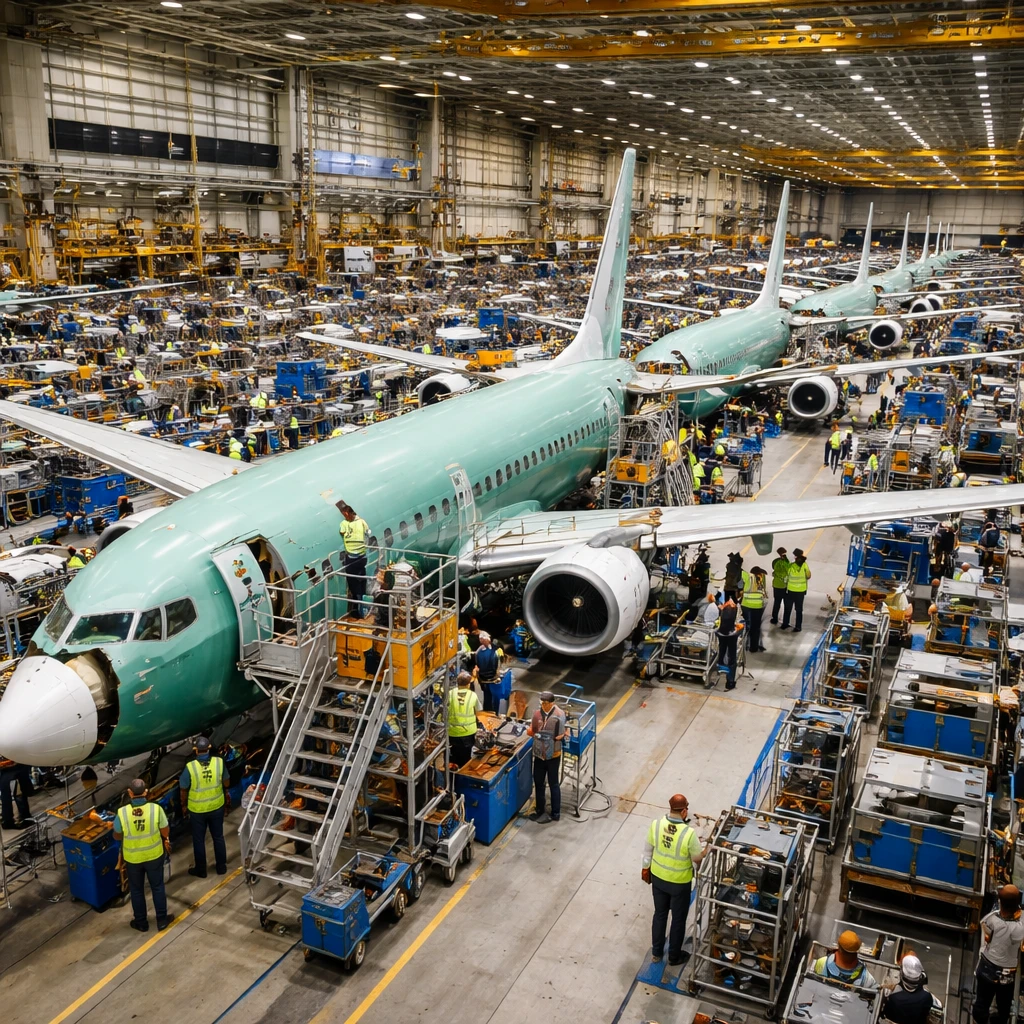
Fitch pointed to what it views as a durable recovery in Boeing's 737 MAX production as a principal reason for the outlook change, saying the improvement materially de-risks the company's path toward credit metrics consistent with a higher rating. The agency noted that MAX output has stabilized at 42 aircraft per month and that the Federal Aviation Administration has cleared Boeing to advance toward 47 per month. Separately, the 787 production line has steadied on a path toward 10 per month.

Fitch's rating case further assumes the MAX production rate reaches 52 per month during 2027 and that certification occurs for the -7 and -10 variants in the second half of 2026, with the 777X certified in 2027.


Profitability, cash flow and debt trends

The agency emphasized the combination of stabilizing output, Boeing's return to full-year profitability in 2025, and an anticipated inflection to positive free cash flow in 2026 as underpinning a credible deleveraging trajectory. Fitch expects Boeing to generate consistently positive free cash flow from 2026 onward, calling this a credible inflection after several years of significant cash burn.

Boeing has guided to positive free cash flow of $1 billion to $3 billion in 2026, reversing the negative $14.3 billion recorded in 2024. Fitch expects cash generation to build steadily thereafter as delivery rates rise and working capital normalizes.

On the balance sheet, Boeing reduced gross debt by $8.3 billion in the first half of 2026 to approximately $45.9 billion, using cash on hand to retire maturities rather than refinancing. Fitch assumes Boeing will repay $4.3 billion of debt due in 2027 with internally generated cash.


Leverage and earnings outlook

Fitch projects recovering EBITDA combined with continued debt repayment will lower EBITDA leverage from about 4.8x in 2026 to below 3.5x in 2027 and roughly 2.5x in 2028. The agency highlighted Boeing's backlog of roughly $695 billion, including more than 6,100 commercial aircraft, as a factor that converts the production ramp into a visible multi-year earnings and cash flow trajectory.


Implications

Fitch framed its outlook revision as evidence that progress on production rates and cash generation materially strengthens Boeing's credit profile, conditional on the company meeting the operational and certification assumptions cited by the agency.

Risks

  • Certification and timing uncertainty - Fitch's expectations depend on certification of MAX -7 and -10 variants in H2 2026 and the 777X in 2027, making the rating case sensitive to certification schedules; this affects aerospace suppliers and delivery timelines.
  • Execution of production ramp and delivery rate increases - The outlook relies on MAX output moving from the current 42 per month toward 47 and ultimately 52 per month in 2027, which impacts manufacturing and supply-chain operations across the aerospace sector.
  • Reliance on internally generated cash for debt repayment - Fitch assumes Boeing will repay $4.3 billion of debt due in 2027 with internal cash, making deleveraging dependent on forecasted free cash flow and normalization of working capital, which has implications for credit markets and corporate creditors.

More from Stock Markets

Zuckerberg Directs Team to Evaluate Ties With Polymarket and Kalshi as Meta Tests Prediction-App Jun 26, 2026 Mexican equities slip as key consumer and industrial names weigh on benchmark Jun 26, 2026 Lantheus Shares Slip After FDA Declines to Approve LNTH-2501 Over Manufacturing Issues Jun 26, 2026 MOEX rises as oil and mining names lead Moscow gains Jun 26, 2026 SpaceX Raises $25 Billion in Five-Part Debt Sale, Commits to Registration Exchange Jun 26, 2026