
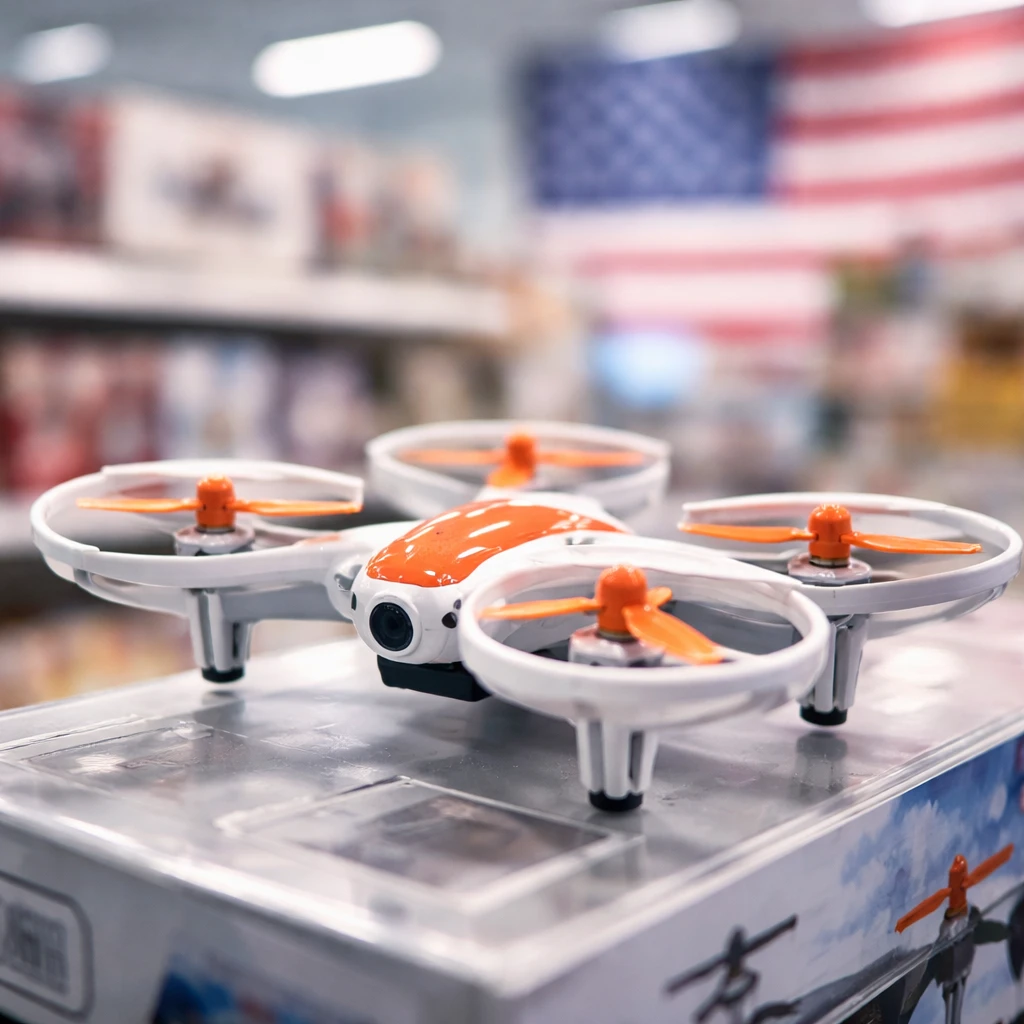
The U.S. Federal Communications Commission announced on Tuesday that it will permit the entry of some new models of Chinese-made toy drones into the American market.
In December, the FCC implemented a broad restriction that blocked imports of all new models of foreign-made drones and certain critical components. The initial ban explicitly included products from established Chinese manufacturers such as DJI and Autel, with the agency citing what it described as unacceptable national security risks.
Since that action, the FCC has revisited its posture and authorized the importation of a subset of new drone models. The agency's more recent decision was guided by an evaluation from the U.S. Department of Defense. The Pentagon's assessment concluded that the national security risks identified previously do not apply to devices it classifies as "unsophisticated, low-risk toys."
According to the Pentagon's findings, these toy-class devices do not possess the advanced attributes present in conventional drones. The assessment specified that the toys lack the "organic capabilities and features in range, endurance, sensing, payload, connectivity, and data collection and storage" that are found in traditional drones. That distinction underpins the FCC's narrower authorization for imports.
The FCC's adjustment narrows the scope of the December import restrictions by drawing a line between higher-capability unmanned aircraft and simpler consumer toys. The agency's reliance on the Pentagon's classification indicates that national security evaluations will continue to play a central role in determining which foreign-made drone models are allowed into the U.S. market.
Details on which specific models have been authorized were not provided in the FCC announcement. The agency's action reflects an evolving regulatory approach that separates certain low-capability consumer devices from the broader set of foreign-made drones and components previously blocked.
Summary
The FCC will allow some new Chinese-made toy drone models into the United States after the Pentagon determined that "unsophisticated, low-risk toys" do not present the national security risks cited in an earlier December import ban. The Pentagon noted these toys lack advanced capabilities in range, endurance, sensing, payload, connectivity, and data collection and storage.
Key points
- The FCC initially blocked imports of all new models of foreign-made drones and critical components in December, including products from DJI and Autel, citing unacceptable national security risks.
- The FCC has since authorized imports of some new drone models after a Pentagon assessment concluded that certain devices qualify as "unsophisticated, low-risk toys."
- Sectors most directly affected include consumer electronics and toy retail, along with regulatory bodies overseeing national security and import controls.
Risks and uncertainties
- Classification uncertainty - Distinguishing between "low-risk toys" and higher-capability drones may be complex and could affect import decisions for manufacturers and retailers.
- Regulatory volatility - The FCC's reversal underscores that import permissions may change as national security assessments evolve, creating uncertainty for supply chains and market planning.