
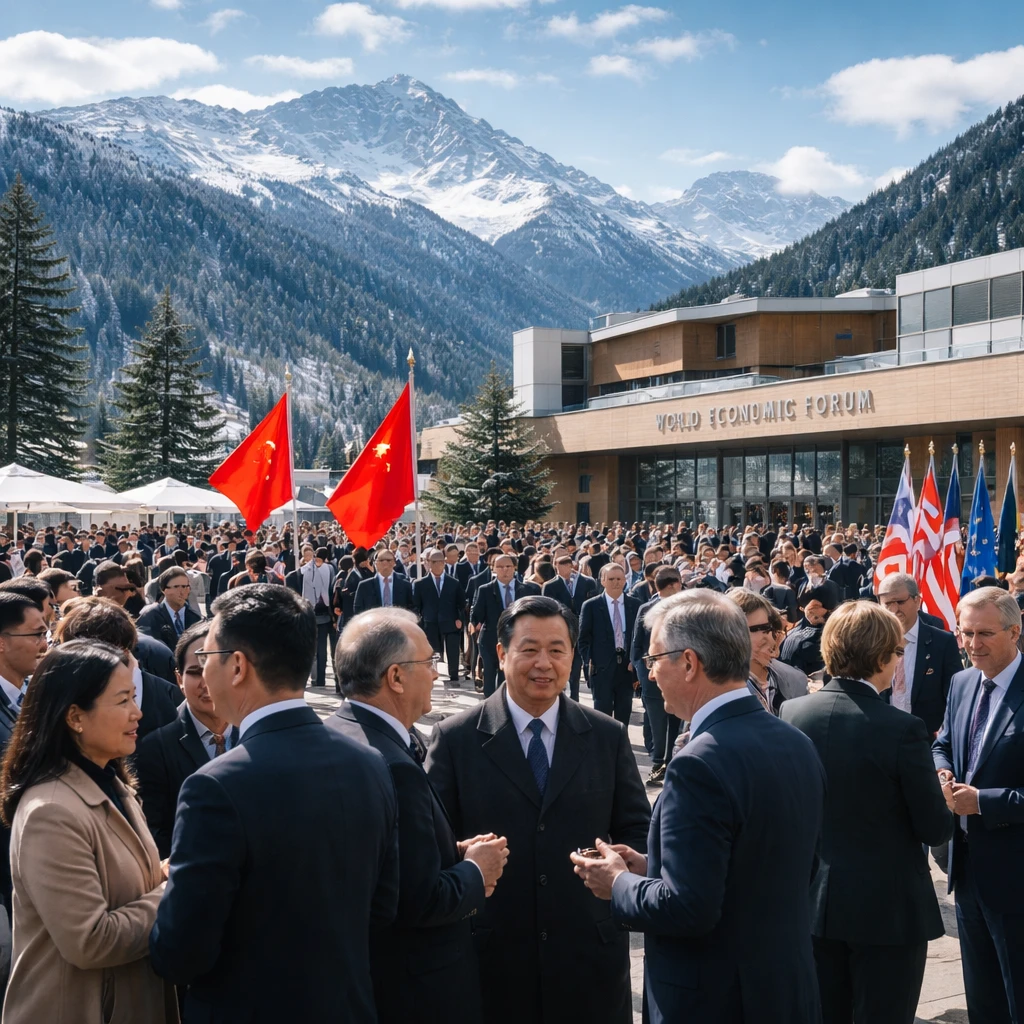
In this year's World Economic Forum held in the Swiss resort town of Davos, China's approach stood in stark contrast to that of the United States. Beijing displayed a notably low-key presence, which some business leaders interpret as a deliberate strategy to benefit from the discord between the Trump administration and Europe over issues such as Greenland. Yet, despite this potential advantage, significant challenges and execution complexities remain if China aims to cultivate trust as a partner for the European Union—a bloc seeking to lessen its reliance on the US.
A senior global business leader described China's tactics as "controlling the dynamic through stillness," drawing upon a principle from The Art of War that suggests waiting for one's opponent to exhaust themselves before advancing. This philosophy was embodied by China's decision to send Vice-Premier He Lifeng to Davos, who delivered a relatively brief address compared to US President Donald Trump's extensive remarks. He's speech underlined China's readiness to increase purchases of goods and services from foreign enterprises, signaling a shift away from the pursuit of a trade surplus.
Nonetheless, the challenge of managing China's persistent manufacturing overcapacity, especially in sectors like electronic vehicles, remains unresolved with no immediate remedy in sight according to a senior executive from a global bank. While President Trump hosted a large gathering of international business leaders, China's engagement was more reserved—a smaller luncheon with Western executives focused on conveying a straightforward message: "We are open for business," a senior banker familiar with the meeting shared.
Amid global instability, some see China's measured course as a path to eventual success. "It will watch all the chaos happening all over the world and steer its own course. China will win," remarked a founder of a global business during this week's Davos events. Canadian Prime Minister Mark Carney contributed by describing China as a "reliable and predictable partner" during his recent visit and encouraged European Union leaders in Davos to embrace Chinese investment.
Efforts to rebuild business relations are underway, with reports indicating that Britain and China are preparing to revive the 'Golden Era' dialogue during British Prime Minister Keir Starmer's upcoming visit. Similarly, Finnish Prime Minister Petteri Orpo plans to visit China accompanied by a delegation from the resources, manufacturing, and food industries.
A senior executive at a multinational financial firm observed that China has learned from earlier missteps made three years ago, including crackdowns on real estate, technology, and education sectors that undermined confidence. Since then, China has sought steadiness and predictability in its policy stance, contrasting with the US's increasing volatility.
However, China's subdued presence in the main forums of Davos coincides with economic growth slowing to a three-year low, and Beijing's promises to bolster domestic consumption have yet to gain traction. The impact of this on global markets, particularly manufacturing and technology sectors, remains under close watch.