
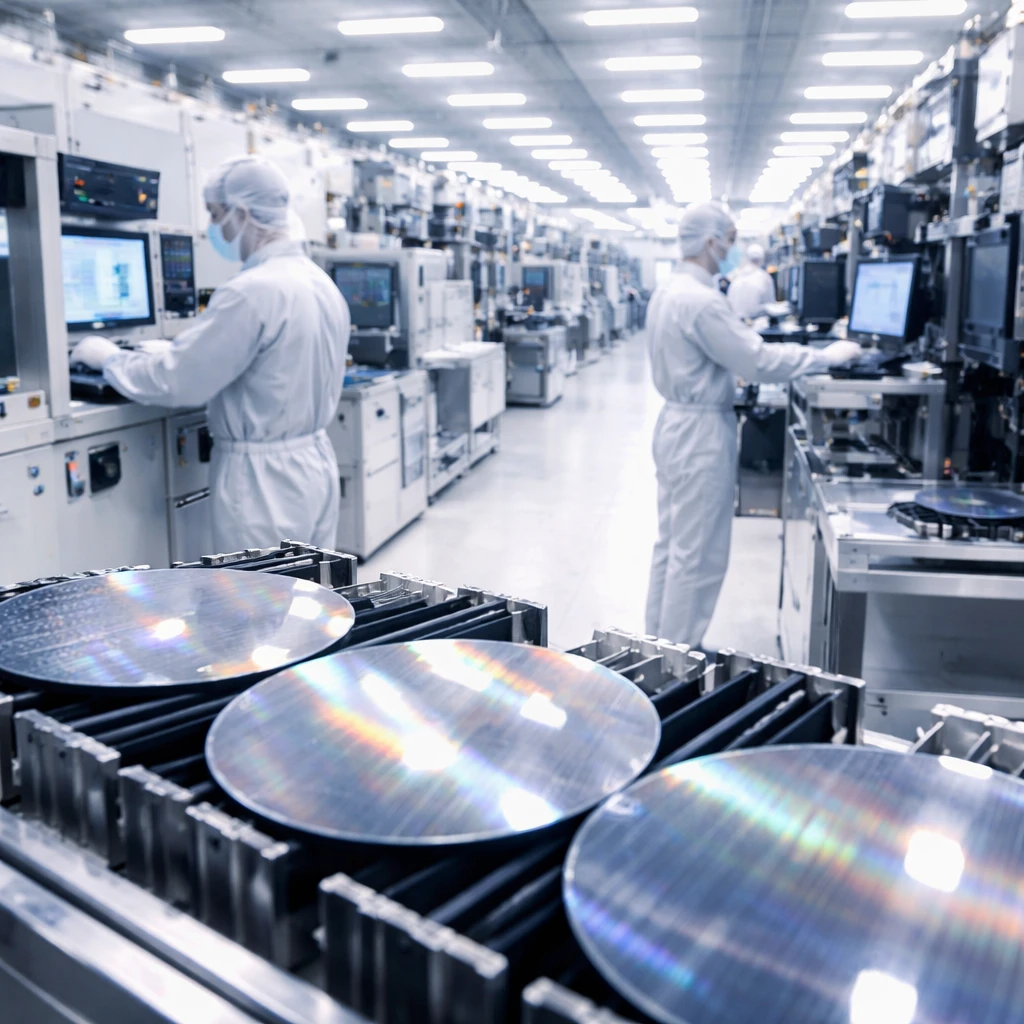
Bank of America has released an analysis identifying semiconductor companies in the Asia-Pacific region that it believes will see meaningful revenue growth as customers scale production of AI processors. The report focuses on front-end wafer requirements, advanced packaging supply, test and assembly services, and third-party design support connected to tensor processing units - or TPUs - and application-specific integrated circuits - ASICs.
Below are the companies BofA highlights and the bank’s estimates of the volume and revenue implications tied to specific customers and programs.
Taiwan Semiconductor Manufacturing Company (TSMC)
BofA projects that Broadcom’s TPU business will require 150,000 and 210,000 units of advanced front-end capacity support from TSMC in 2026 and 2027, respectively. The bank translates that demand into roughly $4.5 billion in sales for TSMC in 2026 and $6.1 billion in 2027.
On advanced packaging, BofA estimates Broadcom will secure about 190,000 and 230,000 CoWoS wafer supply slots for the project in those same years, contributing an additional $2.3 billion and $2.6 billion in TSMC revenue. When combined with Broadcom’s own product lines and broader ASIC opportunities that include work for customers such as Meta, OpenAI and Apple, BofA calculates these sources could account for 11% and 14% of TSMC’s total sales in 2026 and 2027, up from roughly 6% across 2023-2025.
King Yuan Electronics (KYEC)
BofA describes KYEC as the company best positioned to capture growing TPU-related test volumes tied to Broadcom’s training chipsets and MediaTek’s inference chips. The bank notes KYEC holds a dominant share for final chipset testing for both Broadcom and MediaTek, and that the company has added chip probing work outsourced by TSMC.
Under BofA’s scenario, Broadcom and MediaTek could represent about 9% and 15% of KYEC’s sales, respectively. The bank also allocates roughly 5% and 1% of KYEC’s sales to ASIC-related business from those customers.
Chroma ATE
BofA sets a price target for Chroma ATE of NT$1,750, applying a 35 times 2027 price-to-earnings multiple. The valuation rests on several forecasted operating outcomes: a 50% compound annual growth rate in earnings for 2025-2027 driven by 35% sales growth, expanding gross and operating margins, a return on equity rising toward approximately 35%, net cash of about NT$21 per share, and free cash flow generation around NT$15 per share per year.
Global Unichip Corporation (GUC)
BofA estimates GUC will need to secure bookings for 21,000 and 32,000 3nm wafers in 2026 and 2027 to support Google’s Axion CPU production paired with TPUs. The bank projects those volumes would translate into roughly $570 million and $960 million in sales for GUC, which would represent about 37% and 40% of the company’s total sales in each year.
BofA’s recommendations focus on measurable capacity and revenue assumptions tied to specific customer programs and manufacturing nodes. The bank’s estimates quantify how partnerships and outsourced services across wafer fabrication, advanced packaging, final test and design support could shift revenue composition for these Asia-Pacific companies as AI-focused chip production scales.