
After almost 10 days away from Earth, the Artemis II mission concluded when the Orion capsule nicknamed Integrity re-entered the atmosphere and descended beneath parachutes to touch down in calm Pacific waters shortly after 5:07 p.m. Pacific Time (0007 GMT on Saturday). The four astronauts aboard were recovered intact, marking the end of humanity's first crewed trip around the moon in over half a century.
The gumdrop-shaped Orion completed a flight path that included two orbits of Earth and a transit that carried the crew to a peak distance of 252,756 miles from Earth. Over the course of the mission the vehicle and crew traveled a cumulative 694,392 miles (1,117,515 km), including a close lunar flyby on a trajectory that passed roughly 4,000 miles from the moon’s surface. Those distances place the mission beyond any human flight since the Apollo missions of the 1960s and 1970s.
Televised live during a NASA webcast under partly cloudy skies, the final descent and splashdown unfolded without critical incident. "A perfect bull's eye splashdown for Integrity and its four astronauts," said NASA commentator Rob Navias soon after the capsule hit the water. Shortly after splashdown, mission commander Reid Wiseman reported by radio: "We are stable one - four green crew members," indicating the capsule was upright and all four astronauts were in good condition.
Recovery teams from NASA and the U.S. Navy moved quickly. Within two hours the floating capsule had been secured and the crew removed. The four individuals returned to Earth were U.S. astronauts Reid Wiseman, 50, Victor Glover, 49, and Christina Koch, 47, plus Canadian astronaut Jeremy Hansen, 50. Following initial stabilization divers attached a floating collar to the spacecraft, the astronauts were assisted into an inflatable raft while still wearing their orange flight suits, and then lifted one at a time into helicopters that transported them to the nearby Navy amphibious transport ship John P. Murtha for medical checks.
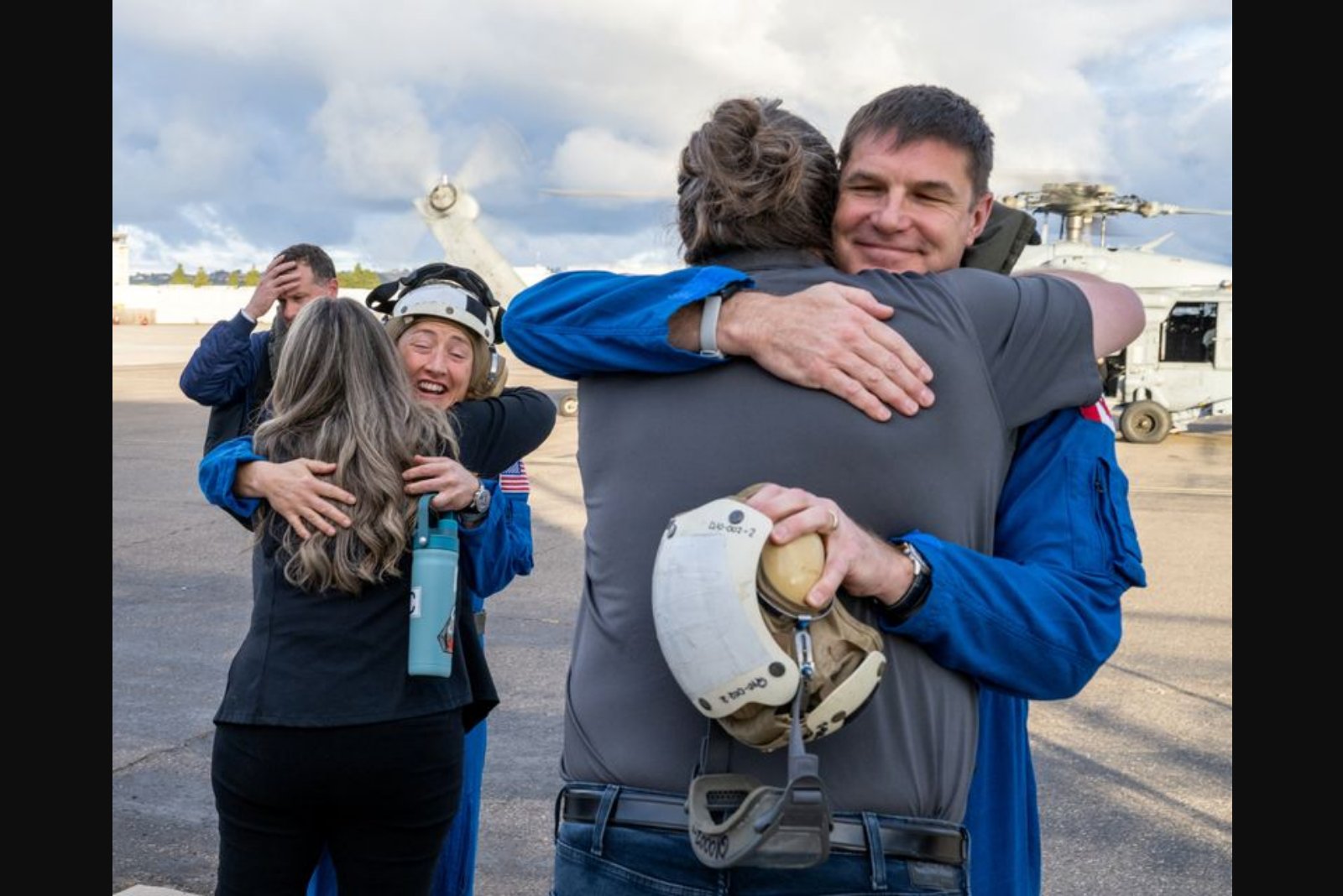
Glover and Koch were visible and outwardly pleased with the successful recovery, smiling and waving at cameras as they sat on the edge of a helicopter door on the ship's flight deck. NASA said the crew was expected to remain aboard the vessel overnight before flying back to Houston on Saturday to reunite with family members.
The return to Earth represented the mission's most demanding technical test - demonstrating that the Orion capsule's heat shield could survive the intense conditions of re-entry from a trajectory that departed and then returned from the lunar vicinity. On re-entry the capsule encountered atmospheric heating at temperatures near 5,000 degrees Fahrenheit (2,760 degrees Celsius) as it plunged toward Earth at roughly 32 times the speed of sound. Atmospheric friction produced a sheath of ionized gas around the vehicle, producing a planned radio blackout of more than six minutes at the point of peak thermal and mechanical stress. Contact with the capsule was restored about 40 seconds later than planned, after which two sets of parachutes deployed from the nose to slow Orion to a descent speed of roughly 15 mph (25 kph) prior to water impact.
The Artemis II mission demonstrated the sequence of re-entry, parachute deployment and maritime recovery under real-world conditions. After stabilization the crew were hoisted to helicopters and transferred to the John P. Murtha for assessment, a standard procedure to confirm crew health following high-energy re-entries and ocean recoveries.
Artemis II launched from Cape Canaveral, Florida, on April 1 aboard NASA's Space Launch System rocket, beginning with two Earth orbits before the spacecraft continued on for a flyby of the far side of the moon. In completing that arc the crew became the first people to travel around the moon since the Apollo program. Three members of the crew - Victor Glover, Christina Koch and Jeremy Hansen - also achieved historic firsts for lunar missions. Glover became the first Black astronaut to take part in such a mission, Koch the first woman, and Hansen the first non-U.S. citizen to fly on a mission that looped around the moon.
The mission's peak distance of 252,756 miles eclipsed the long-standing record of roughly 248,000 miles set by the Apollo 13 crew in 1970, underscoring how far the Artemis II flight extended from Earth.
NASA officials framed the flight as a critical hardware and operational test. "This is an incredible test of an incredible machine," said NASA associate administrator Amit Kshatriya, underscoring the importance of validating the spacecraft systems under the stresses of a deep-space return. The mission followed an uncrewed Artemis I test flight of Orion around the moon in 2022 and is one step in a sequence of Artemis missions intended to return astronauts to the lunar surface beginning in 2028 and to build a sustained human presence on the moon as a precursor to eventual crewed missions to Mars.
The program's development has enlisted commercial and international partners. NASA has contracted major aerospace firms as principal contractors on the SLS rocket, and the lunar lander elements of the program are being built by commercial companies engaged under NASA's broader lunar architecture. NASA has also partnered with the space agencies of Europe, Canada and Japan. The flight's success represented an important validation for the heavy-lift launch system and its contractors, with the SLS rocket and its suppliers receiving a long-sought demonstration that they can safely propel humans beyond low Earth orbit.
Despite the mission's technical success, officials and industry watchers continue to contend with development delays for the lunar landers intended to carry astronauts to the surface. Those delays have the potential to push subsequent missions back from their planned schedules. NASA has indicated that Artemis III will focus on a crewed docking test in Earth orbit next year involving both of the planned lunar landers, ahead of an eventual descent attempt on Artemis IV.
The Artemis II flight unfolded against a complex political backdrop. NASA's renewed lunar ambitions have intersected with national policy changes that have reduced the agency's workforce by 20 percent, and a White House budget proposal for 2027 would cut $3.4 billion from NASA's science unit and reduce the count of science missions by about 40. Those budgetary and staffing developments create uncertainty around the agency's longer-term programs and could affect timelines and resources available for future Artemis missions and other science campaigns.
Political reactions included a public congratulatory message by the U.S. president posted on a social media platform, describing the trip as "spectacular" and calling the landing "perfect."
For a global audience, the mission offered a highly visible demonstration of technical achievement at a time of heightened public interest. More than 3 million viewers tuned in to the splashdown via NASA's YouTube channel, reflecting broad public attention to the return-to-moon effort. Public fascination with the mission has been bolstered by the high stakes of testing new deep-space systems and by the historic nature of the crew composition and the distances travelled.
Engineers had adjusted the re-entry trajectory for Artemis II after observing higher-than-expected heat and stress on the Orion heat shield during its 2022 uncrewed flight. Those trajectory changes were implemented specifically to reduce heat accumulation and lower risk to the capsule and crew during the Artemis II return. The successful re-entry and recovery indicate that those mitigations were effective in practice for this mission.
With the capsule and crew safely back on Earth, NASA's attention shifts toward subsequent missions in the Artemis series. Officials said Artemis III astronaut assignments will be announced soon and that the coming year will focus on crewed docking tests in Earth orbit between the two lunar landers before proceeding toward surface landing attempts on later missions. However, the development delays afflicting the landers remain a factor that could affect the schedule of surface missions.
As they approached re-entry on Friday, Commander Wiseman relayed a final lighthearted observation to mission control: "We got a great view of the moon out window 2, looks a little smaller than yesterday." In reply from Houston, mission control astronaut Jacki Mahaffey quipped: "Guess we'll have to go back."
Key points
- The Orion capsule Integrity and its four-person crew completed a successful splashdown off Southern California after nearly 10 days in space, validating re-entry systems from a lunar-return trajectory.
- The mission reached a peak distance of 252,756 miles from Earth and logged a total distance of 694,392 miles (1,117,515 km), including a flyby roughly 4,000 miles from the moon's surface.
- The flight serves as a crucial hardware and operational test for Artemis missions that aim to return astronauts to the lunar surface in the coming years, while maritime recovery procedures and heat shield performance were confirmed.
Risks and uncertainties
- Delays in the development of lunar landers could push back planned surface landing missions, affecting schedules and program milestones - relevant to aerospace contractors and mission planners.
- Recent workforce reductions and proposed budget cuts at NASA create uncertainty about resources and timelines for future science and exploration missions - affecting government-funded research and aerospace supply chains.
- Re-entry and heat shielding remain technically demanding; although Artemis II validated mitigations, any future unanticipated thermal or structural stresses could pose risks to crew safety and mission success - relevant to crewed deep-space operations and contractor responsibilities.