
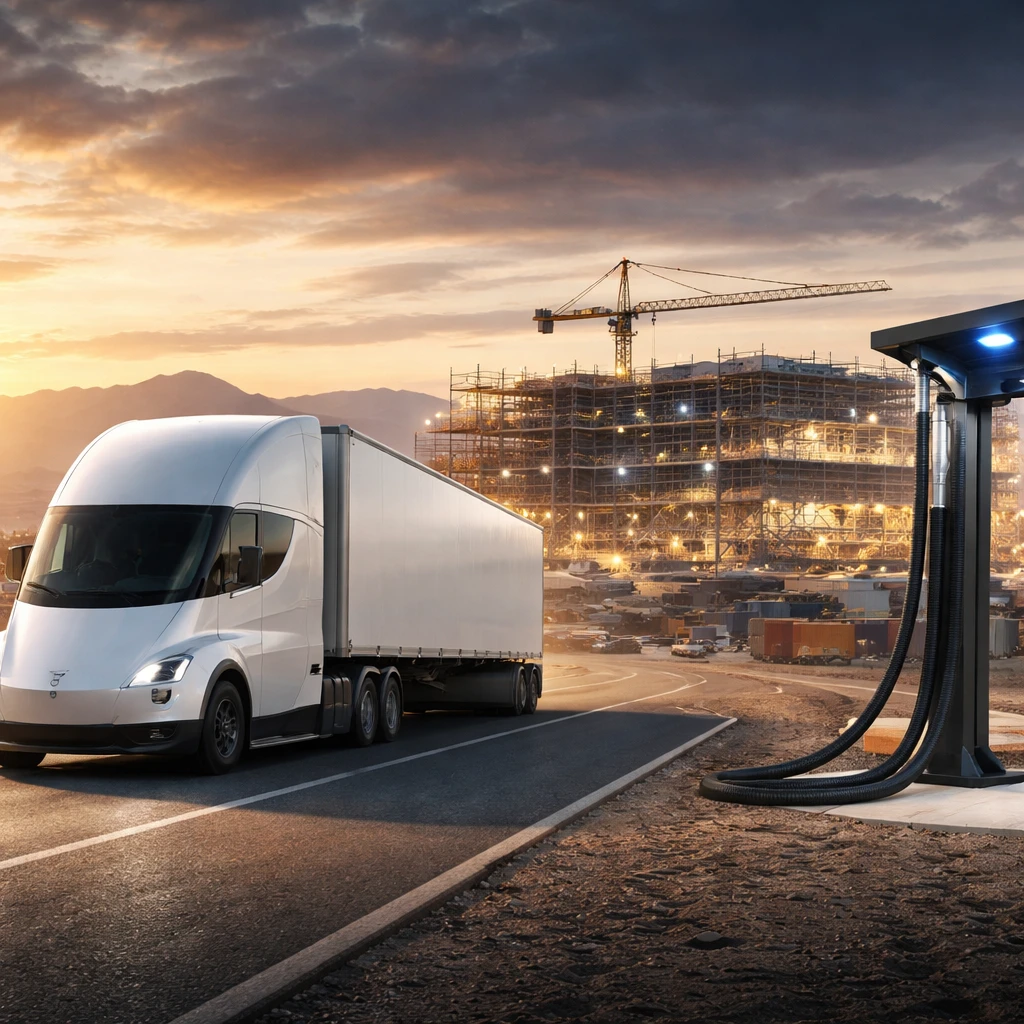
Tesla introduced the Semi in 2017 with the intention of transforming the heavy-duty trucking sector. Approaching the 10-year mark since that unveiling, the vehicle has yet to progress beyond a limited operational footprint. Deliveries have been sporadic, production timelines pushed back multiple times, and the program has frequently been eclipsed by the company’s initiatives in passenger vehicles, artificial intelligence and robotics. The year 2026 is shaping up as a potential inflection point to determine whether the Semi can advance from demonstration and pilot deployments to a scaled commercial product.
Global sales of heavy-duty trucks totaled about 2.8 million units in 2024, with roughly 400,000 of those sold in the United States. Within Class 8 tractors, electrification remains minimal. Fleet purchasers in this segment tend to focus on total cost of ownership rather than brand appeal or novelty, which has constrained adoption of battery-electric long-haul tractors so far.
Tesla maintains that the Semi offers compelling economics: the company cites a roughly 500-mile range enabled by an approximately 850 kWh battery pack, charging capability of up to 1.2 MW for very fast replenishment, and substantially lower energy and maintenance costs compared with diesel equivalents. CEO Elon Musk has characterized demand as "ridiculous" and the business proposition for operators as a "no brainer."
On paper, momentum appears to be building. Records tied to California’s electric truck subsidy program indicate nearly 900 Semi units were requested in 2025, a level higher than the historical orders accumulated by any single legacy truckmaker. Fleet customers including DHL and RoadOne have reported performance that exceeds their expectations and have said they intend to scale up purchases when Tesla achieves volume production.
Nevertheless, execution challenges are significant. Tesla is targeting production of up to 50,000 trucks per year from its Nevada assembly line by the end of 2026. That ambition is large relative to the size of the U.S. tractor day-cab market, which is under 100,000 units annually. Battery supply poses a critical constraint after a key 4680-cell supplier recorded a major writedown, and aerial footage has suggested the Nevada production line is not yet fully installed.
Analysts at Bernstein have further noted that, based on current assumptions, the Semi’s total cost of ownership could remain slightly higher than best-in-class diesel tractors. For established manufacturers such as Daimler, Volvo and Paccar, an immediate competitive impact from the Semi is unlikely while diesel powertrains still dominate and long-haul electrification advances slowly. That said, if Tesla succeeds in the planned 2026 ramp, the Semi could alter industry sentiment, prompting greater capital deployment by incumbents and compressing margins across a key profit pool in trucking.
Context note: The article reports company claims, fleet customer statements, production targets and third-party analyst assessments as described above. It reflects information available about orders linked to California subsidy applications, stated technical specifications and noted execution risks.