
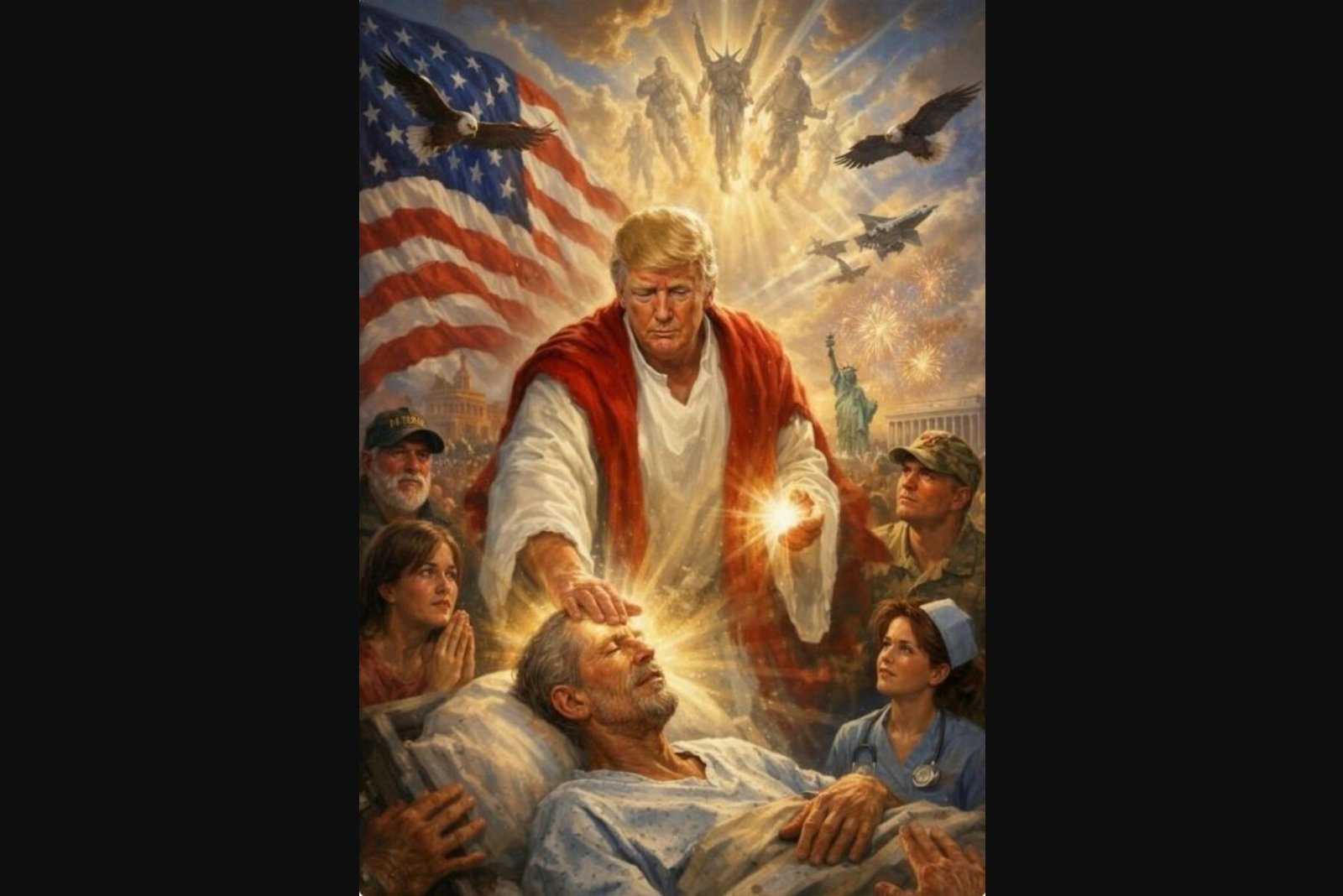
President Donald Trump uploaded an AI-generated image to his Truth Social feed on Sunday that depicted him in a Jesus-like pose, drawing condemnations from religious conservatives who have been important allies in his political coalition. The post was removed on Monday morning.
The image showed Trump clothed in a white robe, placing one hand on the forehead of a man who appeared unwell while holding a glowing orb in the other hand. The scene was rendered in a painting-like style and included a backdrop featuring the Statue of Liberty, fireworks, a fighter jet and eagles.
The post arrived amid a growing public clash between Trump and Pope Leo, who has criticized the U.S.-Israeli war against Iran as inhumane. Shortly before sharing the image, the president posted a lengthy attack on the pope, calling him "WEAK on crime and terrible for Foreign Policy." Pope Leo, the first U.S.-born pope, replied that he had "no fear" of the Trump administration and affirmed he would continue to speak out.
In a forceful address Monday in Algiers, Pope Leo denounced what he described as "neocolonial" world powers violating international law, remarks that did not explicitly name the United States.
Observers noted the image could widen a schism with the religious right, a bloc that helped secure Trump’s victory in the 2024 election. Some religious conservatives reacted with disappointment or dismay; their concerns underscore the delicate political ground between personal branding and faith symbols.
Brilyn Hollyhand, who formerly co-chaired the Republican National Committee Youth Advisory Council, posted on X calling the image "gross blasphemy" and wrote that "Faith is not a prop. You don’t need to portray yourself as a savior when your record should speak for itself." Riley Gaines, a former collegiate swimmer and an outspoken critic of transgender athletes who has appeared with Trump at rallies, likewise criticized the post on X, saying she could not understand why Trump published the image and adding: "Does he actually think this? Either way, two things are true. 1) a little humility would serve him well 2) God shall not be mocked."
Not all Catholic observers were uniformly critical. Bishop Robert Barron, who serves on a commission established by the president on religious liberty, wrote on X that Trump owed Pope Leo an apology for his "inappropriate" statements on social media while also praising the president's outreach to Catholics.
The episode comes against a backdrop of strong support for Trump among Christian voters in the 2024 election. Trump, who does not attend church regularly, won large majorities of Christian voters overall and made notable gains among Catholic voters, who supported him by a 56% to 42% margin according to analysis by Ryan Burge, a political science professor at Washington University and a former pastor.
Some elements of Trump’s base have previously interpreted personal events through a religious lens. After Trump narrowly survived an assassination attempt in July 2024, some evangelical supporters described the episode as evidence he had been blessed by God.
The president has previously used religious imagery in social posts. Last year, following the death of Pope Francis, Trump posted an AI-generated image showing himself as pope, a move that also prompted outrage among many Catholics.
Pope Leo has emerged in recent weeks as a prominent critic of the war in Iran, making an unusual direct appeal to Trump and urging him to find an "off-ramp." The pope has also asserted that Jesus cannot be used to justify war and that God rejects the prayers of those who start conflicts. Those remarks were widely interpreted as a rebuke to Trump officials who have framed the conflict in religious terms. For example, U.S. Secretary of Defense Pete Hegseth has cited scripture to justify the use of "overwhelming violence" against enemies and compared the rescue of a U.S. airman inside Iran to the resurrection of Jesus Christ.
Trump’s relationship with the papacy has been contentious at times. He previously clashed with Pope Francis, who publicly criticized his deportation policies as un-Christian.
Religion remains a notable feature within the administration: at least eight cabinet members are Catholic, including Vice President JD Vance and Secretary of State Marco Rubio. The reaction from Catholic leaders, conservative activists and rank-and-file supporters to the AI image underscores the political and cultural tensions that can follow the mixing of religious symbolism and presidential self-presentation.
Context and implications
The post and the responses it generated highlight the friction between the president’s social-media-driven approach to public communication and the expectations of some religious supporters. The episode also sits within a broader public dispute between the president and Pope Leo over the humanitarian and moral framing of the U.S.-Israeli war in Iran.
While the post was removed, the debate it ignited touches on issues that have recurred during Trump’s time in office: the role of religious identity in politics, how religious rhetoric is deployed by officials, and the limits of symbolism for a president whose base includes committed faith communities.