
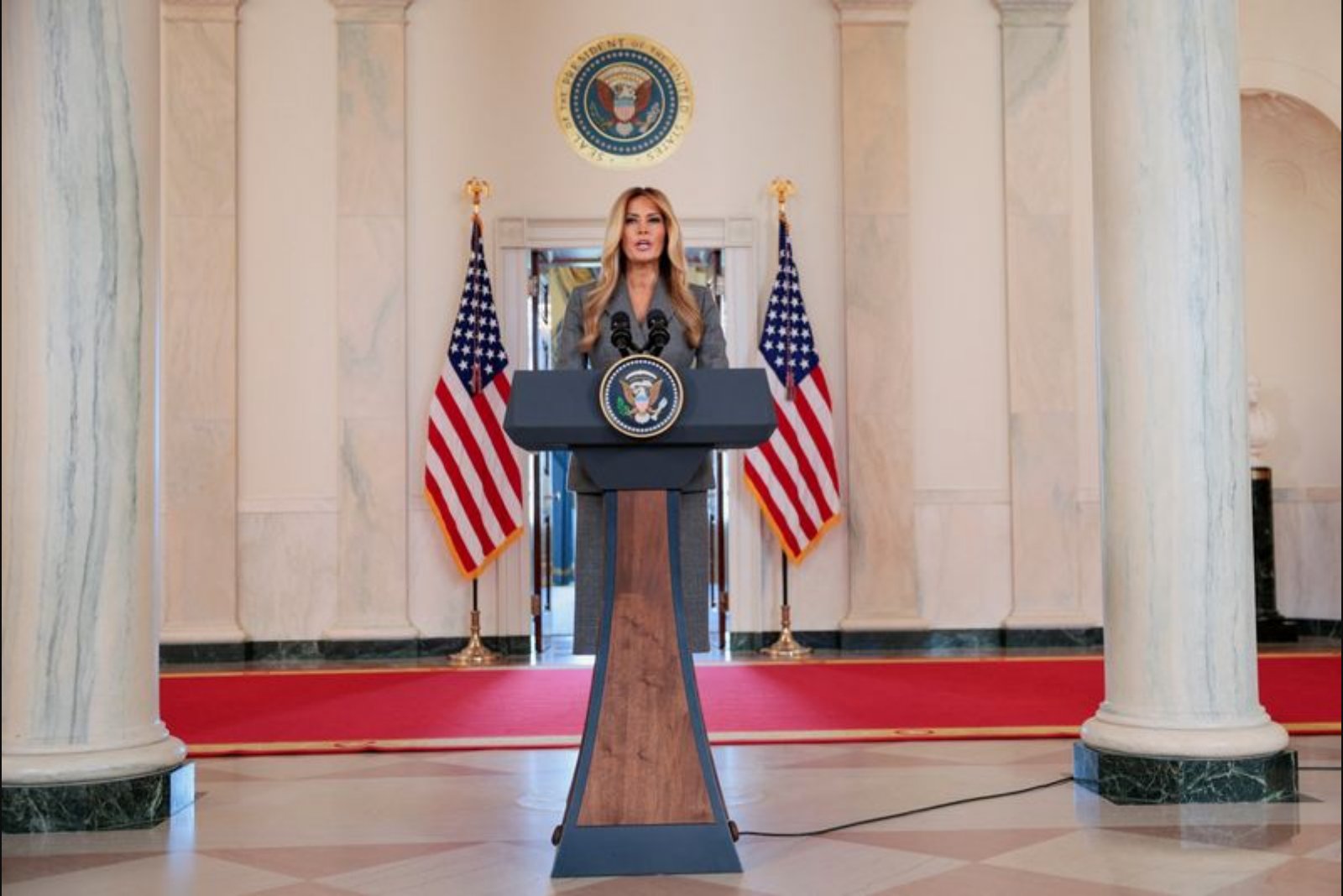
On April 9 in Washington, Melania Trump publicly refuted the notion that she had any relationship with convicted sex offender Jeffrey Epstein, speaking directly to a group of journalists in one of her rare press appearances. The first lady's remarks on Thursday stand out in a tenure marked by relative silence on political matters and a tendency to communicate indirectly or through symbolic gestures.
Throughout her time in the White House, Melania Trump has largely shaped the role on personal terms, avoiding extensive engagement in public debate and offering limited public commentary that typically signaled quiet support for her husband, President Donald Trump. Her Thursday statement rejecting an association with Epstein represents one of only a handful of occasions in which she has faced the press in person.
Her public output has been modest compared with predecessors. In 2017, Melania Trump delivered eight speeches during the administration's first year; by contrast, Michelle Obama gave 74 speeches in 2009, the initial year of Barack Obama’s presidency. The disparity in public speaking underscores how privately Melania has conducted her role while remaining a prominent public figure.
Observers and chroniclers of first ladies have described her as difficult to read. "She is very unknowable," Kate Andersen Brower, author of the book "First Women: The Grace and Power of America’s Modern First Ladies," told Britain’s The Times in 2024. Yet, at times, Melania Trump has drawn significant attention for public statements or symbolic actions that reverberated through the media landscape.
For example, in the aftermath of the 2020 presidential election, she echoed language used by her husband in challenging the results. She wrote, "Every legal - not illegal - vote should be counted," a formulation that mirrored rhetoric he employed in asserting election irregularities. In 2018 she prompted extensive coverage by wearing a jacket reading: "I REALLY DON’T CARE, DO YOU?" during a flight to Texas to see migrant children who had been separated from their parents. She later said the garment was a response to media critics.
This year, she released a film titled "Melania" that follows her life in the 20 days before her husband's second inauguration. The documentary was presented as a behind-the-scenes look at the first lady, though critics said it did not substantially deepen public understanding of her.
Biographical details remain part of her public profile: Melania, 55, is Donald Trump’s third wife and is the first U.S. first lady who is a naturalized citizen. Her modeling career began at age 16 and took her to fashion centers such as Paris and Milan before she relocated to New York in 1996. She met Donald Trump at a New York party two years later and the couple married in January 2005.
President Trump has frequently complimented her public image, likening her to the glamour of Jackie Kennedy and stating on Fox News’ "Fox and Friends" in 2019: "We have our own Jackie O today. It’s called Melania. We’ll call it Melania T." He added, "People love her. She gets no credit from the media, but she gets credit from the people."
Separately, the topic of investment opportunities for 2026 has been referenced in materials accompanying public coverage, asking: "What are the best investment opportunities in 2026?" Those materials state that stronger investment decisions depend on better data and describe a product called InvestingPro as combining institutional-grade data with AI-powered insights intended to help identify opportunities more frequently, while noting it cannot guarantee winners. The same materials suggest consulting a tool called WarrenAI as part of determining investment choices.