
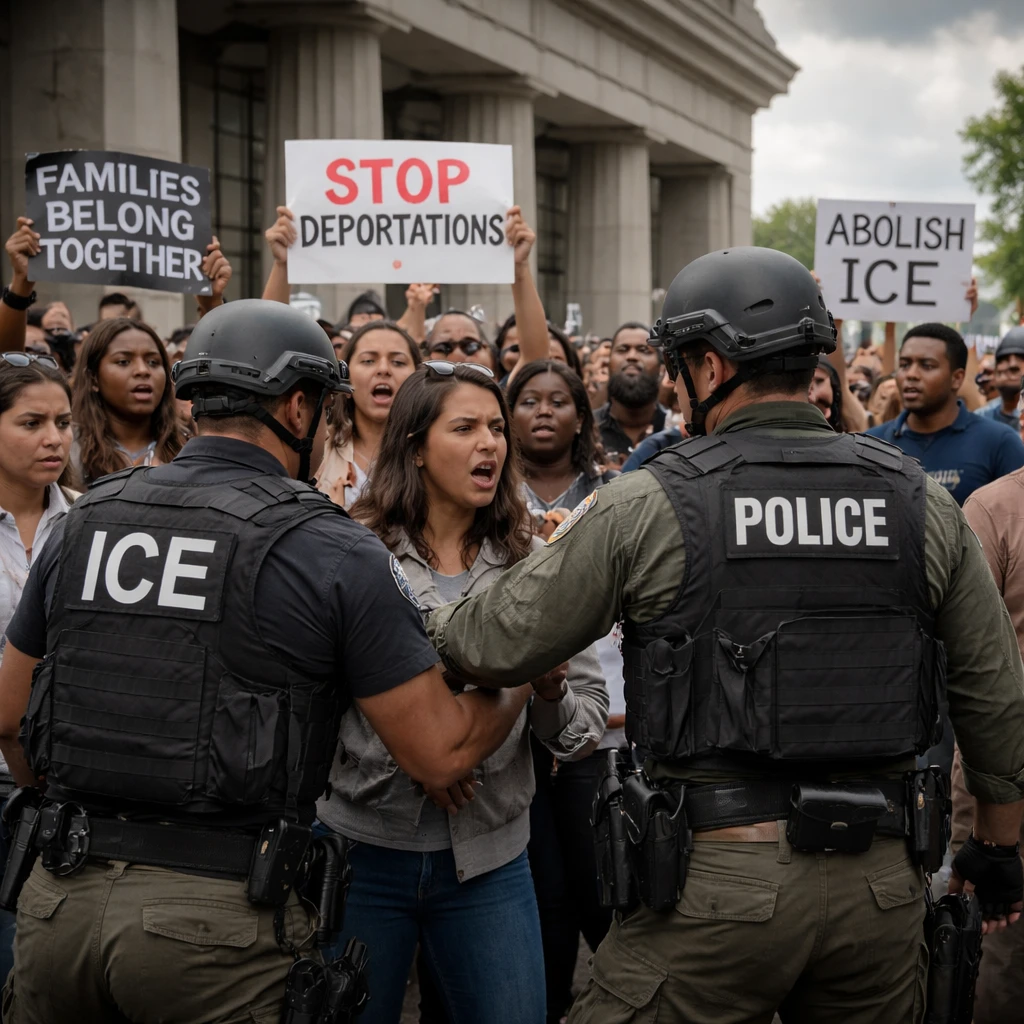
As the November midterm elections draw near, President Donald Trump's stringent immigration policies, chiefly the enforcement measures executed by Immigration and Customs Enforcement (ICE), are emerging as a politically complex issue, revealing a divide among voters and complicating campaign strategies for both major parties.
The situation intensified after a Minneapolis shooting incident on January 7, when an ICE officer fatally shot 37-year-old Renee Good, sparking public protests and raising concerns over the conduct of immigration agents. Opinion surveys including those conducted by Reuters/Ipsos reveal a majority of Americans disapprove of ICE officers' methods, showing fractures within the Republican base regarding the extent to which federal agents should prioritize minimizing harm during enforcement.
This backlash toward ICE enforcement has weakened a traditionally strong Republican argument that underscores law and order, thus limiting their ability to deflect mounting voter pessimism about economic conditions. Analysts suggest Democrats may capitalize on this shift, despite the party’s frequent struggle with border security perception, if voters perceive that President Trump’s immigration approach has exceeded reasonable boundaries.
Polling trends have heightened Republican apprehension that adverse views of ICE’s tactics may undermine the perceived successes of the Trump administration’s border security efforts, including controlling the significant surge of migrants arriving under the Biden presidency. Meanwhile, Democrats face their own challenge, as some candidates have advocated abolishing ICE, potentially alienating voters concerned about immigration and security ahead of the elections.
The current political landscape finds Republicans governing both the Senate and the House, yet facing public dissatisfaction driven by inflation and economic uncertainties during a crucial election year in which all House seats and a third of Senate seats are contested. Amy Walter, editor-in-chief of the Cook Political Report, likened the present climate to the post-George Floyd era, noting that public opinion on law enforcement can shift rapidly and have significant political ramifications.
Public reaction has not only spotlighted ICE's use of masks during raids and the restraint methods applied to minors but also highlighted instances where U.S. citizens have suffered harm during immigration enforcement. Notably, in Minneapolis, naturalized citizen Scott (ChongLy Thao) recounted a harrowing experience when agents entered his home with firearms drawn, detaining him inappropriately without subsequent explanation or apology. The Department of Homeland Security (DHS) has acknowledged that ICE officers themselves have occasionally faced violent resistance.
Political analysts anticipate that Democrats are well-positioned to reclaim the House majority and might erode the Republican Senate advantage, although taking full control of the Senate remains uncertain. Such outcomes could impede the Trump administration's legislative agenda and open doors to congressional scrutiny of immigration policies.
Senate Majority Leader John Thune expressed uncertainty regarding the electoral impact of ICE-related issues, underscoring the unpredictability of voter priorities. Nevertheless, the Trump administration is expected to intensify immigration enforcement throughout the year, supported by congressional funds allocated for recruiting thousands of ICE agents, maintaining high detention capacities, and expanding surveillance operations targeting immigration violations. Planned enforcement is likely to focus more intensely on employers in industries that employ undocumented workers.
This enforcement expansion could particularly impact Republican appeal among Latino voters and affect critical Senate races in Democratic-leaning states like Maine and Michigan, according to Walter. Senator Susan Collins of Maine, one of the most vulnerable Republican incumbents, publicly criticized what she deemed excessive ICE measures, including directives from DHS Secretary Kristi Noem to deploy tactics such as mask-wearing and arrests of immigrants without criminal records. Collins argued the problem lies with policy direction rather than the officers themselves.
Some Senate Democrats aim to use upcoming government funding legislation to impose restrictions on ICE operations, although Collins advocated for oversight hearings with Secretary Noem as an alternative. In response, DHS Assistant Secretary Tricia McLaughlin defended the administration’s actions, stating they fulfill public expectations for deportation policies. Her statement referenced polls conducted before the Good shooting incident, highlighting that a majority favors deporting undocumented individuals, yet acknowledging some voters believe current enforcement has strayed too far.
The assertion that 70% of those arrested by ICE have criminal charges or convictions remains contested by independent experts and advocacy organizations, revealing ongoing debate regarding the agency's practices.
Within Democratic circles, a division persists between calls for ICE reform or abolition, with some cautioning that radical proposals risk alienating moderate voters. The centrist think tank Third Way advocates for restoring responsible enforcement practices while deterring politically motivated abuses.
Key Points:
- Public disapproval of ICE enforcement tactics erodes traditional Republican strengths on crime and security messaging amid economic challenges.
- Democrats may gain electoral advantage if voter sentiment turns against perceived excesses in immigration control, despite their internal debate over ICE’s future.
- Heightened immigration enforcement funding aims to expand ICE's operational footprint, including increased scrutiny of employers, affecting various economic sectors.
Risks and Uncertainties:
- Negative public perception of ICE tactics may cost Republicans support among Latino voters and in key swing states, impacting electoral and legislative outcomes.
- Democratic proposals to abolish or reform ICE could alienate voters concerned about immigration security, leading to unintended electoral losses.
- Increased immigration enforcement could pose operational risks for businesses employing undocumented workers, influencing sectors reliant on low-skilled labor.
Disclosure: This article does not constitute investment advice. Readers should exercise independent judgment and seek professional consultation regarding market and political risks.