
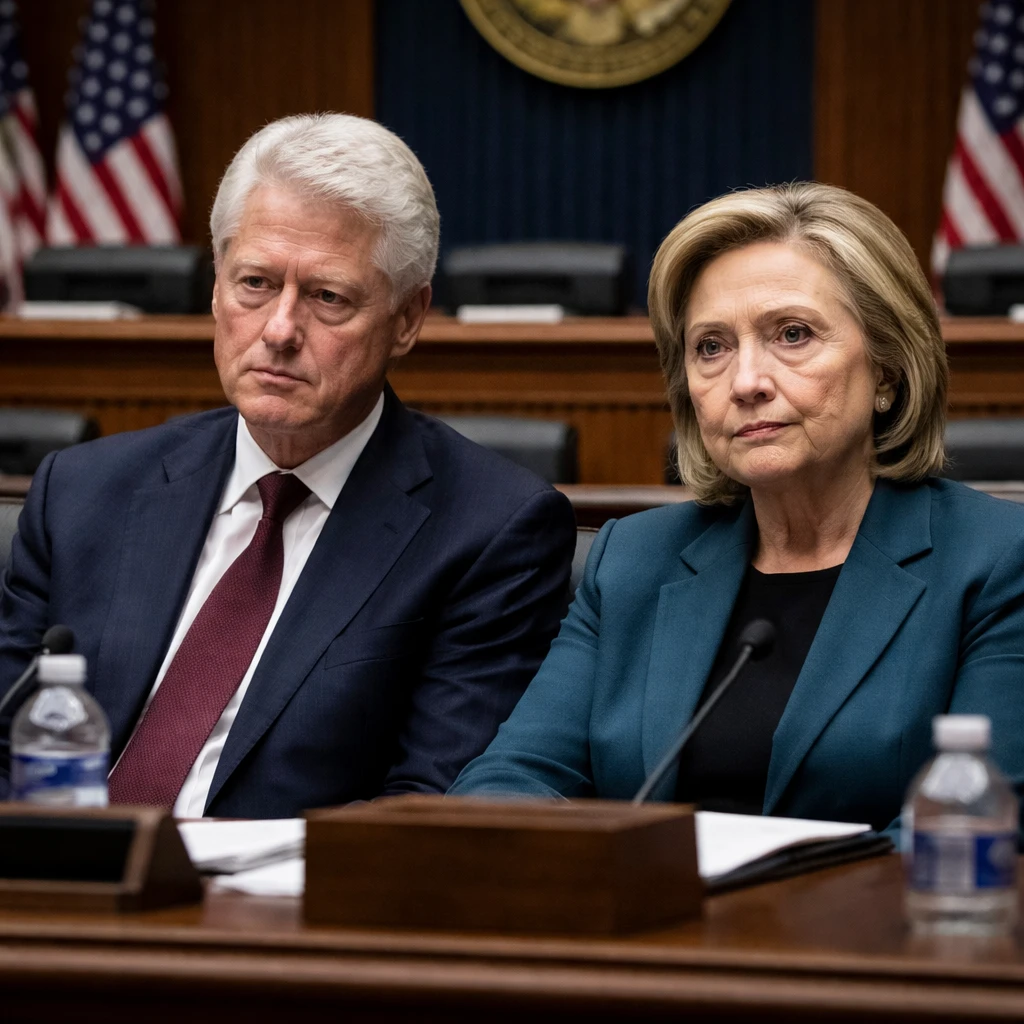
A Republican-controlled House committee has voted to recommend that former President Bill Clinton and former Secretary of State Hillary Clinton be held in contempt of Congress for declining to testify in the investigation related to their associations with Jeffrey Epstein. The committee's decision paves the way for potential criminal prosecution as the matter moves to the full House and possibly the Justice Department. The investigation highlights deep partisan divisions, with the Clintons characterizing the probe as politically motivated.
Key Points
- The House Oversight Committee, led by Republicans, voted to recommend holding Bill and Hillary Clinton in contempt for refusing to testify about their links to Jeffrey Epstein.
- The committee's vote clears the way for the full House to decide on referring the case to the Department of Justice for potential prosecution of misdemeanor contempt charges.
- Contention over the investigation is intensified by partisan divisions, with the Clintons alleging the probe aims to shield President Donald Trump from scrutiny.
WASHINGTON, Jan 21 – The U.S. House Oversight Committee, under Republican leadership, has advanced resolutions recommending that former President Bill Clinton and former Secretary of State Hillary Clinton be held in contempt of Congress for their refusal to appear in person and testify regarding their ties to Jeffrey Epstein, the disgraced financier and sex offender who passed away in 2019. This recommendation could lead to criminal charges if the full House and subsequently the Justice Department decide to act.
Though the Clintons have expressed willingness to cooperate with the committee, they have not agreed to participate in in-person testimony, asserting that the investigation is driven by partisan motives to protect Republican President Donald Trump. The committee voted 34-8 in favor of holding Bill Clinton in contempt and 28-15 for Hillary Clinton. Support for the measures was unanimous among committee Republicans, totaling 25 votes.
The forthcoming step involves the House voting on referrals to the Department of Justice, which would consider pursuing misdemeanor contempt charges. Under federal law, contempt of Congress can result in penalties including up to one year of imprisonment and fines amounting to $100,000.
The committee's resolutions emphasize that the Clintons’ failure to comply with subpoenas, after several months of negotiation, has significantly obstructed oversight efforts. The documents indicate that neither former official provided legally sufficient reasons for declining to appear.
Reports by the New York Times suggest that Bill Clinton had offered to give sworn testimony at his office in New York; however, this offer was dismissed by committee Chairman James Comer, a Republican representing Kentucky.
The inquiry into the Clintons’ relationship with Epstein occurs in a context marked by politically charged history. Bill Clinton reportedly took multiple flights on Epstein's private plane in the early 2000s following his presidency and has since expressed remorse about the association, claiming no knowledge of Epstein's illicit conduct. Meanwhile, Donald Trump and Epstein were friends during the 1990s and early 2000s, though Trump asserts he ended their acquaintance before Epstein's conviction on prostitution-related charges.
In the 2016 presidential race, Donald Trump and Hillary Clinton were fierce competitors, highlighted by chants at Trump rallies advocating for her imprisonment. The political tensions evident from that contest underpin the current controversy surrounding the investigation.
Risks
- Possible criminal proceedings against the Clintons could heighten political tensions and uncertainty in Washington, potentially affecting market confidence in sectors sensitive to political risk.
- The investigation’s partisan nature may contribute to further polarization in government, complicating legislative processes relevant to economic and regulatory policies.
- Obstruction of Congressional probes may undermine the oversight function, impacting sectors reliant on clear government scrutiny and regulatory transparency.