
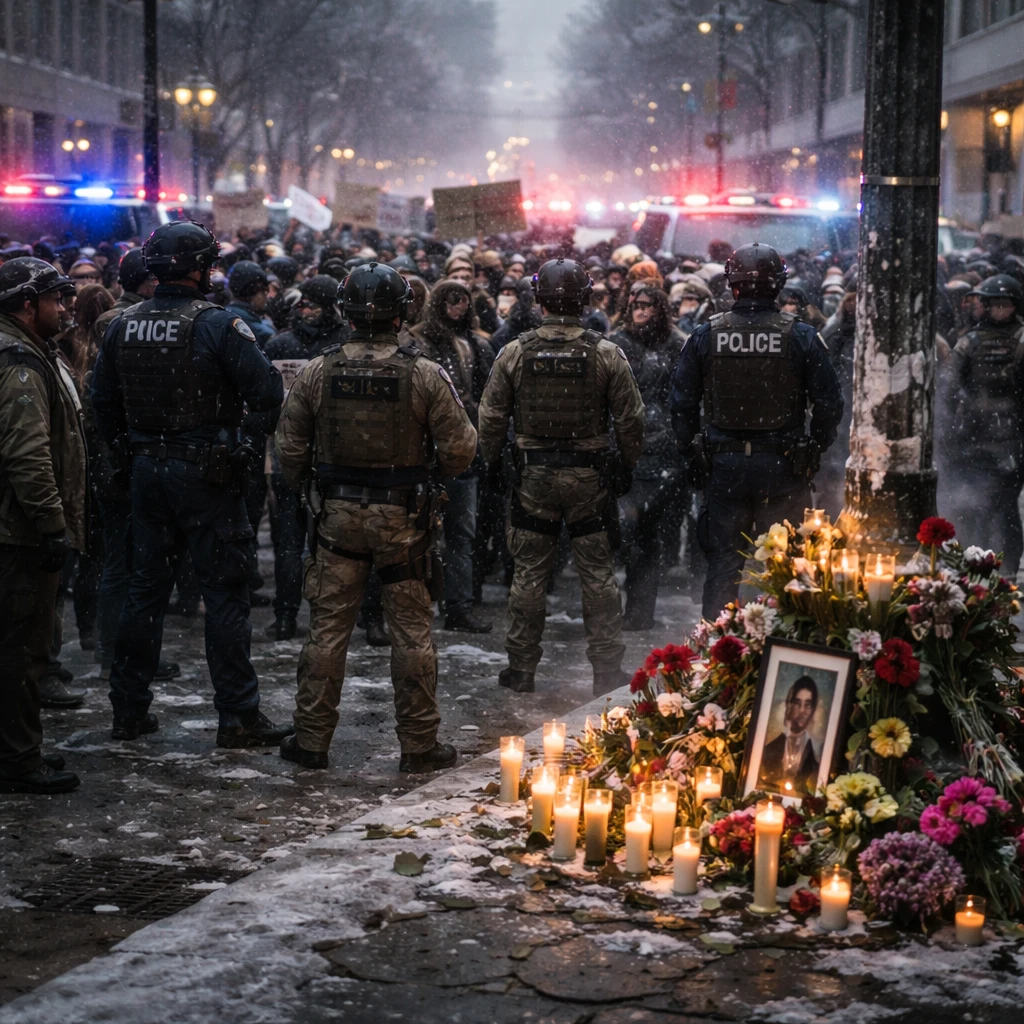
Minneapolis experienced significant civil unrest following the shooting of Renee Good by an Immigration and Customs Enforcement (ICE) officer, an event captured vivid through newly released emergency call transcripts and dispatch logs. The recordings document a chaotic scene marked by panicked eyewitness accounts, escalating tensions between federal agents and community members, and violent confrontations amid heightened immigration enforcement activity.
Emergency operators repeatedly received calls describing the incident’s immediate aftermath. Witnesses reported seeing ICE agents firing shots at a vehicle, which then collided with other cars, leaving blood visible at the scene. One caller noted the presence of approximately 15 ICE agents and indicated that the agents had opened fire because the driver refused to unlock her car door. Another described shots hitting the vehicle’s windshield while trying to calm bystanders with instructions to control their breathing due to the distressing situation.
As Renee Good was declared deceased at a hospital, police efforts focused on securing the area and safely extracting ICE officers amid growing unrest. Protesters dismantled crime-scene barriers, and communications among responders alerted officials of ICE agents being surrounded by an increasingly hostile crowd, illustrating the surge of public anger within approximately 80 minutes of the shooting.
The release of these emergency communications coincided with reports that the U.S. Justice Department has launched an inquiry into Minnesota’s political leadership, including Governor Tim Walz and Minneapolis Mayor Jacob Frey. The investigation reportedly centers on potential conspiracy allegations linked to comments made by these leaders regarding the federal deployment of immigration enforcement officers. Both officials and affiliated Minnesota Democrats have condemned the ICE operation and the fatal shooting, attributing such outcomes to a deliberate strategy by the federal administration to incite unrest.
Minneapolis continues to grapple with the consequences of the federal immigration enforcement surge, which was announced by the Department of Homeland Security as the largest of its kind, involving the deployment of roughly 2,000 agents initially, and later expanded to nearly 3,000. This substantial federal presence exceeds the size of local law enforcement in the metropolitan region encompassing Minneapolis and St. Paul, contributing to frequent and sometimes volatile interactions with community members.
Renee Good, a 37-year-old mother of three, was shot while participating in community patrols organized to monitor and document ICE activities in local neighborhoods. The shooting followed directly after the federal announcement of the immigration crackdown and intensified scrutiny on ICE tactics. Reports detail numerous arrests targeting both immigrants and protestors, instances of property damage, and confrontations characterized by accusations of targeting Black and Latino residents, some of whom are U.S. citizens.
Federal officials have raised concerns about the public exposure of their agents’ identities, with officers allegedly adopting masks for protection. Conversely, the Trump administration has suggested the creation of a registry to publicly identify individuals arrested for interfering with ICE operations or assaulting officers, with the intent of discouraging such actions via social accountability.
Regarding the shooting, federal authorities contend that Renee Good intentionally attempted to run over ICE officers, an assertion contested by city and state officials who challenge the official narrative as contradictory to evidence. Conflicting accounts also exist about injuries sustained by ICE officer Jonathan Ross during the encounter. Video footage appears to show him mobile following the incident, while official reports mention both his serious injury during the shooting and unrelated prior trauma from a traffic stop.
Among the complexities surrounding the federal operation are allegations of fraudulent activities targeting the Somali American community in Minnesota, an issue highlighted by the federal government and reflected in President Trump’s disparaging remarks on immigrants. Law enforcement reported recent arrests of individuals labeled as agitators, accused of assaulting officials amid protests. Despite the intensity of enforcement actions across Minneapolis, the death of Renee Good remains the only fatality attributable to the federal immigration surge so far.
Emergency response records show paramedics arriving expeditiously at the shooting location, to find Good unresponsive in her vehicle with multiple gunshot wounds. Attempts to resuscitate her in the field and en route to medical facilities were unsuccessful, confirming her death within the hour.
The environment at the scene remained volatile as first responders managed an increasingly hostile crowd urging federal agents to withdraw. Protesters reportedly expressed hostility through actions such as snowball throwing, targeting ICE agents but not local police. The encirclement of ICE personnel compelled their eventual withdrawal from the site shortly before midday.
Despite freezing temperatures and snowfall, community members continued to maintain a growing memorial at the location of Good’s shooting. The area remains cordoned off where her vehicle collided with a light pole, adorned with hand-painted signs demanding justice and expressing opposition to ICE’s presence.