
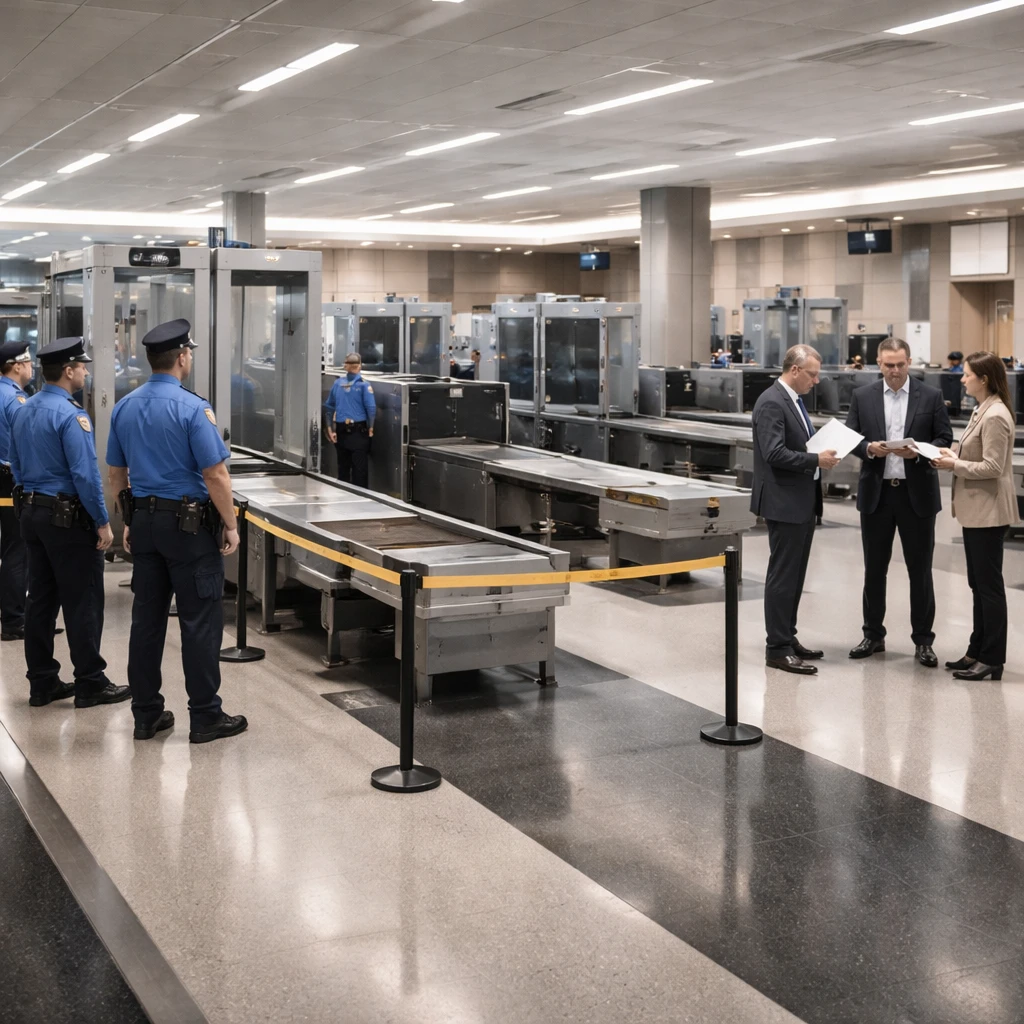
The White House has put forward a budget proposal that would reduce staffing at the Transportation Security Administration by more than 9,400 positions and cut slightly over $1.5 billion from the agency's funding, according to the budget documents.
The TSA currently employs roughly 60,000 people and is charged with managing security operations at airports. The administration's plan includes a two-track approach to shrink the agency's payroll.
First, President Donald Trump on Friday proposed a policy requiring smaller airports to discontinue the use of TSA officers and instead contract with private security firms. The White House describes this step as the initial move toward privatizing parts of the agency that was established after the September 11, 2001 attacks. Officials say shifting smaller airports to private security would reduce TSA payroll by more than 4,500 positions.
Second, the TSA itself is proposing additional workforce reductions to occur through internal changes. The agency has put forward plans to eliminate around 4,800 jobs by pursuing efficiency improvements, ending staffing at exit lanes, and removing redundancies in operations.
Summary
The administration's budget documents propose a combined reduction of more than 9,400 TSA jobs and a budget cut of just over $1.5 billion. The plan pairs a move to require smaller airports to use private security - described as a first step toward privatization - with an internal TSA proposal to streamline operations and cut positions by improving efficiency and eliminating overlapping roles.
Key points
- The White House proposal would cut over 9,400 TSA jobs and slightly more than $1.5 billion from the agency's budget, per budget documents.
- Requiring smaller airports to replace TSA officers with private security is presented by the administration as the first step toward privatizing parts of the agency; that change is estimated to reduce the TSA payroll by more than 4,500 employees.
- The TSA's own plan calls for about 4,800 additional job cuts via efficiency gains, ending staffing at exit lanes, and eliminating duplicative roles. The TSA currently has about 60,000 employees focused on airport security operations.
Risks and uncertainties
- The budget documents outline proposals rather than finalized policy, leaving the timeline and full implementation details unspecified in the materials provided.
- The extent to which smaller airports would transition to private security and the operational path for that change are presented as proposals, creating uncertainty about how and when payroll reductions would occur.
- The TSA's internal efficiency measures are described at a high level in the proposal; the documents do not provide further detail on how redundancies would be identified and removed.
The budget documents frame these measures as a combination of privatization steps for smaller airports and internal streamlining to reduce staffing needs. Beyond the figures and the broad methods laid out above, the materials do not include additional implementation specifics or timelines.