
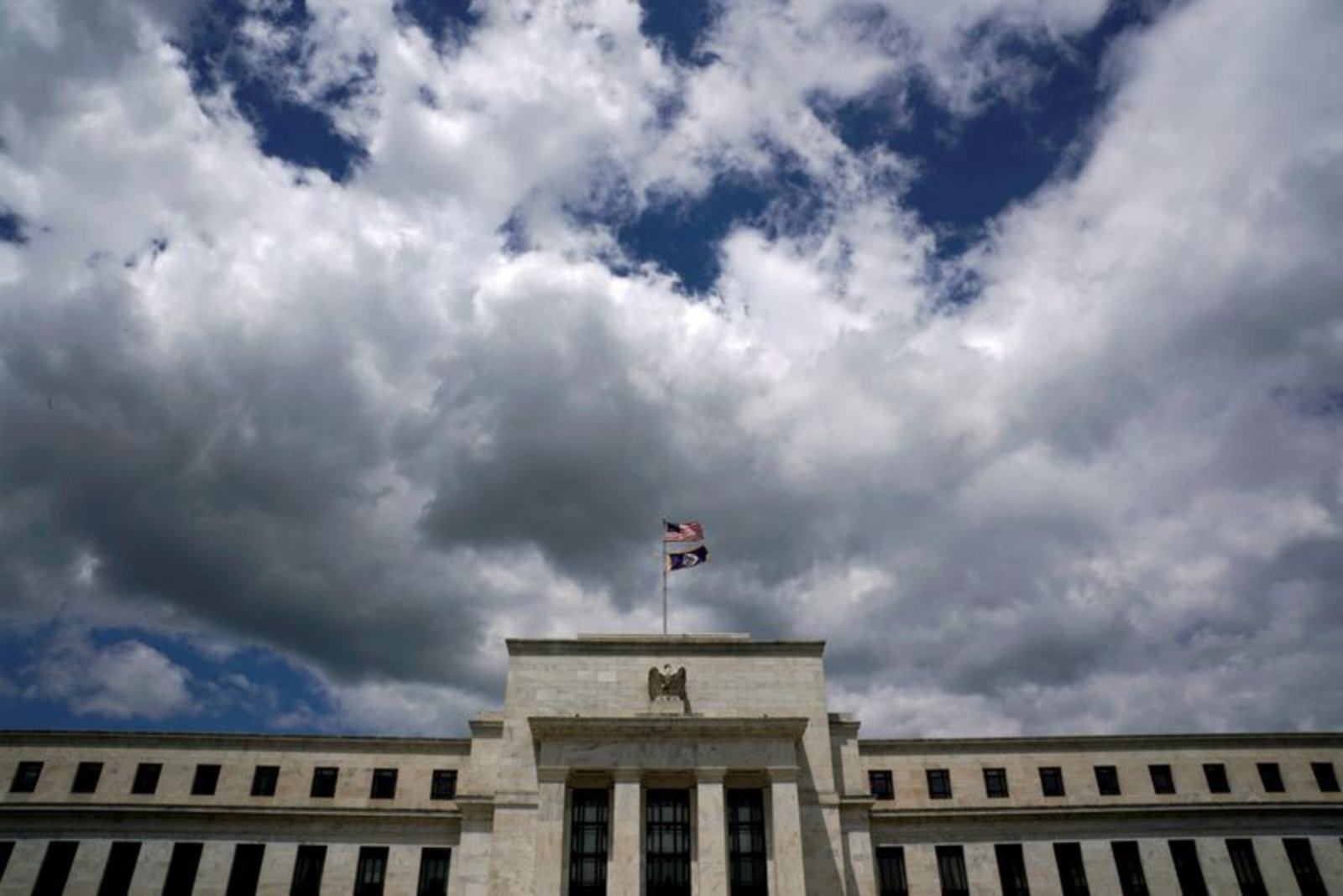
U.S. President Donald Trump recently complained that the trouble with appointing a new Federal Reserve chair is that "they change once they have the job." That observation has been taken as tacit encouragement by some on Wall Street, where banking executives I spoke to at the World Economic Forum in Davos said they have been preparing for a possible shift in the Fed's stance once a successor to current chair Jay Powell is named.
The central thread running through those conversations was twofold: first, that many market participants expect a new chair to enter office predisposed toward easing policy; second, that there remains hope the incoming leader will respond to hard economic evidence rather than political direction once vested with the role.
With probes reported into Powell and governor Lisa Cook, and broader questions about the Fed's independence intensifying, senior figures from global banks said they have been scenario-planning to gauge the effects on inflation, economic activity and their own balance sheets. Their baseline assessment is that a chair inclined toward rate cuts would raise the odds of higher inflation and push up long-term yields, but not necessarily trigger abrupt, irresponsible rate reductions.
"The Fed under a new chair is going to be less likely to react quickly when they see early signs of inflation building up, but they are not going to cut rates and 'put gasoline on a fire' either," one senior executive at a global bank told me. That view captures a tension in market thinking: an expectation of greater tolerance for inflationary pressures, tempered by confidence that the Fed’s procedural checks and the incoming chair's own incentives will limit extreme policy moves.
Another senior executive at a major U.S. bank interpreted the president's remark about people changing once they hold office as effectively offering the next chair "permission to be independent." That interpretation is consistent with an emerging narrative on the Street: nominees might be selected with a preference for more dovish thinking, yet once confirmed the chair could prioritize data and institutional norms over political signals.
Adding a research voice to that debate, David Doyle, head of economics at Macquarie Group, noted in a pre-meeting research note that there is "the potential for an incoming Fed Chair to sway the committee in a more dovish direction." Doyle also cautioned, however, that such a risk could be moderated by "a potential shift in the new Chair’s incentives once they assume the role."
Why independence matters
Fed independence is central to investor confidence and to preventing unanchored inflation. Several top bank CEOs, including the leaders of very large U.S. banks, have publicly emphasized the importance of preserving that independence as the administration presses on multiple fronts.
Powell himself has said that the Justice Department threatened him with criminal indictment over Congressional testimony regarding a Fed building project. He described that action as a "pretext" aimed at gaining more influence over the central bank and monetary policy. Such developments have sharpened the focus on the timing and politics of the next chair appointment: Trump is expected to announce his nominee to succeed Powell soon, and Powell's term as chair ends in May.
Markets are already reflecting concerns about the potential for political encroachment on the Fed. Some analysts point to these worries as one factor behind recent weaknesses in the dollar.
Public comments and private calculations
Conversations in Davos underscored that bankers do not rely on any single reassurance. Some cited the institutional design of the Fed and the role of fellow governors as constraints that would blunt attempts to exert direct control. The seven members of the Board of Governors are nominated by the president and confirmed by the Senate to staggered 14-year terms, a structure bankers said helps prevent any single actor from exerting outsized influence once inside the institution.
Yet not everyone at the forum was aligned on the implications. In a Davos panel, Commerce Secretary Howard Lutnick criticized the traditional, cyclical monetary approach of raising interest rates during rapid growth and lowering them as growth slows, describing that "classic" response as defining "mediocrity." He questioned why the United States should pay higher rates than other credits, framing it as a policy issue rather than one solely for central bankers.
When asked about the impact of such views on Fed independence, Lutnick said the president "will pick the governors, and the outcomes will be set by the Fed governors." One banking executive who followed Lutnick’s remarks said they read them as an expression of the president’s preference for "more like-minded thinkers" on the board rather than a demand for direct control, noting that appointment does not automatically remove independence once governors are in place.
Stress tests and balance-sheet preparations
Even as bankers expressed conditional optimism that institutional incentives would nudge a new chair toward evidence-based policymaking, many said their firms are preparing for less favorable outcomes. Several large banks are running stress tests across a wide range of macro scenarios, from stagflation and recession to episodes of simultaneous high growth and high inflation.
One source said their institution is examining how to manage interest-rate risk under each scenario. A less independent Fed, the source noted, could make stagflation or high-growth/high-inflation outcomes more probable, and the bank is therefore evaluating hedging approaches that can be implemented quickly to protect the balance sheet.
Another executive said his bank has taken steps over the past five years to substantially reduce interest-rate risk on its balance sheet, aiming to be more resilient to unexpected shocks. That bank runs stress tests that assume rapid swings in interest rates - for example, movements as large as 100 basis points beyond what markets currently price in - to ensure capital and liquidity metrics remain robust under tail-risk scenarios.
Those tail risks include events such as the COVID-19 pandemic, which produced abrupt financial stress, or more idiosyncratic shocks that in the past have been cited as extreme hypotheticals. The logic at many institutions is straightforward: if policymakers become less responsive to early inflation signals, the likelihood of longer, higher-inflation episodes rises, and banks need to be structurally prepared for that possibility.
Market implications and concluding observations
Across the conversations in Davos, the shared refrain was cautious preparation. While many banking executives judged it plausible that a new Fed chair would initially favor easier policy, most stopped short of assuming a rapid or reckless loosening. Instead, they emphasized the checks and incentives embedded in the Fed’s governance and the ability of data to redirect policy once a chair is installed.
At the same time, the fact that so many large banks are actively hedging interest-rate exposures and running robust stress tests points to a market that is pricing in increased uncertainty about the Fed's future stance. For markets and the broader economy, the balance between signaling, appointment choices and the Fed’s actual conduct in office will be critical to how inflation, long-term yields and currency valuations evolve in the months ahead.