
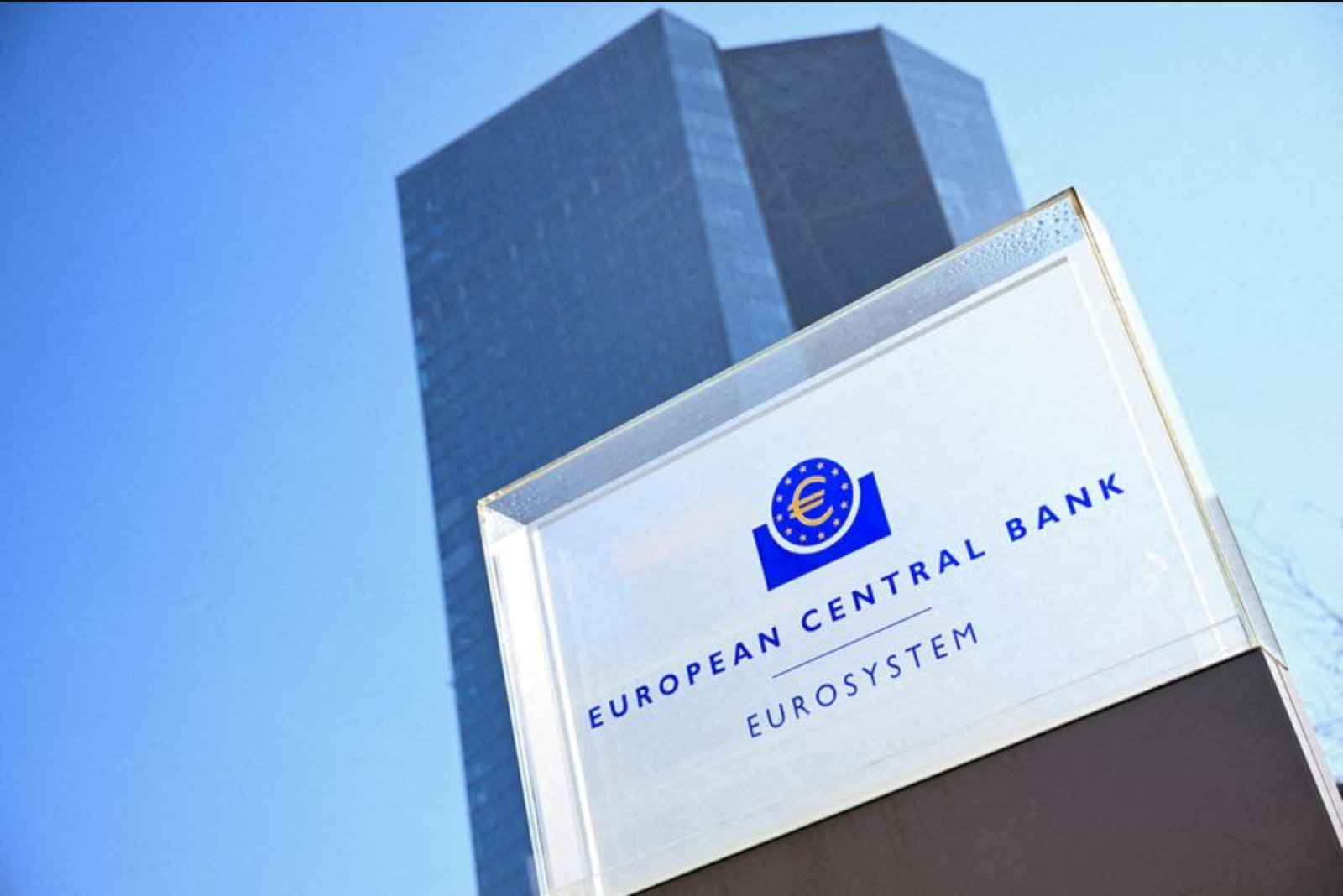
Money market participants are increasingly pricing a sustained period of tighter monetary policy from the European Central Bank, reflecting concerns that the recent energy supply shock will not be transient. After weekend negotiations failed to produce a settlement to end the Iran war, the U.S. military said it would begin a blockade of all maritime traffic entering and exiting Iranian ports and coastal areas on Monday - a move that market participants say has amplified the upward pressure on oil and gas prices.
The jump in energy costs since the conflict began has driven traders to assign up to an 80% chance of a rate increase at the ECB's April meeting, and to price in almost four further hikes in 2026. That marks a dramatic shift from the outlook that prevailed prior to the conflict, when markets saw roughly a 40% chance of a rate cut this year.
Two-year sovereign yields, which are the most sensitive to expectations for near-term policy rates and inflation, have climbed sharply across most euro zone countries. Analysts warn that if central bank rates remain higher for longer, financial conditions will tighten, overall growth will slow and governments will face higher debt-servicing costs - a particular concern for countries with large debt burdens.
Benchmark moves underline the change in market positioning: Germany's 10-year yield has risen above 3%, and the spreads of Italian and French yields over German Bunds reached their widest levels in 10 and 5 months, respectively, by late March.
Several economists argued that the ECB, having underestimated inflation in 2022, is likely to act more swiftly this time to prevent inflation becoming self-sustaining through second-round effects, where initial price shocks feed into wages and broader price-setting behavior. Worries about lasting damage to regional energy infrastructure - and the consequence for both short- and long-term inflation - have also pushed longer-term bond yields higher, they said, even if a peace accord were to be reached immediately.
"If the Iran conflict persists, the ECB might ultimately deliver more than two hikes and might even consider 50-bp steps," said Reinhard Cluse, chief European economist at UBS.
Market pricing shows a considerable repricing of policy over the coming months. Traders now expect the key rate to be around 2.6% over the next 15 months, compared with just under 2% before the war began. The euro short-term rate (ESTR) 5-year overnight index swap - often viewed as a market-implied gauge of the medium-term policy outlook and the neutral rate - has risen and remains noticeably above 2.4%, its highest level in the prior 19 months.
"With this high level of uncertainty, the focus is primarily on inflation," said Luca Pennarola, senior economist at BNP Paribas. "Definitely we can see ECB doing more than 75 bps (of rate hikes, if the backdrop worsens). I don’t see a limit to that, to be honest." His comment underscores the view among some economists that the central bank will prioritize preventing inflation from becoming entrenched.
Carsten Brzeski, head of macro strategy at ING, cautioned that markets may be underestimating the negative effects on growth from higher oil prices. He laid out a contingent near-term path for policy: two rate hikes by June and the potential for a cut in December if the Strait of Hormuz does not remain closed before the summer; no policy change if it reopens before summer.
Forward interest-rate contracts that are closely linked to oil prices posted their largest monthly increase on record after Iran effectively shut the Strait of Hormuz, a strategic chokepoint responsible for roughly a fifth of global oil and gas supplies. That dynamic has reinforced market expectations that energy-driven inflation could be persistent rather than temporary.
Despite the repricing toward higher rates, a market gauge of inflation expectations indicates investors still expect the ECB to bring price pressures under control, with medium-term inflation expectations sitting slightly above 2%.
Silvia Ardagna, head of European economic research at Barclays, attributed part of that market confidence to the central bank's track record following earlier energy shocks. "It is, in part, the credibility that the ECB has gained after the Russia-Ukraine crisis: they have demonstrated that they were able to bring inflation back to 2%," she said. Ardagna added that this confidence is, however, conditional on assumptions about the reopening of the Strait of Hormuz.
As markets digest the dual risks of elevated energy prices and a central bank prepared to act to prevent second-round inflation effects, investors and policymakers face a narrower margin for error. Financial conditions that tighten as a result of prolonged higher rates would likely weigh on growth and increase fiscal pressure on indebted governments, while also reshaping returns across fixed income, equities and energy-related sectors.