
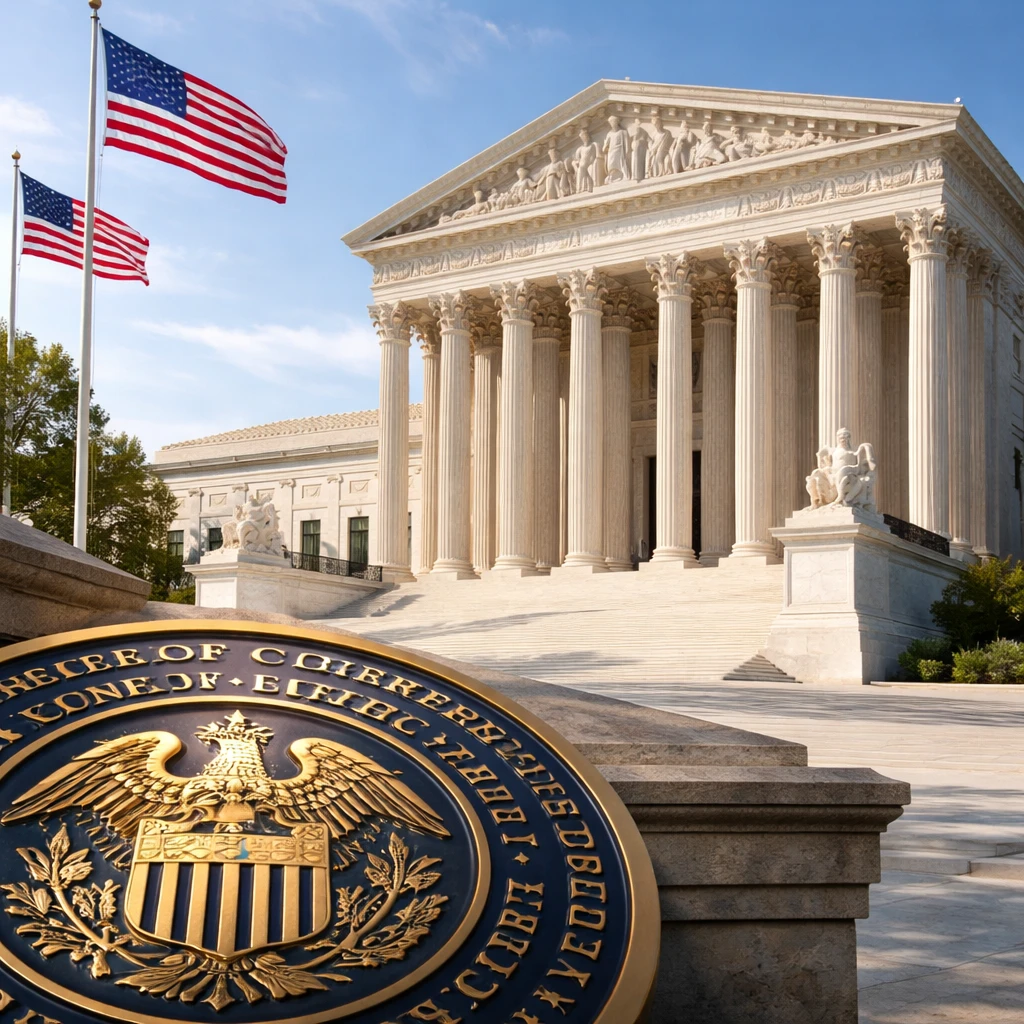
In Washington, D.C., a pivotal Supreme Court hearing sparked a focused discussion among justices regarding President Donald Trump's move to remove Lisa Cook, a sitting governor of the Federal Reserve Board. The panel's questions and remarks on Wednesday signaled a strong recognition of the vital role that Federal Reserve independence plays in safeguarding the nation's monetary policy from political sway. Several justices indicated that extensive presidential authority to oust Federal Reserve officials might jeopardize not only the institution's credibility but also the broader economic stability grounded in over a century of insulated central banking practices.
Conservative Justice Brett Kavanaugh particularly articulated these worries during an exchange with Solicitor General D. John Sauer, who is defending the president's position. Justice Kavanaugh cautioned against permitting removal without judicial oversight or a defined process, warning it would effectively undermine the Federal Reserve's independence. "The notion that there would be no checks, no review, and that the president alone decides with minimal threshold for cause, risks fracturing the Federal Reserve's autonomy," Kavanaugh asserted. He stressed the potential for a 'search-and-destroy' approach wherein presidents could arbitrarily target policymakers by manufacturing reasons for dismissal, void of any external scrutiny.
This legal confrontation over Governor Cook's tenure arises against the backdrop of former President Trump's persistent calls for the Federal Reserve to accelerate and deepen interest rate cuts amidst entrenched inflation pressures. Trump criticized the current Federal Reserve Chair Jerome Powell for not moving aggressively enough and expressed intentions to replace him once his term concludes in May. Trump defended the push to remove Cook by citing unsubstantiated accusations related to mortgage application discrepancies predating her 2022 appointment by President Joe Biden, whose term for Cook extends until 2038. Cook herself has dismissed these claims as a facade for policy disagreements.
Adding complexity to the situation, the Department of Justice, under Trump's direction, initiated a criminal probe into Chair Powell over his involvement in renovating historic Fed headquarters buildings. Powell also decries this investigation as a politically motivated tactic to seize control over monetary policy decisions.
Justice Amy Coney Barrett, another Trump appointee on the court, probed the Solicitor General on the potential economic fallout from allowing the removal to proceed. Referring to economist filings warning that such a precedent could induce a recession, Barrett questioned how the court should weigh public interest considerations. Sauer contended that market reactions following the announcement of Cook's firing demonstrated optimism, but Barrett declined to rely solely on market movements to assess risk. She emphasized judicial caution in quantifying economic consequences, positioning herself as a judge rather than an economist, and highlighted the prudence warranted if risks exist.
Economists broadly agree on the principle that central banks insulated from short-term political pressures produce superior long-term economic results. This can mean enduring periods of higher interest rates to rein in inflation, even when this slows growth or elevates unemployment—outcomes often politically unpalatable. Within this context, the Supreme Court justices are weighing the traditionally robust independence of the Federal Reserve against arguments forwarded by the Trump administration, which posit the president's prerogative to remove federal agency officials he deems unsuitable.
The court has previously favored Trump in various emergency rulings that uphold his capacity to remove agency officials pending protracted litigation. Nevertheless, the Federal Reserve's unique role as the cornerstone of U.S. and global finance places this case in distinct legal territory. Liberal Justice Sonia Sotomayor underscored this by noting that retaining Governor Cook would not obstruct any presidential rights concerning agency leadership since monetary policy decisions traditionally do not fall under executive branch discretion. Sotomayor also referenced the lower court ruling that blocked Trump's attempt to fire Cook without notice or hearing, finding it likely violated due process under the Fifth Amendment.
As the Supreme Court evaluates whether to lift this injunction pending a full hearing of Cook's legal challenge, Justice Sotomayor emphasized the importance of due process and thorough judicial consideration. She stated, "We recognize the agency's independence is highly significant, and if we rush to judgment without appropriate deliberation, that independence suffers. Allowing courts below to examine all aspects carefully protects public confidence in legal and administrative processes." Sotomayor further questioned the rationale for premature court intervention, advocating for final decisions after full case development.
A Supreme Court ruling is anticipated by the end of June though may be issued earlier. The outcome will have profound implications for the Federal Reserve's operational independence and the balance of power between the presidency and monetary policymaking.