
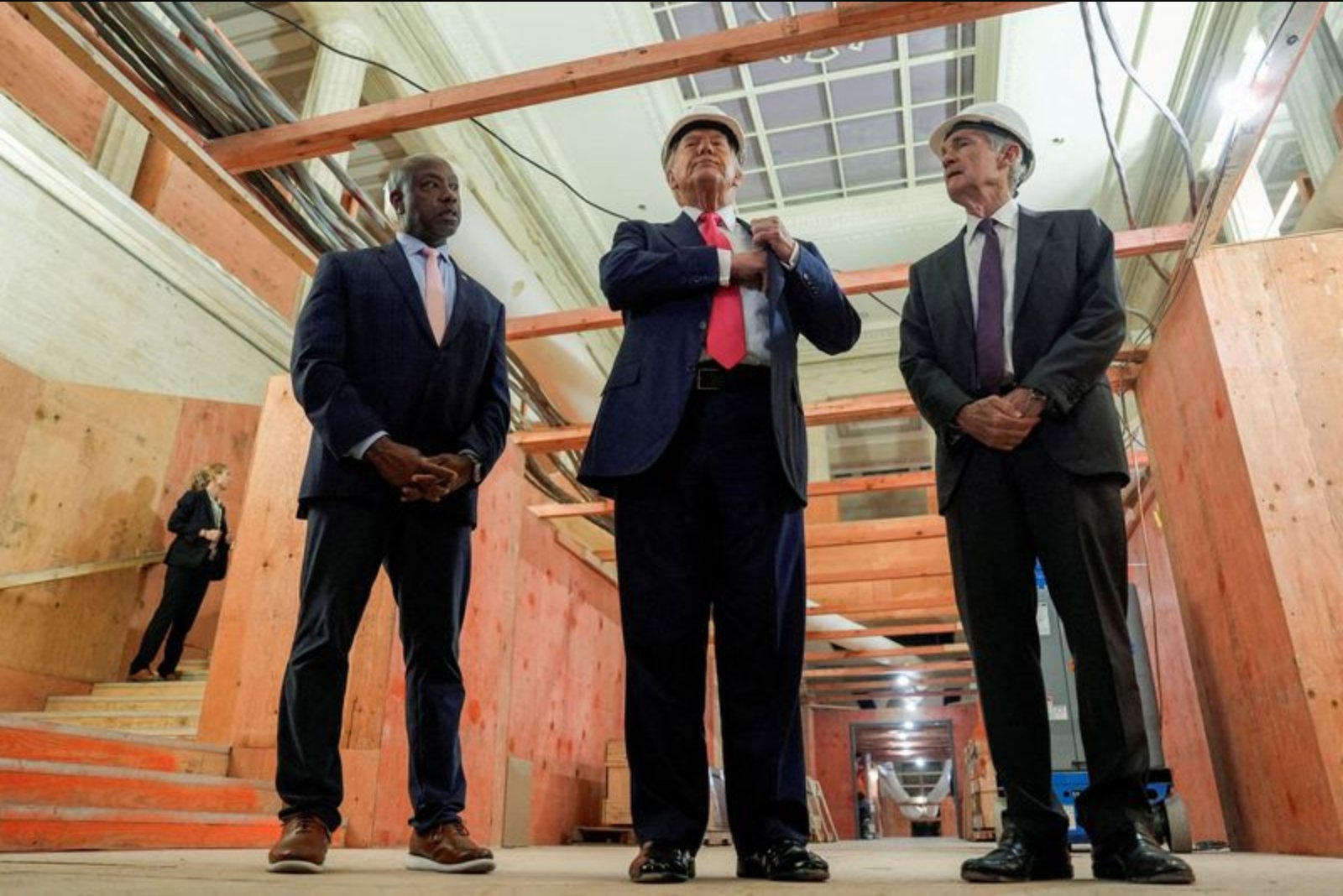
Senate Banking Committee Chair Tim Scott on Wednesday pushed back against the idea that Federal Reserve Chair Jerome Powell committed a crime in his testimony to the panel last summer, saying he would tell any prosecutor that he does not believe criminal charges are warranted.
Scott’s remarks mark the first time the panel’s chair has publicly questioned the rationale for a criminal investigation into Powell, an inquiry started by the Justice Department that has emerged as a key obstacle to President Trump’s effort to replace Powell by the time his leadership term ends in May.
The investigation came to light more than three weeks after the Fed disclosed it had been served with DOJ subpoenas related to Powell’s June remarks to the Senate Banking Committee about renovations to the central bank’s buildings. The White House had alleged the Fed overspent on those projects. Powell has described the subpoenas as an attempt at intimidation and part of a broader campaign by the president to pressure the Fed to lower interest rates.
The revelation of the probe triggered widespread criticism from Democrats and drew notable Republican concern, including from Senator Thom Tillis, a committee member who called the inquiry political interference and said he would block any Fed nomination while the probe is active.
President Trump has named former Fed Governor Kevin Warsh as his choice to succeed Powell. Warsh, who aligns with the president on the need for lower rates, enjoys support among many Republicans. But Tillis’ announced opposition has effectively paused movement on Warsh’s nomination in the Senate Banking Committee - a necessary step before a full Senate confirmation vote.
In a television interview on Fox Business Network, Scott, who said it was he who questioned Powell about the building renovations, told host Maria Bartiromo: "I do not believe that he committed a crime during the hearing." Scott added he would tell any prosecutor who came to his office that Powell was "to be inept at doing his job, but ineptness or being incompetent is not a criminal act."
Scott also said he had held productive discussions with Tillis, and that, in his view, Tillis would vote to advance Warsh. "I believe we can solve the Jay Powell issue and move forward with a strong vote for all Republicans on the committee," Scott said.
Despite Scott’s efforts to reassure colleagues about Powell’s conduct, Tillis remained firm in public comments on CNBC, describing the DOJ probe as "vindictive" and suggesting it appeared aimed at forcing a Fed board member out over policy disagreements. Tillis said the investigation could have unintended consequences - including prompting Powell to remain on the Fed Board as a governor after his chair term ends.
Powell’s leadership term at the Fed concludes in May, while his term as a governor runs through 2028. Tillis noted that while most chairs leave the institution when their chair terms end, Powell has not committed publicly to doing so. If Powell chose to stay as a governor, Tillis said, it would deny the White House an additional open seat to fill with someone who favors lower rates and add complexity to the leadership dynamics should a new chair take office while Powell remained influential on the policy-setting committee.
"The perverse consequence of this is maybe Fed Chair Powell will think about being on the board for two more years," Tillis said. "I know how I would react to this: I’d be there for the remaining two years because I don’t want to reward bad behavior, but that’s a decision that Chair Powell makes and he’s probably a little bit less confrontational than I tend to be."
In a separate appearance, committee member Senator Kevin Cramer said he viewed Tillis’ decision to oppose Warsh while the DOJ probe is ongoing as unlikely to be a "winning strategy." Asked whether he thought Powell might remain on the board, Cramer said he hoped Powell would "exit gracefully." At the same time, Cramer said of Powell, "I don’t think that he belongs in a federal courtroom or a federal penitentiary."
The convergence of the DOJ subpoenas, public criticism of the inquiry, and divisions within the Senate GOP has left the Warsh nomination stalled for now. The Senate Banking Committee must approve any Fed nominee by a majority vote before the nomination can move to the full Senate. With Democratic opposition united behind the view that proceeding under the shadow of a criminal probe would imperil the Fed’s independence, Tillis’ stance could lead to a tied committee vote and keep Warsh’s nomination bottled up at the panel.
Warsh remains a favored candidate among many Republicans because his views align with the president’s desire for lower interest rates. But until the committee’s dynamics change - whether through a shift in Tillis’ position, a resolution of the DOJ probe, or other developments - the path for Warsh to the full Senate appears uncertain.
Contextual note - The situation described here is focused on statements and actions by senators and the DOJ subpoenas related to Powell's testimony on renovations. It reflects the positions and remarks made publicly by the officials cited and the procedural stakes for the Senate Banking Committee and the Fed.