
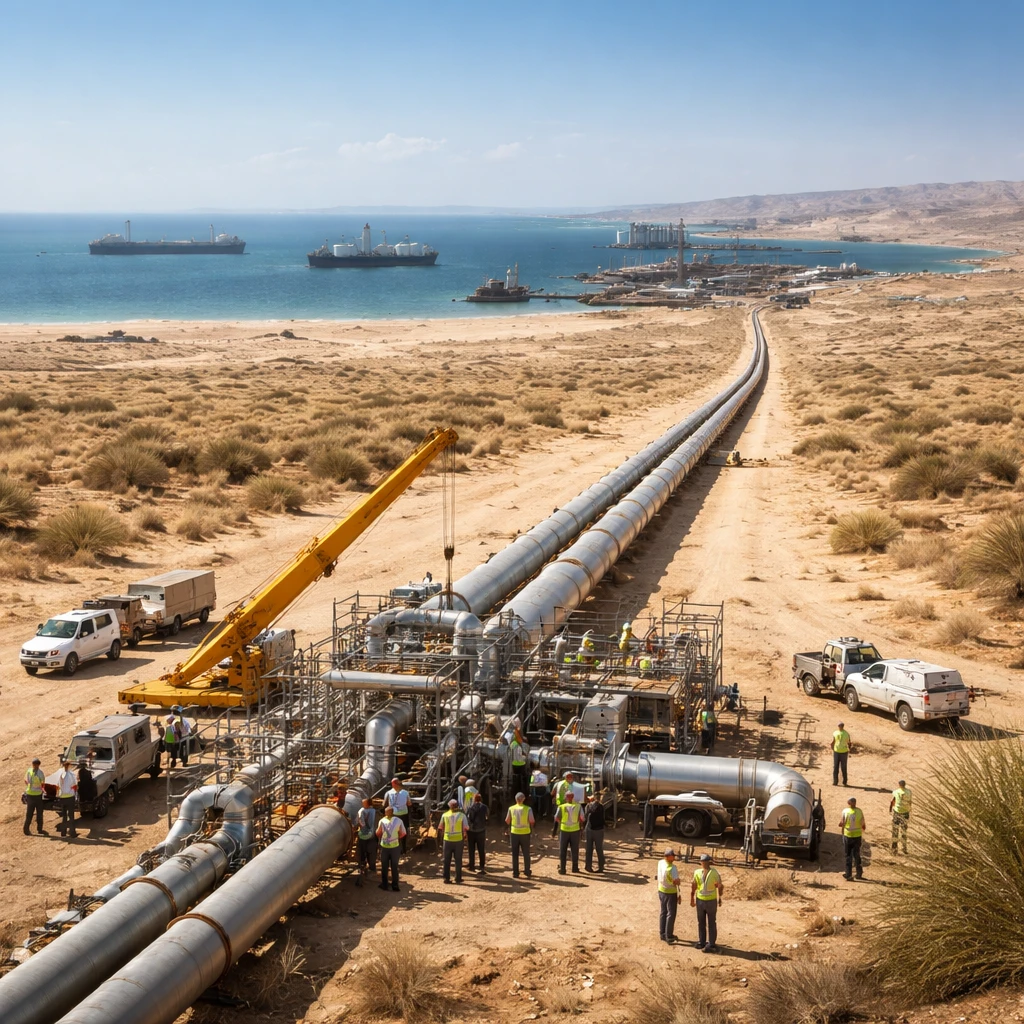
Saudi authorities announced the full restoration of the East-West pipeline's 7-million-barrel-per-day pumping capacity after completing repairs to a pumping station hit in a strike last week. The energy ministry said the rehabilitation returned 700,000 barrels per day of throughput to service, renewing a key export artery as the kingdom continues to route crude away from the Strait of Hormuz.
The repaired conduit runs roughly 746 miles (1,200 kilometers) across the country and is central to Riyadh's ongoing strategy of shipping more crude from Red Sea terminals. Saudi officials noted that shipments through those terminals have quadrupled since late February as they compensate for the near-total suspension of Persian Gulf shipping lanes.
In addition to the pipeline repair, Saudi Aramco restored output at the Manifa offshore facility, which had been disconnected for 300,000 barrels per day amid regional hostilities. The energy ministry, speaking via the Saudi Press Agency, described the rapid recovery as evidence of "high operational resilience and crisis management efficiency" within Saudi Aramco and the broader national energy ecosystem.
Not all disruptions have been resolved. The Khurais onshore complex, an important supplier of the light crude that normally moves through the East-West line, remains under repair after losing 300,000 barrels per day of capacity. That ongoing work means some parts of the supply chain are still fragile even as other links come back online.
Restoring the East-West pipeline bolsters the kingdom's ability to deliver crude to international buyers at a time when global markets are sensitive to supply risks. The energy ministry framed the network stabilization as improving the reliability of Saudi shipments to a market that, the ministry said, is still coping with the fallout from the Islamabad diplomatic breakdown.
Alongside developments in Saudi infrastructure, Iran reported progress on domestic recovery efforts. Iran's Deputy Minister of Oil indicated that damaged refinery and distribution facilities are expected to regain between 70% and 80% of their previous capacity within one to two months. That timeline points to an internal focus on technical restoration even as maritime routes remain insecure.
Market observers say the complete reopening of the East-West pipeline provides an important safety valve for global crude flows, although the continuing repairs at Khurais and persistent security concerns for Red Sea transit are keeping a conflict-related premium embedded in Brent and WTI futures.
Summary
The East-West pipeline has resumed its full 7 million bpd pumping capacity after the kingdom repaired a damaged pumping station, returning 700,000 bpd online. Aramco also brought Manifa output back after a 300,000 bpd disruption. Khurais remains under repair for its 300,000 bpd outage. Iran expects 70-80% recovery of damaged refineries and distribution within one to two months.
Key points
- Restoration of the 746-mile East-West pipeline returns 7 million bpd capacity and adds 700,000 bpd of throughput - sectors affected: oil production, export logistics, global oil markets.
- Saudi Aramco recovered Manifa output that had been down 300,000 bpd and continues to repair the Khurais onshore complex, which still has a 300,000 bpd outage - sectors affected: upstream oil operations and refining feedstock availability.
- Iran projects 70-80% recovery of damaged refinery and distribution capacity within one to two months, indicating regional efforts on internal stabilization - sectors affected: refining, domestic fuel distribution.
Risks and uncertainties
- Ongoing repairs at Khurais leave part of Saudi crude supply vulnerable - impact on upstream production and export reliability.
- Security risks to Red Sea transit continue to apply a "war premium" to Brent and WTI futures - impact on global oil prices and shipping costs.
- Broader regional diplomatic and security tensions, referenced through the Islamabad diplomatic breakdown, add uncertainty to export routes and market sentiment - impact on commodity markets and energy-dependent sectors.