
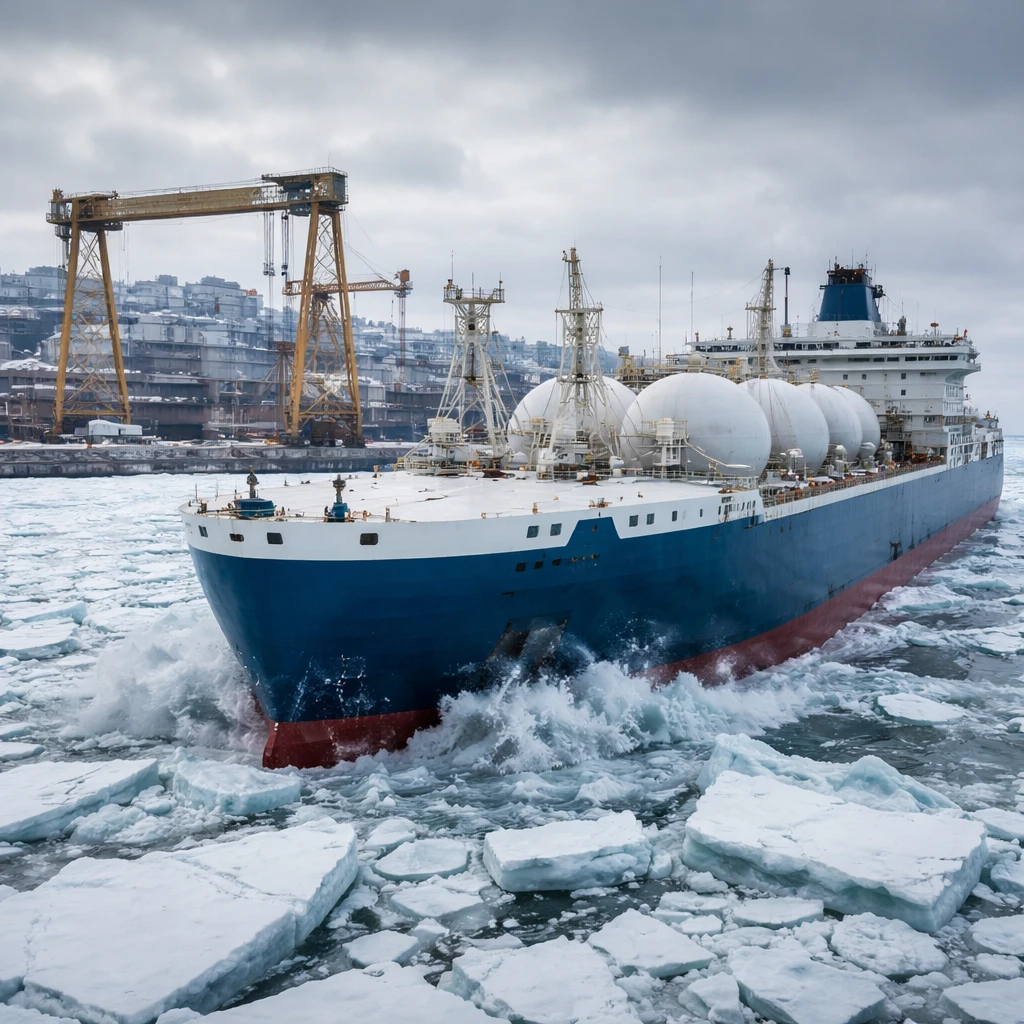
Prime Minister Mikhail Mishustin said today that Russia will commission its second domestically built ice-class liquified natural gas carrier, the Konstantin Posiet, at the Zvezda shipyard in the country’s far eastern Primorsky region.
The Konstantin Posiet is the latest addition to a class of vessels intended to move LNG from Russia’s Arctic developments to Asian and other markets on a year-round basis. The ships are designed to operate in severe conditions; the Zvezda facility focuses on large Arc7 ice-class tankers that can break through ice up to two meters thick.
Zvezda has been described as one of Russia’s most advanced shipbuilding facilities. The yard was originally scheduled to construct 15 tankers for the Arctic LNG-2 project. According to the announcement, sanctions associated with the conflict in Ukraine have created delays and complications for that construction program.
State-controlled Sovcomflot, Russia’s largest shipping company, previously took delivery of the first domestically built Arc7 ice-class tanker, the Alexei Kosygin, in December 2025. The commissioning of the Konstantin Posiet follows that delivery and represents the next step in deploying domestically produced heavy ice-capable tonnage to support Arctic exports.
The program is positioned to enable year-round shipments from Arctic fields to distant markets, with an emphasis on routes to Asia. The vessels’ icebreaking capability is a technical requirement for operations in thick ice fields and informs the shipyard’s focus on Arc7-class designs.
Context and commercial implications
The deployment of additional domestically built Arc7 tankers is intended to support continuous LNG flows from Arctic projects by providing vessels able to operate in harsh, ice-prone waters. The extent to which the original plan of 15 tankers will be completed has been affected by the construction delays and complications cited in the announcement.
This commissioning underlines ongoing efforts to field ice-capable shipping capacity despite logistical and geopolitical obstacles identified by authorities.