
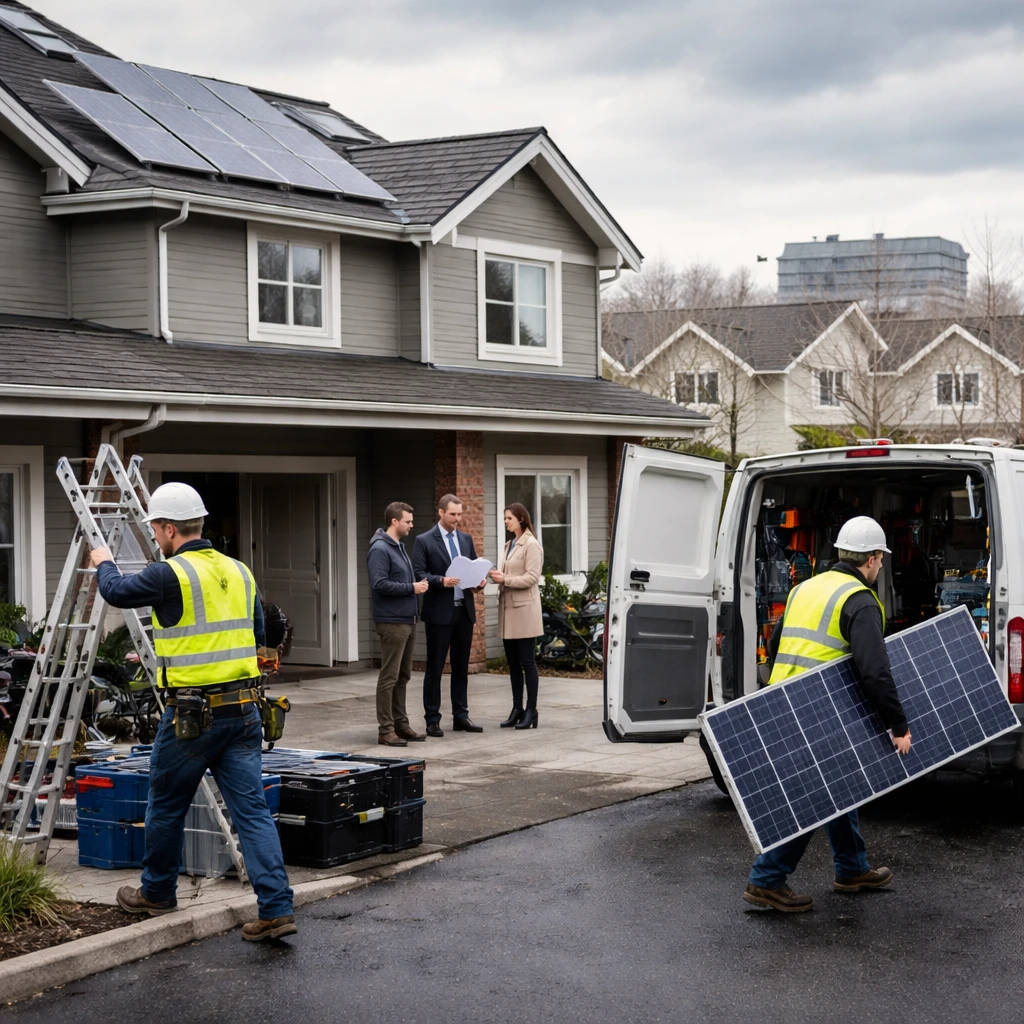
The U.S. residential solar market is entering a period of pronounced contraction after the 30% federal income tax credit for homeowners who purchase rooftop systems expired at the end of 2025 under President Donald Trump’s tax overhaul. That incentive had been a central driver of more than a decade of rapid growth in rooftop installations; its removal comes as the sector already faces pressure from higher interest rates and reduced state-level support, prompting layoffs, market withdrawals and a handful of company failures.
Industry participants report an abrupt slowdown in demand. "We’re going to see, between now and July, a very meager market that is going to be struggling to sustain itself," said Chris Castro, chief sustainability officer at Climate First Bank, which provides loans for solar projects. The change has forced both manufacturers and installers to reassess staffing and operating plans.
Among the companies announcing workforce reductions, Enphase - a manufacturer of microinverters that convert solar power into usable electricity - said last month it would eliminate 160 positions, equal to about 6% of its staff, and move to lower operating costs because of the policy shift. Freedom Forever, the country’s second-largest residential installer behind Sunrun, informed Reuters that it pulled out of 10 of its 30 state markets and cut roughly 20% of its employees, according to policy director Ben Airth.
Some smaller installers have been hit harder. Purelight Power, an Oregon-based firm operating in about a dozen states, filed for Chapter 11 bankruptcy protection on December 30; the filing affected roughly 200 workers. Texas-based TriSMART Solar reportedly suspended operations at the end of last year, according to employee posts on LinkedIn. Company leadership did not respond to requests for comment.
The policy change is part of a broader rollback of clean energy subsidies enacted by the administration since President Trump took office last year. The administration has argued that solar and wind are more expensive and less efficient than fossil fuels and has questioned climate-related concerns.
Analysts and industry data services have adjusted forecasts sharply downward in response to the lost federal credit. Solar analytics firm Ohm Analytics reduced its projection for residential panel installations, saying it now expects a 20% decline in 2026 rather than an 8% increase it had earlier projected. Wood Mackenzie similarly predicts installations will drop to their lowest level since 2020 - when the COVID-19 pandemic halted much activity - and that the market will not recover until the end of the decade.
Industry participants warn the slowdown could complicate efforts to meet rising electricity needs driven by the expansion of new datacenters, undermining what some describe as a key policy objective. "This is the easiest and fastest way to support the increased demand," said Emily Walker, director of content and insights at EnergySage, an online solar marketplace that has diversified into heat pumps and other home energy equipment.
EnergySage said the removal of the federal incentive has extended the typical payback period for rooftop systems to about 10 years from around seven years previously, and has made systems roughly $8,000 more expensive for homeowners.
Not every business model in the residential solar ecosystem is equally exposed. Third-party ownership (TPO) structures - where a company like Sunrun owns the rooftop system and sells the generated electricity to the homeowner under a subscription-style contract - remain eligible for a separate federal tax credit. That access allows owners of TPO portfolios to pass some savings to customers and has prompted a strategic shift among some installers.
Many firms that historically served cash buyers or customers using loans are now working with financiers to pivot toward TPO arrangements. "People are looking to save, and that TPO product is the quickest route to do so," said Zac Hare, vice president of residential sales at Lumina Solar in Maryland. Enphase and Freedom Forever have introduced third-party ownership financing products that enable customers to take ownership of a system after several years of leasing. Other installers are partnering with financiers such as IGS Energy and HDM Renewable Finance to offer comparable structures.
However, not all industry stakeholders see leasing as a clear win for homeowners. Some installers and technical sales professionals highlight potential complications associated with leasing contracts, especially when a homeowner seeks to sell the property. "I don’t see the value in a lease to a homeowner," said Tom Mills, director of technical sales at installer Alpenglow Energy in Park City, Utah.
The sector’s near-term trajectory will depend on how quickly demand adjusts to higher out-of-pocket costs, how broadly TPO models can scale, and whether state policies or private financing can partially fill the gap left by the expired federal tax credit. For now, the immediate effects are visible in workforce reductions, market retrenchment and a reshaping of sales and financing strategies across the residential solar landscape.