
During his address at the World Economic Forum in Davos, Nvidia Chief Executive Officer Jensen Huang underscored the substantial employment opportunities emerging from the fast-growing artificial intelligence sector. Huang described this surge as the largest infrastructure expansion in recorded human history, which is expected to produce a multitude of employment prospects. Significantly, he pointed out that many of these jobs are rooted in skilled trades rather than solely in high-level academic roles.
He elaborated by naming specific occupations that will experience heightened demand, including plumbers, electricians, construction workers, steelworkers, network technicians, and professionals involved in equipment installation and setup. Highlighting a positive economic trend, Huang noted that salaries within these professions are experiencing a notable increase, nearly doubling in some cases.
Focusing on the nature of the growth, Huang mentioned that individuals working on the construction and operation of chip manufacturing plants, computer factories, and AI-specific production facilities can expect six-figure incomes. This development challenges prevailing narratives about AI predominantly displacing workers and instead demonstrates tangible benefits for those in trade crafts.
Huang’s remarks come at a time when other major global companies, including Amazon, Salesforce, Accenture, and Lufthansa, have identified artificial intelligence developments as factors influencing plans for workforce reductions in 2025. Despite these concerns, Huang maintained an encouraging perspective by asserting that good earnings are accessible to those without doctoral degrees in computer science, emphasizing the broad inclusivity of opportunities facilitated by AI infrastructure growth.
His insights signal a complex dynamic in the labor market, wherein AI technology drives both shifts in employment structures and the emergence of lucrative, specialized trade roles linked to the building and maintenance of AI-related industrial facilities.
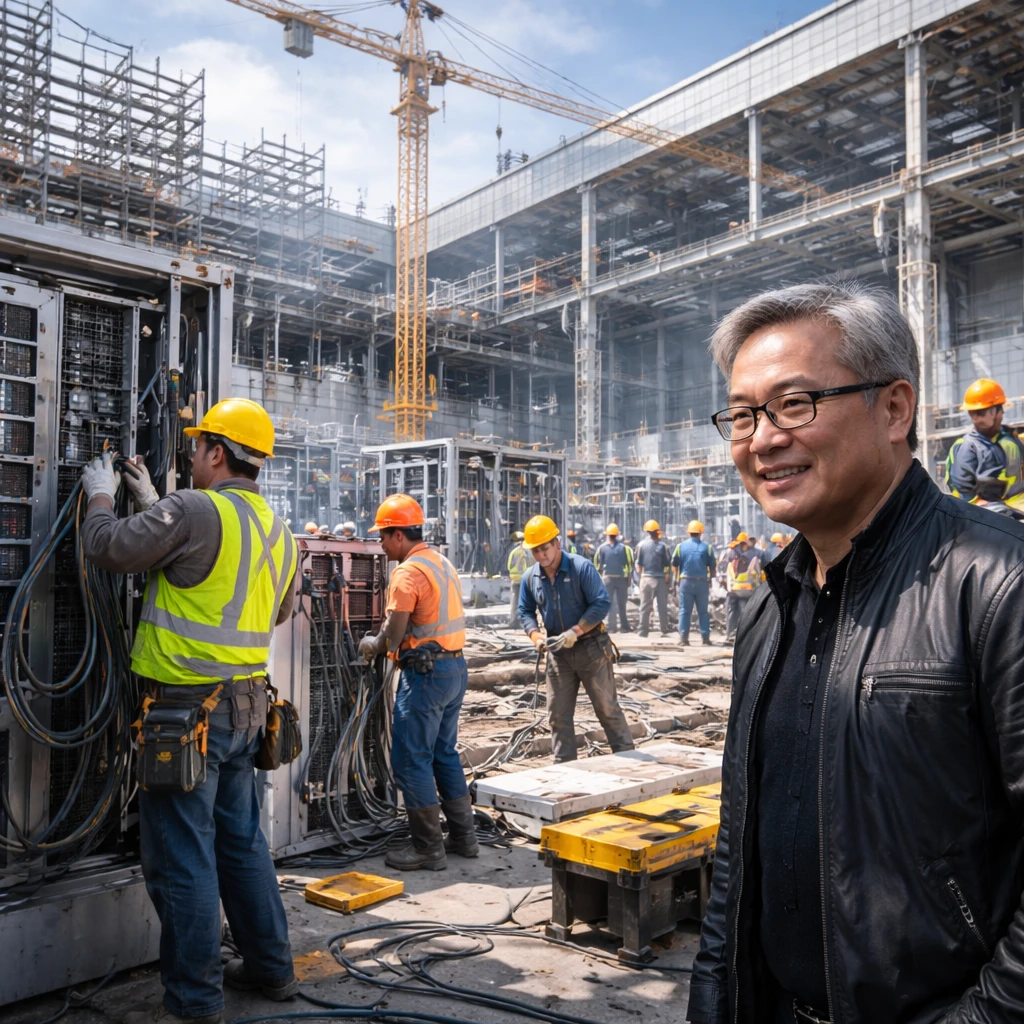
Nvidia CEO Jensen Huang shared insights at the World Economic Forum in Davos about the substantial job creation resulting from the ongoing AI infrastructure expansion. He emphasized that this development is generating numerous well-paid trade positions, challenging misconceptions about AI eliminating jobs exclusively in technical sectors. Despite concerns about automation, Huang conveyed optimism about opportunities for workers without advanced degrees, citing almost doubled salaries in several skilled trades linked to AI-related factory construction and maintenance.
Key Points
- The artificial intelligence sector is driving the largest infrastructure build-out in human history, leading to substantial job creation in various skilled trade occupations.
- Salaries for trade roles related to AI infrastructure, such as technicians and construction workers involved in chip and AI factory development, are significantly increasing, nearing six-figure levels.
- Despite broader concerns about AI leading to job reductions, especially within white-collar professions, opportunities are expanding for workers without advanced degrees in computer science across several technical trades.
Risks
- Several prominent corporations have cited AI as a driver behind planned employee layoffs for 2025, highlighting ongoing labor market adjustments and uncertainty in certain sectors.
- The rapid advancement in AI infrastructure creates uncertainties around workforce requirements and the balance between automation and human labor, potentially impacting wage dynamics and job availability.
- As sectors like technology manufacturing and network services expand their AI-related infrastructure, the demand for specialized skilled labor may strain training and education systems needed to meet this growth.