
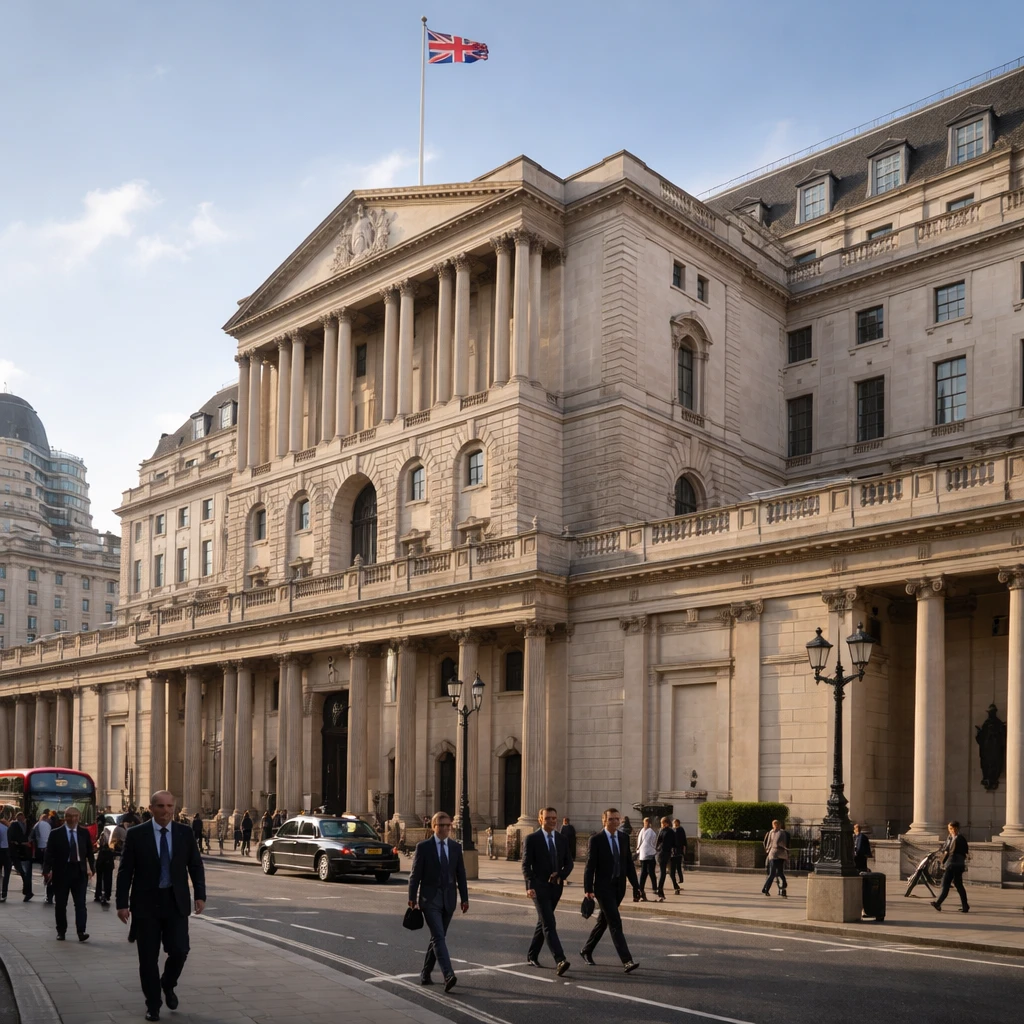
The Bank of England is widely expected to maintain its policy rate at 3.75% at the February meeting, according to a Reuters poll conducted between January 21 and 26. Of 56 economists surveyed, 54 predicted the Monetary Policy Committee (MPC) would leave Bank Rate unchanged at its February 5 gathering, with only two foreseeing a cut to 3.50%.
The survey captures a policy backdrop in which the nine-member MPC has been narrowly split at recent meetings. The committee's last decision in December was a 5-4 vote in favour of a quarter-point reduction, illustrating how finely balanced the stance among policymakers remains.
Recent data that could shape the February deliberations include the strongest private sector business expansion since April 2024, unexpectedly robust retail sales, and inflation that has moved further above the 2% target. Those indicators have complicated the case for immediate further easing, and the poll suggests the bank may prefer to wait for additional evidence before pressing ahead with more cuts.
Sanjay Raja, chief UK economist at Deutsche Bank, captured that caution in his assessment: "If you go back to December, some of the voters who have cited two-sided risks to the outlook have talked about the need for a potentially larger accumulation of evidence before we have the next move in Bank Rate. And so that gives us some pause for thought in thinking whether this is an MPC that potentially considers skipping Q1 entirely...The bank will want to take a wait-and-see approach, let the dust settle on some of the data."
Looking beyond February, the unanimous expectation for a hold is less firmly translated into the timing of subsequent easing. Only 31 of the 56 economists surveyed - about 55% - now expect the MPC to deliver a rate cut by the end of March. The remaining 45% anticipate that Bank Rate will remain unchanged through the first quarter.
By contrast, in December's poll a stronger consensus existed for near-term easing: 72% of respondents then expected a 25 basis-point cut or more during the quarter. The shift between surveys reflects the influence of the recent positive economic data and the persistence of inflation above peers in the Group of Seven.
The poll also found no majority view on the path of interest rates beyond the current quarter. The median projection shows a final cut to 3.25% in the third quarter of the year, but individual expectations vary. A majority of economists still project rates will bottom at 3.25% or lower by year-end, with 21 predicting Bank Rate at 3.25% by the end of the year, 16 forecasting 3.00% and two anticipating 2.75%.
Growth and inflation projections in the survey remained broadly unchanged from December. The UK economy was forecast to expand by 1.0% in the current year and by 1.4% in the following year. Inflation was expected to average 2.5% this year and to decline to 2.1% in 2027.
Several forecasters pointed to factors that could push inflation down in the months ahead. Ellie Henderson, an economist at Investec, noted that a one-year comparison effect will begin to work in January - the prior-year inclusion of 20% VAT on private school fees will drop out of the annual calculation. Henderson also flagged expectations for smaller rises in household water bills from April. She added: "There are also signs the labour market is loosening, wage growth is coming down, that should weigh on services inflation as well. So yeah, we think inflation will fall over the coming months, not quite to the 2% target, but we’ll certainly make progress towards it."
At the same time, some MPC members remain attentive to upside wage pressures. MPC member Megan Greene, speaking on Friday, said she remained concerned about how much businesses plan to increase pay this year and the potential challenge that could pose for returning inflation to the 2% target.
The poll highlights the narrow margin for a policy shift in a period of mixed signals: stronger private sector activity and retail spending point toward looser financial conditions, while persistent inflation and uncertainties in wage dynamics argue for continued caution. Against that backdrop, the Bank of England will publish updated quarterly forecasts when it meets in February, and the MPC's decision is likely to reflect a careful weighing of the recent data rather than a decisive move in either direction.
Survey details: The poll ran from January 21 to 26 and included 56 economists. All but two expected a February hold at 3.75%. Thirty-one of 56 expected a cut to 3.50% by the end of March. Median projections indicate a final cut to 3.25% in Q3, with year-end expectations ranging between 3.25% and 2.75% among respondents.