
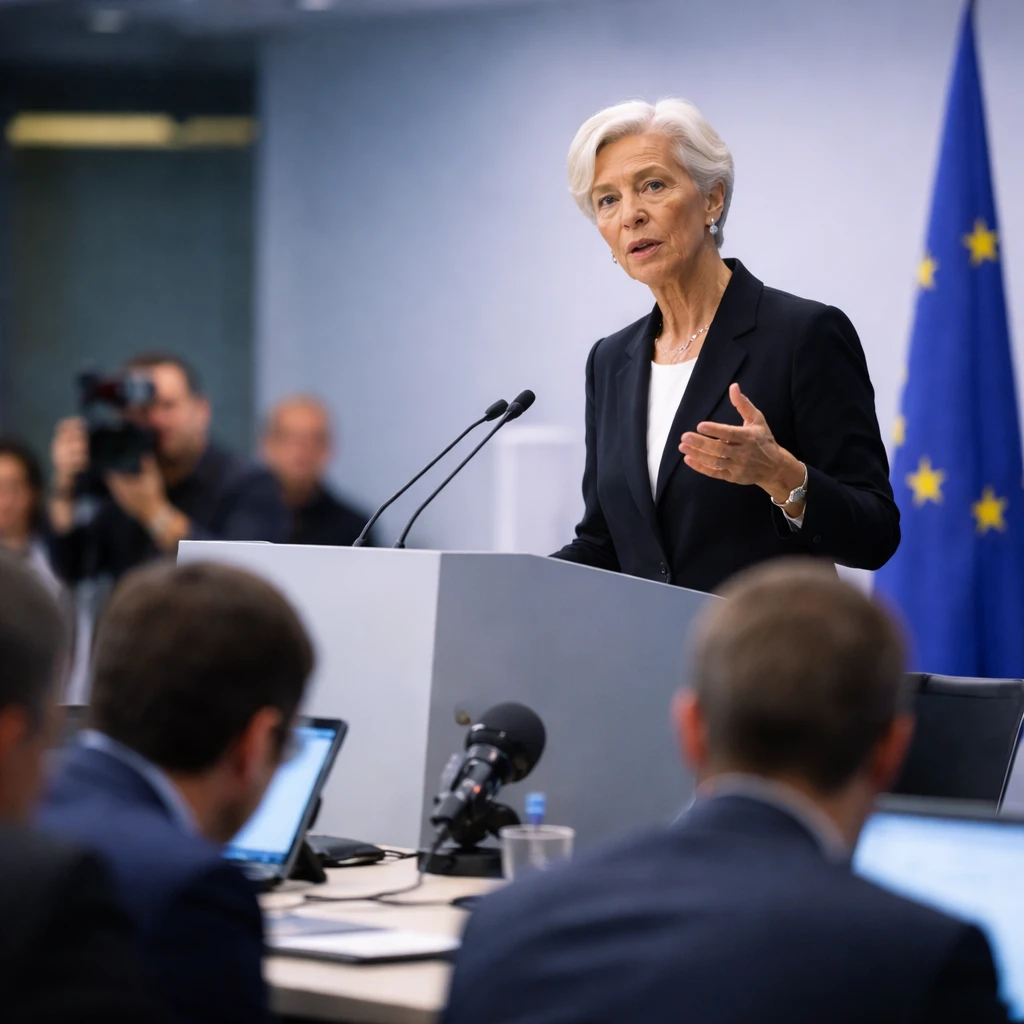
European Central Bank President Christine Lagarde said Thursday that the euro zone will need time before artificial intelligence-related spending translates into meaningful productivity improvements.
Lagarde made the remarks at a press conference in Frankfurt following the ECB's decision to keep interest rates unchanged. She emphasized that AI-related outlays form part of a broader pivot toward domestic sources of growth in the region.
Asked about the economic implications of the AI investment wave, Lagarde said the key issue is how that spending will affect productivity and inflation. "The really interesting thing from our perspective is how it will impact productivity, and how it will contribute or not to inflation, depending on the level of improved productivity," she told reporters. "There is a little bit of that, but it's going to take a while to unleash."
Policymakers at the ECB retained their existing monetary policy stance, noting that "the economy remains resilient in a challenging global environment." In that context, Lagarde identified investment as the principal driver of growth in the euro zone.
"While the net export activity and contribution to growth is on the decline, the domestic market is responding strongly," she said. "Consumption is improving a little bit, but not much. But investment is the big story."
Lagarde pointed to artificial intelligence as a major factor behind rising private-sector capital expenditure, particularly within information and communication technology. She said AI is prompting spending across several categories.
"It's everything having to do with AI," she said. "It's AI, it's the infrastructure that comes with it - so construction of data centers in the pipeline - and going through the process of licensing and authorization, it's software, it's hardware. It's a lot of investment that is coming out of that particular segment."
Her comments echoed a theme she raised in December, when she encouraged Europe to embrace the potential advantages associated with artificial intelligence.
Summary
Following the ECB's decision to hold interest rates steady, Christine Lagarde highlighted a shift toward domestic momentum in the euro-zone economy, driven chiefly by rising investment. She noted that AI-related investment spans infrastructure, software and hardware, but warned that measurable productivity benefits from this spending will take time to appear and could influence inflation depending on productivity outcomes.
Key points
- ECB left interest rates unchanged and described the economy as resilient amid global challenges - impacting monetary policy and fixed-income markets.
- Private-sector investment, led by AI-related spending in information and communication technology, is the main source of growth as net exports wane - relevant to technology and construction sectors.
- Lagarde stressed that productivity gains from AI are uncertain in timing and scale, which matters for inflation dynamics and corporate investment returns.
Risks and uncertainties
- Timing of productivity gains - AI spending may not produce near-term productivity improvements, creating uncertainty for policymakers and markets, particularly in inflation forecasting.
- Dependency on domestic demand - with net exports and consumption only modestly supporting growth, a heavy reliance on investment leaves the economy vulnerable to shifts in corporate spending or project authorization delays, affecting construction and ICT sectors.