
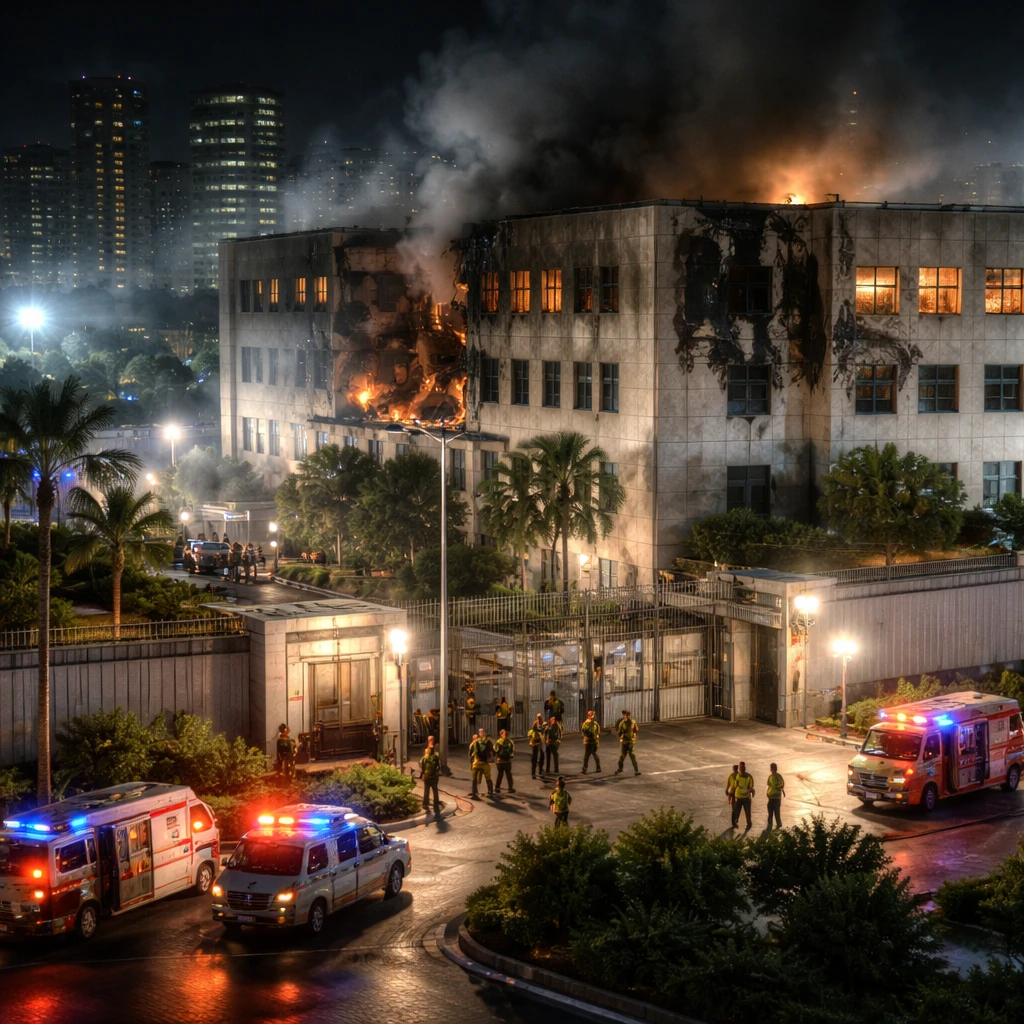
An aerial assault on the United States Embassy in Riyadh on March 3 resulted in far greater destruction inside the diplomatic compound than early statements indicated, according to current and former U.S. officials cited in reporting. Two drones bypassed Saudi air defenses and entered a secured area of the embassy, triggering a fire that burned for twelve hours and inflicting significant internal damage.
Initial messaging from the Saudi Defense Ministry described the incident as having limited impact, but more detailed accounts now portray a different picture: multiple floors sustained heavy damage and some portions of the embassy structure have been characterized as "unrecoverable." The strike also affected a local CIA station inside the compound, according to military analysts and officials.
The attack unfolded in the early hours, at about 1:30 a.m., with the first drone breaching the building and a second arriving roughly one minute later through the same opening. Analysts and officials told reporters the sequence - the second drone entering the same breach created by the first - appears to have been aimed at maximizing internal destruction. Observers noted that had the strike occurred during daytime hours, it could have produced mass casualties.
The incident is being viewed in the context of a wider campaign of targeted strikes against American military and diplomatic assets across the region. In late March, Iranian forces struck at Prince Sultan Air Base, damaging an E-3 AWACS surveillance aircraft and a number of refueling tankers; that assault left a dozen U.S. troops injured. Tehran has also claimed hits on an F-15E fighter jet and an A-10 Thunderbolt.
Officials and analysts point to Tehran's continuing tactical capability to strike a range of targets - from airfields and naval vessels to energy infrastructure - despite sustained countermeasures. Reporting notes that U.S. and Israeli forces have mounted more than 20,000 retaliatory strikes in response to the campaign, yet Iran has retained the ability to prosecute precision attacks.
The breach of the Riyadh diplomatic quarter - long seen as heavily defended by Patriot batteries and other systems - has had immediate operational and commercial effects. The U.S. State Department has issued advisories urging American citizens to avoid hotels, U.S.-branded businesses and educational institutions in the Kingdom. Several business parks and office towers that host U.S. multinational firms temporarily closed after receiving specific threats tied to the conflict.
Observers highlighted that, while the United Arab Emirates has experienced a higher volume of attempted launches - estimated at approximately 2,500 drones and missiles - the successful penetration of Riyadh's "leafy enclave" represents a notable escalation in the perceived reach of Iranian strikes. Former intelligence officials described a "complete blackout" on full damage assessments to U.S. bases and embassies, a lack of clarity that is contributing to investor and corporate unease.
As the confrontation moves into its second month, multinational corporations operating in Saudi Arabia have shifted from short-term contingency measures to longer-term assessments of war risk for their local operations. The uncertainty over the true extent of damage to U.S. facilities and the persistence of precision strike capability are driving changes in security postures and business continuity planning across affected sectors.
Context and implications
The incident underscores a shift in the operational environment for Western diplomatic and commercial presence in the Gulf. The combination of successful penetration of defensive perimeters and targeted strikes on high-value assets has prompted changes in travel advisories, temporary closures of corporate premises, and renewed scrutiny of regional supply chain and personnel security risks.