
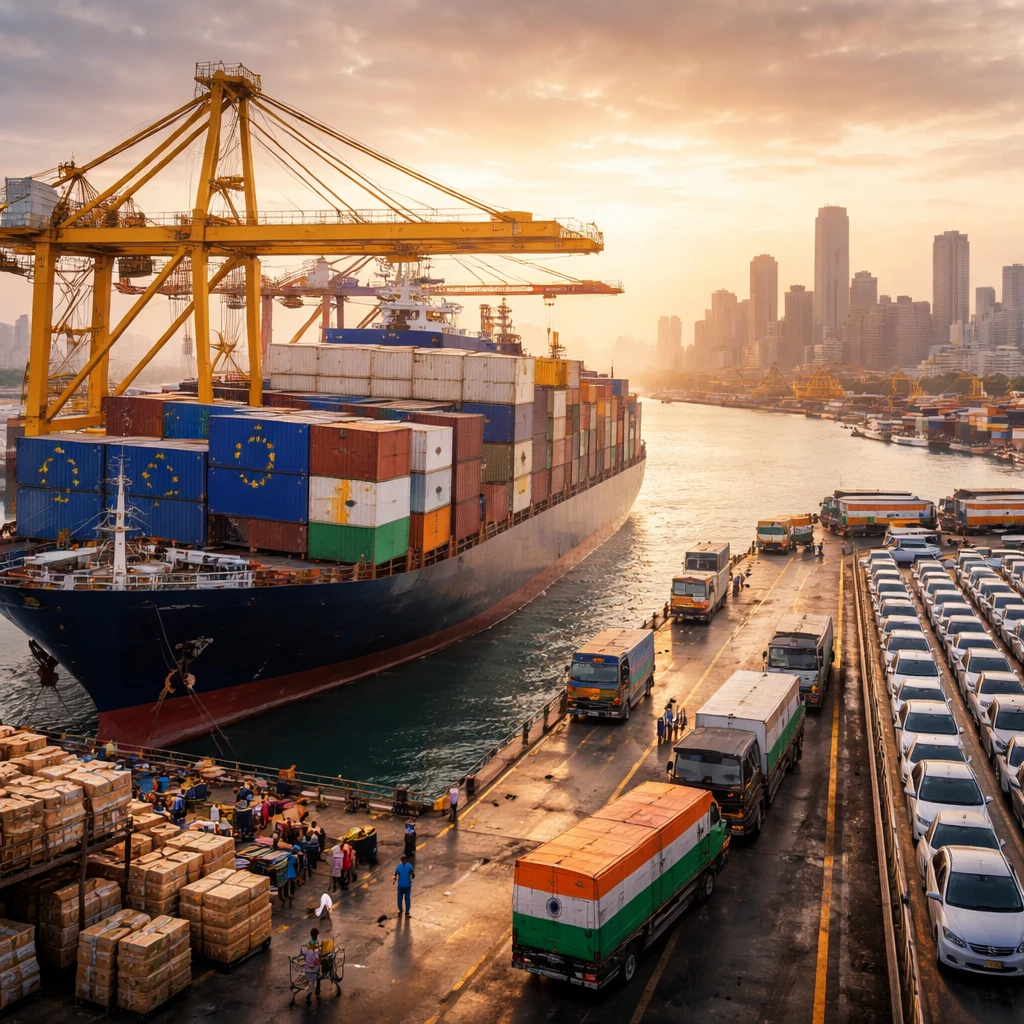
India and the European Union have formalized a far-reaching trade agreement earlier this week that analysts at Deutsche Bank say removes substantial barriers to trade and broadens market access for Indian exporters across Europe.
Under terms outlined by the EU, tariffs on goods accounting for 96.6% of trade value will be eliminated or reduced. India’s trade ministry separately reported that the EU will progressively cut duties on 99.5% of goods it imports from India over a seven-year schedule.
Deutsche Bank highlighted the pact’s near-term winners in a note dated Jan. 27, saying the Free Trade Agreement gives a strong lift to labour-intensive Indian industries. The bank cited textiles, apparel, leather, footwear, marine products, gems and jewellery, handicrafts, engineering goods and automobiles as sectors that will see tariff reductions of up to 10% on almost $33 billion of exports effectively moved to zero.
The bank also identified agricultural and foodstuffs that stand to gain from improved cost competitiveness in Europe. Key commodities such as tea, coffee, spices, fresh fruits and vegetables and processed foods were singled out as likely to benefit from the new tariff framework.
At the same time, Deutsche Bank noted India negotiated protections for certain sensitive domestic areas. The agreement leaves sensitive agricultural items and the dairy sector outside of market access concessions, meaning those Indian products will not be opened to competition from EU imports under the deal.
A notable element of the accord is the expanded quota for European automakers. India has agreed to a gradual allowance of up to 250,000 European-made vehicles to enter at preferential duty rates. Deutsche Bank contrasted that figure with the 37,000-unit quota that India extended to the U.K. under a separate arrangement, describing the EU quota as more than six times larger than recent offerings.
Beyond goods, the FTA secures commercially meaningful openings in services where India has established strengths. Deutsche Bank pointed to commitments across IT and IT-enabled services, professional services, education, financial services, tourism, construction and other business-related sectors as areas where European market access will expand for Indian firms.
The German bank emphasized the strategic weight of the agreement given trade linkages between the two economies. The EU is India’s largest trading partner for goods, accounting for roughly 12.0% of India’s trade. Conversely, India ranked as the EU’s ninth-largest trading partner, representing about 2.2% of the EU’s total goods trade in 2023.
Deutsche Bank noted that its long-term projections for India are unchanged or strengthened by the pact. The bank anticipates nominal growth in India of 10% to 10.5% year-on-year and real GDP averaging at least 6.5% year-on-year over the coming decade. Under those assumptions, India would become the world’s third-largest economy by 2028, up from its current fourth-place position.
Germany, the bank observed, is among India’s most important European trading partners and remains a leading bilateral partner globally. Given Germany’s role and scale - currently the world’s third-largest economy while India is fourth-largest - Deutsche Bank suggested Germany could be among the primary beneficiaries within Europe from the India-EU deal.
While the accord’s full commercial effects will unfold over time, the agreement clearly reconfigures access and tariffs across a wide range of goods and services, affecting manufacturers, exporters and service providers on both sides.