
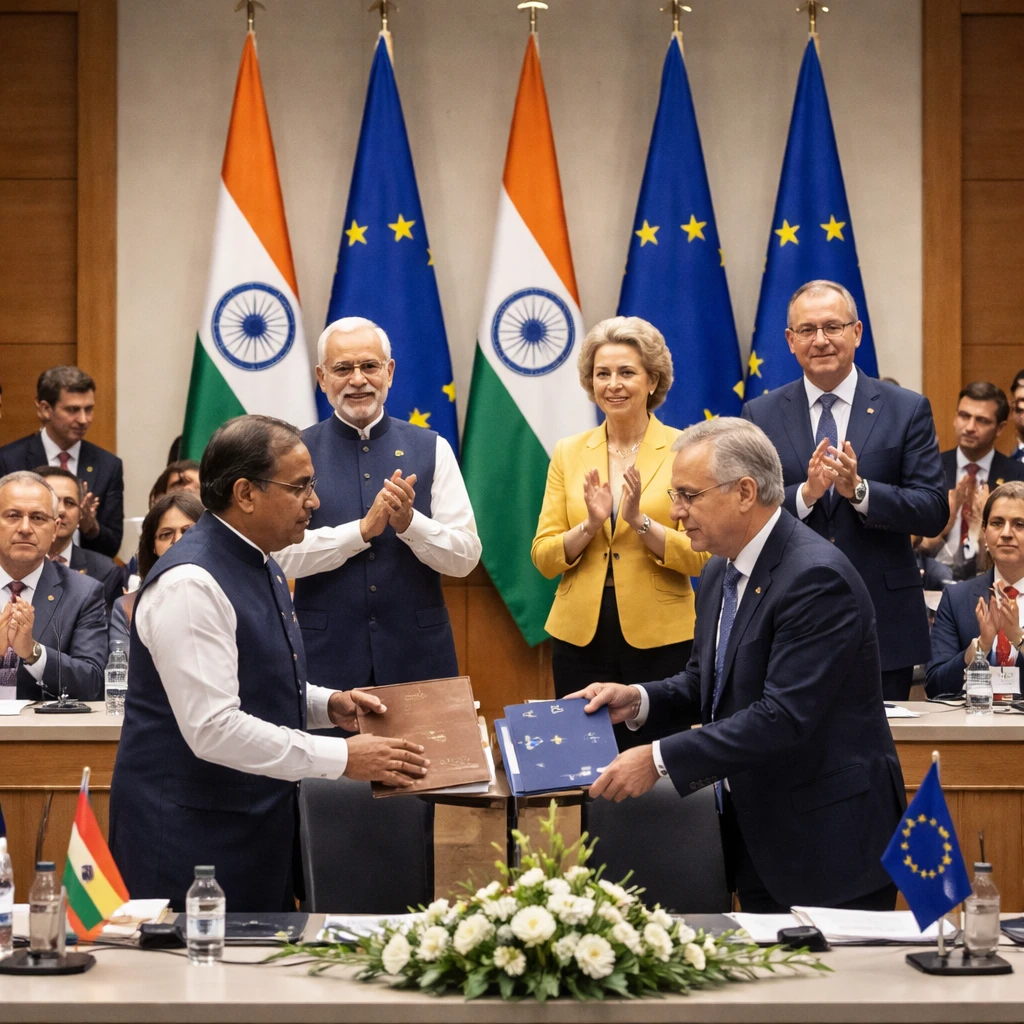
India and the European Union finalized a landmark free trade agreement on Tuesday, bringing to an end nearly twenty years of negotiations. The signing took place during the 16th India-EU summit, which was co-chaired by Prime Minister Narendra Modi, European Council President Antonio Costa and European Commission President Ursula von der Leyen.
Leaders attending the summit characterized the pact as transformative, with some referring to it as the "Mother of all deals." Prime Minister Modi said the agreement "represents 25 per cent of global GDP and one-third of global trade," and noted that it complements India's existing arrangements with the United Kingdom and the European Free Trade Association (EFTA).
The accord covers three primary areas: trade, investment and regulatory cooperation. Delegates at the summit indicated that the two sides are also expected to adopt a joint strategic agenda as part of the discussions surrounding the agreement.
Together, India and the EU account for nearly a fifth of global trade and for roughly a quarter of the world's population, figures cited by leaders at the summit. Those proportions were highlighted by officials to underscore the scale of the partnership established by the agreement.
The announcement marks the conclusion of a negotiation process that has spanned almost two decades. Summit participants framed the deal as comprehensive in scope, encompassing market access, cross-border investment and frameworks for aligning regulatory approaches between the two parties.
While officials described the pact in sweeping terms at the summit, the public statements made at the event focused on the agreement's coverage of trade, investment and regulatory cooperation and on the expectation that a joint strategic agenda will be adopted by leaders. The summit co-chairs - Prime Minister Modi, European Council President Antonio Costa and European Commission President Ursula von der Leyen - were central to the announcement and the formalization of the agreement.
Summary
India and the EU signed a free trade agreement at the 16th India-EU summit after almost two decades of talks. Leaders called the pact the "Mother of all deals," said it represents 25% of global GDP and one-third of global trade, and indicated it covers trade, investment and regulatory cooperation while a joint strategic agenda is expected to be adopted.
Key points
- The agreement was signed at the 16th India-EU summit co-chaired by Prime Minister Narendra Modi, European Council President Antonio Costa and European Commission President Ursula von der Leyen.
- Leaders described the pact as covering trade, investment and regulatory cooperation and said it represents 25% of global GDP and one-third of global trade.
- India and the EU together account for nearly a fifth of global trade and about a quarter of the world population; leaders expect to adopt a joint strategic agenda at the summit.
Risks and uncertainties
- The article notes the expectation that leaders will adopt a joint strategic agenda, which indicates that aspects of the post-signing coordination remain to be formalized - impacting trade and regulatory sectors.
- The deal concluded after nearly two decades of negotiations, highlighting the complexity of reaching agreement across many issues and jurisdictions - a factor that could affect implementation timelines in trade and investment sectors.
- The public statements at the summit emphasize coverage areas but do not provide detailed measures or timelines in this announcement; that absence of detail leaves open questions for market participants and regulators.