
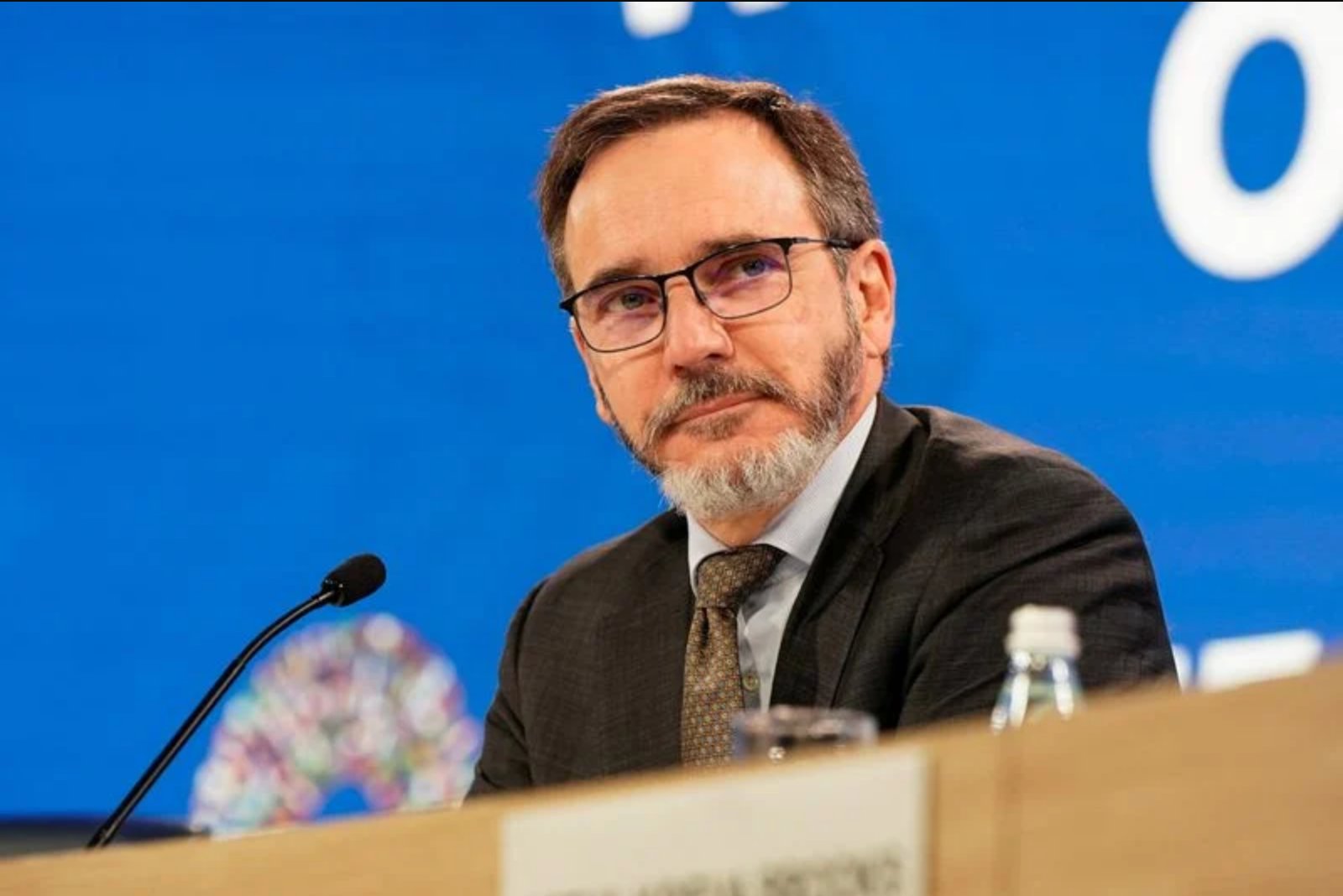
Pierre-Olivier Gourinchas, the outgoing chief economist at the International Monetary Fund, highlighted profound vulnerabilities in the global economic landscape, emphasizing the precarious nature of the current ceasefire between the United States and Iran. Speaking to Reuters shortly before his departure from the institution to return to the University of California, Berkeley, Gourinchas warned that the global economy faces substantial downside risks should this fragile truce collapse. A critical concern is the exhaustion of strategic petroleum reserves, which had successfully prevented a more severe escalation in oil prices during recent hostilities in the Middle East. With these stockpiles now significantly depleted, national governments possess considerably less fiscal and logistical maneuvering room to stabilize markets if diplomatic efforts fail and armed conflict resumes.
Gourinchas, who has consistently cautioned that intensifying geopolitical friction contributes to a more fragmented international economic system, provided no specifics regarding a new economic forecast scheduled for release by the IMF on July 8, following his transition into academia. However, he indicated a potential return to a standard baseline forecasting methodology. This would mark a departure from the three-scenario approach employed in April. The Fund previously abandoned a traditional baseline forecast in April 2025, a decision driven by the profound disruption to global trade initiated by United States President Donald Trump, who imposed sweeping tariffs on imports from numerous nations worldwide.
IMF spokeswoman Julie Kozack maintained that the institution might retain the three-growth scenarios or revert to a conventional baseline approach. During a discussion last month, with the Strait of Hormuz obstructed and benchmark crude prices exceeding $100 per barrel, Kozack noted that the global economy was transitioning from a "reference forecast," which anticipated a swift conclusion to the conflict and 3.1% growth in 2026, toward an "adverse scenario" projecting 2.5% growth. In both 2025 and 2026, Gourinchas observed a severe lack of historical precedent for establishing a credible baseline model. This absence of reliable data necessitated a humble approach from economists, who opted to map out a range of potential outcomes through scenarios rather than committing to a single trajectory. He emphasized that such forecasting difficulties should remain exceptional, though he acknowledged that current uncertainty and associated risks remain elevated.
Regarding the energy sector specifically, Gourinchas noted that the rapid release of strategic oil reserves and production adjustments by refiners successfully averted steeper price increases. These interventions limited the actual removal of oil from the global market to approximately 3%, a far cry from the initial predictions of a 10% to 15% supply shock. Nevertheless, the buffer provided by these reserves is now compromised. If the ceasefire disintegrates and hostilities resume, the capacity to cushion subsequent supply disruptions will be severely constrained.
Diplomatic tensions were further underscored on Friday when President Trump accused Iran of violating the preliminary ceasefire agreement through an attack on a vessel near Oman. This incident highlighted the extreme fragility of the current diplomatic arrangements. Beyond the immediate threat of renewed conflict, Gourinchas pointed to significant structural shifts in global commerce. In the wake of Trump's tariff policies, international trade flows and alliances are visibly realigning. He specifically cited the European Union's recent completion of extensive trade agreements with Latin America and India, negotiations that had stalled for decades but were concluded in less than a year. Gourinchas remarked that this rapid acceleration is not coincidental, asserting that nations recognize the necessity of deepening trade relationships outside traditional frameworks, many of which now exclude the United States.
Furthermore, the IMF chief economist expressed skepticism regarding the long-term utility of tariffs and economic sanctions as policy tools. While acknowledging that such measures provide temporary leverage, he argued that global market actors are highly adaptive and rarely passive. When faced with economic choke points, nations swiftly develop strategies to circumvent restrictions, accelerate domestic innovation, and forge new commercial partnerships with alternative allies. Consequently, these tools tend to become ineffective or blocked over time. Gourinchas concluded that while sanctions might yield short-term pressure, they almost never achieve their intended objectives in the medium to long term, forcing the global economy to continuously reconfigure itself around imposed barriers.