
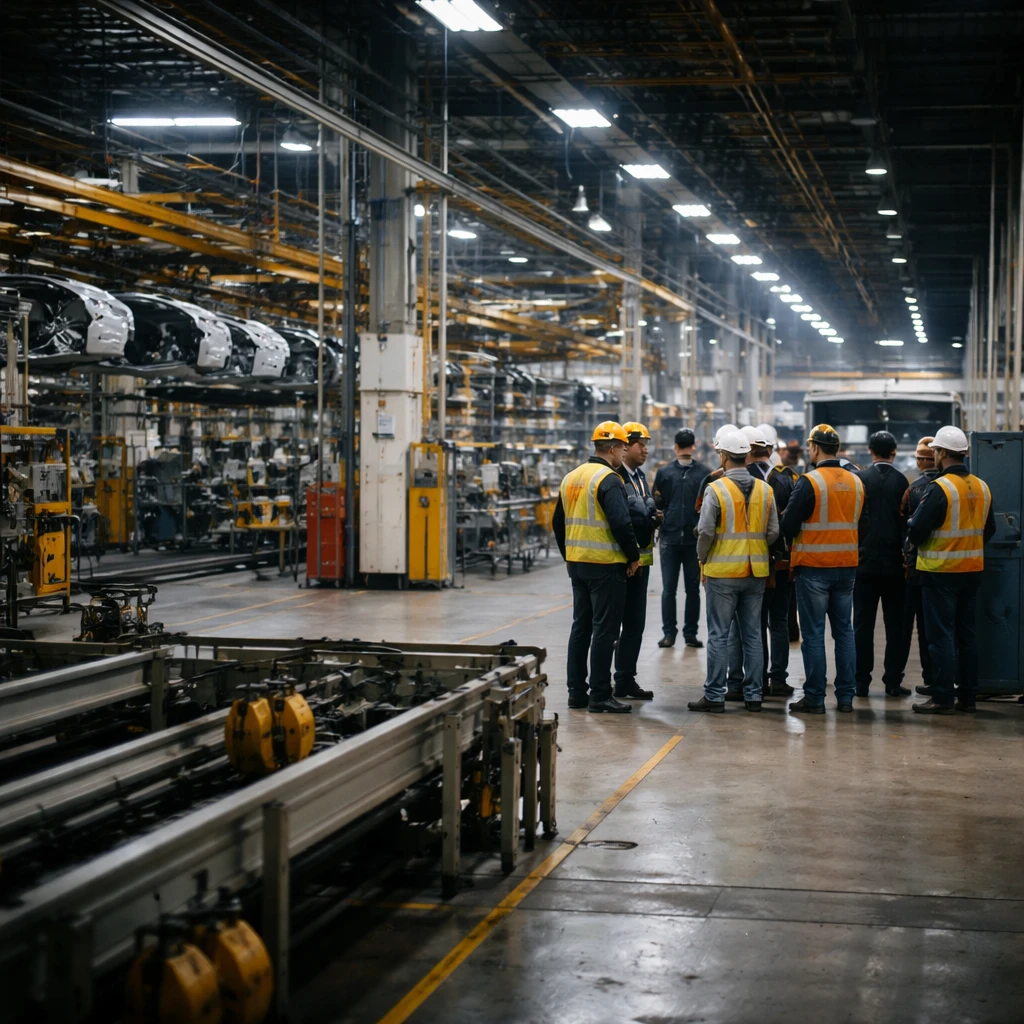
General Motors implemented a planned scale-back at its Oshawa auto assembly operation on Friday by removing one of the production shifts and moving to a two-shift schedule. The company’s change in operations places up to 1,200 jobs in the surrounding region at risk, with roughly 500 of those positions held by GM employees directly.
The reduction reflects a permanent contraction of local manufacturing activity at the plant, which historically operated three shifts. Company confirmation on Thursday identified approximately 500 direct employee roles among those affected, while the remainder of the losses are expected to reverberate through the plant’s integrated supplier network.
Unifor Local 222, the union representing workers at the site, engaged in months of negotiations in an effort to preserve jobs at the facility. "We did everything we could ... we’ve made our arguments to General Motors," said Jeff Gray, president of Unifor Local 222, describing the union’s efforts to avert the reduction.
The layoffs are being administered according to seniority rules, resulting in younger workers being displaced across operational tiers. Gray characterized the transition as "heartbreaking" for those finishing their last scheduled shifts, noting the personal toll of departing colleagues and the wrenching final hours on the floor.
Regional economic unease is already evident as hundreds of families confront the loss of a primary income source. "You feel very nervous and anxious that you can continue to provide a living for yourself and your family," Gray said, reflecting the immediate financial and emotional pressures on affected households.
Beyond direct employment, local suppliers that support assembly line operations will likely feel the impact of the reduced shift pattern, given the tightly interconnected nature of the plant’s supply chain. The move to a smaller production footprint signals a permanent scaling back of on-site activity rather than a temporary slowdown.
Key points
- GM eliminated a production shift at its Oshawa facility, shifting the plant from three shifts to two - up to 1,200 regional jobs are at risk.
- Approximately 500 of the affected positions are held by GM employees directly; the rest are expected to affect the supply chain that supports the plant.
- The reduction follows months of union negotiations; layoffs are being implemented by seniority, displacing younger workers and creating palpable economic anxiety in the community.
Risks and uncertainties
- Job losses beyond GM’s direct workforce - suppliers and subcontractors tied to the assembly line face uncertain demand and potential layoffs, impacting the manufacturing and industrial sectors.
- Community economic stress - the reduction of primary incomes for hundreds of families may depress local consumption and housing-market dynamics, affecting regional retail and services.
For workers and the broader local economy, the transition to a two-shift operation marks a significant change in the plant’s employment footprint and a noteworthy disruption for the tightly woven supply network that supports automotive assembly.