
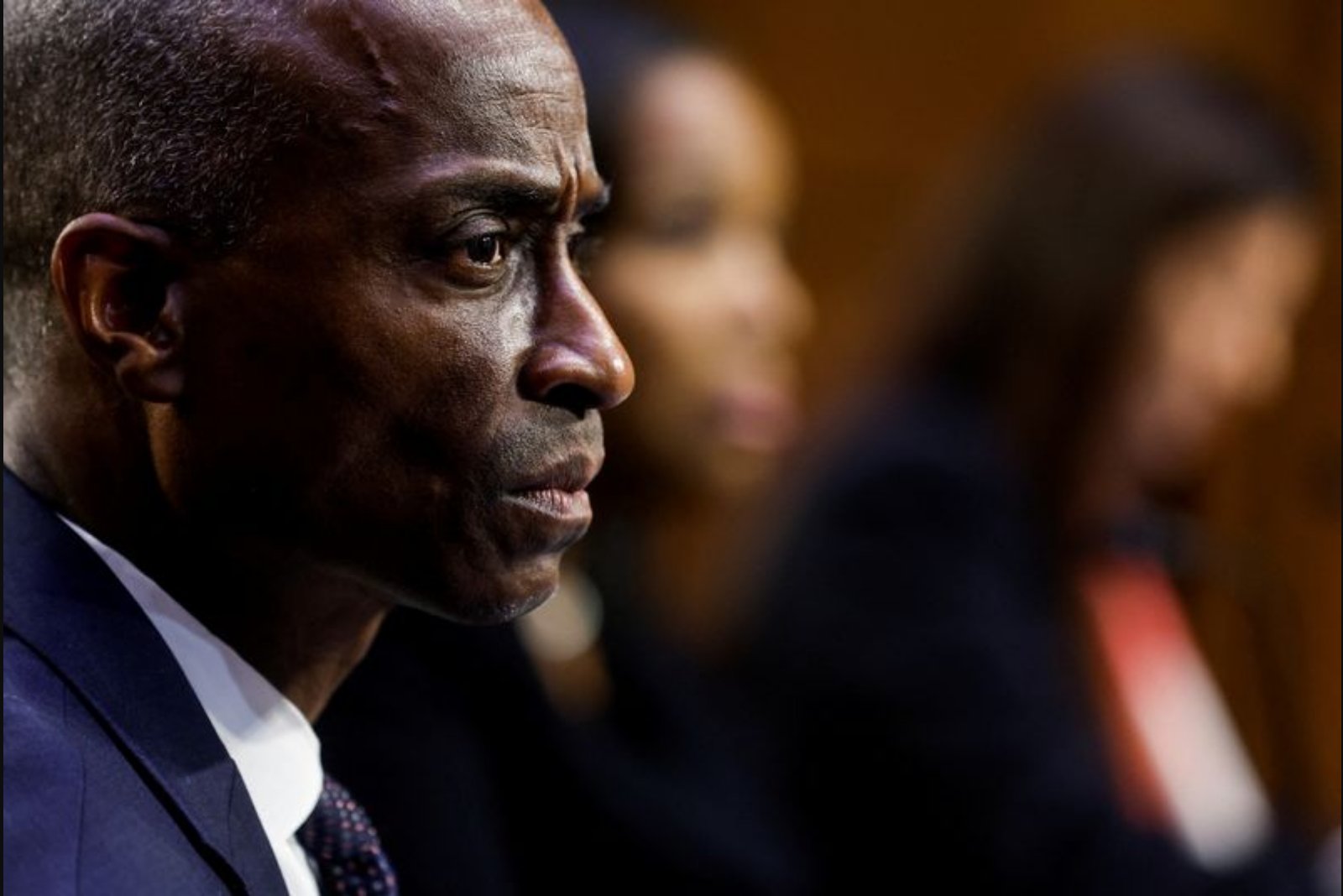
Federal Reserve Vice Chair Philip Jefferson on Tuesday reiterated that the central bank's current short-term interest rate setting provides flexibility to address uncertain economic effects stemming from rising energy prices and the conflict in the Middle East. In prepared remarks delivered at the University of Detroit Mercy, Jefferson outlined a view in which the labor market faces potential weakness even as inflation risks have shifted higher.
"In the current environment, I confront an outlook in which there is downside risk to the labor market and upside risk to inflation," Jefferson said. He added, "I remain cautious about my outlook.... I continue, however, to see our current policy stance as appropriately positioned to allow us to assess how the economy evolves."
Last month, Fed officials decided to keep the policy rate unchanged in the 3.50%-3.75% range, signaling they want further evidence of progress on inflation before moving to cut interest rates. Jefferson echoed that approach, saying he views the present stance as one that permits the Fed to react to a range of possible outcomes rather than committing to immediate easing.
Jefferson described the labor market as broadly balanced but vulnerable to negative shocks because businesses are already showing reluctance to hire. He warned that "a sufficiently large negative shock" could slow job creation and push the unemployment rate higher from its current level of 4.3%.
At the same time, he expressed concern about inflation remaining above the Fed's 2% objective. Jefferson noted that he previously expected inflation to ease later this year as the impact of last year's tariff shock faded. However, he said that view has changed in the short term: he now expects inflation to rise, at least temporarily, because of the oil shock.
Despite these conflicting forces, Jefferson maintained that the current monetary policy setting should continue to support the labor market while still allowing inflation to resume its downward path. He emphasized that higher energy costs present a two-sided risk - they can push inflation up while at the same time curbing consumer and business spending if the price increases persist.
"I am confident that our current policy stance is well-positioned to respond to a range of outcomes," Jefferson said, underscoring the Fed's focus on data-dependent decision-making as officials monitor how economic conditions unfold in light of global developments and domestic price pressures.
Context and implications
- Fed policy remains on hold at 3.50%-3.75% pending clearer inflation signals.
- Officials see the labor market roughly in balance but vulnerable to shocks that could raise unemployment from 4.3%.
- Recent increases in oil prices have altered short-term inflation expectations, producing upside risk to price growth.